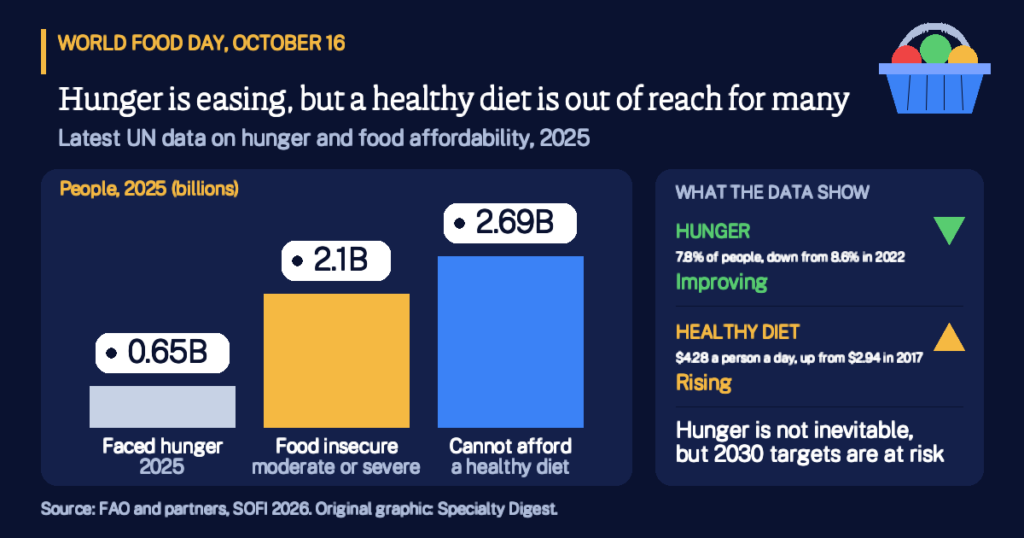
Hunger is one of the few global problems that has a clear cure and a long record of failing to get it. The world grows enough calories to feed everyone, yet in 2025 about 645 million people still faced hunger, and nearly one in three could not afford a healthy diet. World Food Day, observed every October 16, exists to keep that gap in view. It asks a simple question: if food exists, why do so many people lack it, and what would it take to change that? Water is part of the answer too, as World Water Day explains, because agrifood systems account for around 70 percent of global freshwater withdrawals.
From a Quebec hotel to a global day
The date was chosen with care. On October 16, 1945, 44 nations gathered at the Château Frontenac in Quebec City and founded the Food and Agriculture Organization of the United Nations, with a shared purpose: a world free from hunger and support for agricultural development. Member nations later decided that the anniversary should become a day of awareness. World Food Day was established at the twentieth session of the FAO Conference in November 1979, and it has been observed every year since. FAO describes today’s campaign as collective action across about 150 countries, in up to 50 languages.
What hunger and food insecurity measure
Three terms do most of the work. Undernourishment, the usual measure of hunger in United Nations reports, is the share of people whose regular food intake does not supply enough energy for an active, healthy life. Food insecurity is broader: people may be uncertain whether they can get food, and when it is moderate they often cut the quality or quantity of what they eat. When it is severe, they may run out of food altogether. Finally, an unaffordable healthy diet counts people who might avoid hunger but cannot pay for the foods that keep a body well.
The numbers behind the day
The 2026 edition of The State of Food Security and Nutrition in the World, released on July 21, 2026 by five UN agencies, brings some good news. In 2025, 7.8 percent of the world’s people, about 645 million, were undernourished. That is down from 8.1 percent in 2024 and 8.6 percent in 2022, a drop of nearly 14 million people from 2024 and 43 million from 2022. It is the third straight year of improvement. Moderate or severe food insecurity also eased, from 27.1 percent in 2024 to 25.8 percent in 2025, or about 2.1 billion people.
Example 1: what a healthy diet costs a family. The 2026 report puts the average cost of a healthy diet at 4.28 international dollars per person per day in 2025. Suppose, for a round illustration, a household of five faces a cost of $4 each. That is $20 a day, or about $600 over 30 days, before rent, fuel or school fees. If the household’s entire monthly food budget is $300, a healthy diet is out of reach however carefully it shops.
It is not only about calories
A healthy diet has become more expensive. The average cost rose from 2.94 international dollars per person per day in 2017 to 3.44 in 2021 and 4.28 in 2025. Even so, the number of people unable to afford it fell, from 2.97 billion (37.4 percent) in 2021 to 2.69 billion (32.7 percent) in 2025, which suggests incomes grew faster than prices for some. Nearly one in three people still cannot pay for a healthy diet. The World Health Organization’s Director-General has put it this way: a healthy diet “remains unaffordable for one in three people globally.”
Diet quality shows up in the body. The report counts about 150 million children under five as stunted, and says stunting is declining in Africa and on track for the 2030 target in Asia. Meanwhile adult obesity rose from 12.1 percent in 2012 to 16.2 percent in 2024, even though the world had aimed to halt that rise by 2025. Hunger and obesity are two faces of the same problem: food systems that do not reliably deliver affordable, nutritious food.
- 645 millionpeople faced hunger in 2025
- 2.69 billioncould not afford a healthy diet in 2025
- 13%of food produced is lost after harvest, FAO
- 19%further wasted at retail and consumer levels, FAO
Who bears the burden
Averages hide a sharp geography. In 2025, 56.6 percent of people in Africa experienced moderate or severe food insecurity, against 22.9 percent in Latin America and the Caribbean, 20.3 percent in Asia and 8.7 percent in Northern America and Europe. Africa also has the world’s largest hungry population in absolute terms, about 309 million people, with Asia at about 292 million. Rural areas are hit harder than cities, and women are disproportionately affected, although the gender gap narrowed slightly in 2025. Behind that gap sits another: FAO notes that women’s land productivity trails men’s by 24 percent, largely a question of access to inputs, land and credit rather than skill.
Example 2: food that never reaches a plate. FAO reports that about 13 percent of food is lost after harvest and a further 19 percent is wasted at retail and consumer levels. As a simple illustration, treat both shares as parts of the original harvest. Of 100 tons of grain, 13 are lost before reaching the market and 19 more are thrown away, so about 32 tons never feed anyone. The real accounting differs by crop and country, but it shows why better storage and less waste count as food production too.
Innovation, safety and the road to 2030
The 2026 theme, “Innovate today. Nourish tomorrow.,” points to tools already within reach: digital advisory services for farmers, improved seed varieties and biotechnology, cooperative models and preventive approaches that lower risk. FAO’s opening line for the campaign is blunt: ending hunger is within reach. The investment case needs attention, though. Growth in agrifood research and development slowed from 2.7 percent a year between 1980 and 2015 to 1.9 percent between 2015 and 2021.
Example 3: why a small slowdown matters. Imagine a research budget of $100 billion that grows 2.7 percent a year for ten years. It reaches about $131 billion. At 1.9 percent growth, it reaches about $121 billion. That $10 billion gap, in illustrative round figures, is money that could have funded new crop varieties, storage or advice. Safety matters here as well: FAO’s 2025 fact box states that unsafe food causes some 420,000 deaths a year and sickens about 600 million people.
The destination is still uncertain. FAO says around 520 million people could still face hunger in 2030, which would leave the world off track for the Zero Hunger goal. The projections do not fully account for El Niño in 2026 and 2027 or for cuts to development and humanitarian funding.
- 2025Hand in Hand for Better Foods and a Better Future
- 2026Innovate today. Nourish tomorrow.
Key Takeaways
- The day marks FAO’s founding. October 16 honors the 1945 meeting in Quebec City, and the FAO Conference made it World Food Day in 1979.
- Hunger is falling, slowly. About 645 million people faced hunger in 2025, 43 million fewer than in 2022.
- Affordability is the hidden barrier. 2.69 billion people could not afford a healthy diet in 2025.
- Geography decides. More than half of Africans faced moderate or severe food insecurity in 2025, against under one in ten in Northern America and Europe.
- Hunger and obesity travel together. Adult obesity rose to 16.2 percent in 2024 while 150 million children were stunted.
- Waste is a lever. About 13 percent of food is lost after harvest and 19 percent is wasted later.
- 2030 is at risk. FAO projects around 520 million people could still face hunger, so research and funding choices made now matter.
How solid is this? Hunger and food insecurity figures are modeled estimates from SOFI 2026 and are revised as new data arrive. The 2030 projection is a scenario, not a forecast, and the food loss and waste shares are FAO global averages. The three worked examples use round, made-up numbers to show an idea. See also World Water Day, the International Days hub and the International Days Calendar.
More in Society
- FAO. SOFI 2026: Hunger not inevitable, FAO says as global hunger report shows progress (July 21, 2026).
- World Health Organization. UN report: Global hunger levels ease for third consecutive year as regional disparities persist (July 21, 2026).
- UNICEF Data. The State of Food Security and Nutrition in the World 2026.
- FAO. About World Food Day 2026: Innovate today. Nourish tomorrow.
- FAO Director-General. World Food Day 2026 opening statement (October 16, 2026).
- FAO. A historic bond between Quebec and FAO: 80 years of shared commitment (2025).
- FAO. About World Food Day (1993 publication, establishment at the 20th FAO Conference, November 1979).