Poverty is easy to describe in numbers and hard to see in a crowd. It hides in missed meals, skipped school days and the quiet fear of one more unpaid bill. The International Day for the Eradication of Poverty, observed every year on October 17, exists to bring it into view and to remind the world that it is a problem people can solve. The day grew from a gathering of poor families and their supporters, not from a conference room, and that origin still shapes what it asks of governments. It is closely linked to the fight against hunger that World Food Day marks each October.
From a square in Paris to a United Nations day
The story begins on October 17, 1987. More than 100,000 people gathered at the Trocadéro in Paris, the same place where the Universal Declaration of Human Rights was signed in 1948. They came to honor the victims of extreme poverty, violence and hunger, and they declared that poverty is a violation of human rights. Their conviction was carved into a commemorative stone unveiled that day. Replicas of the stone now stand in cities around the world, including one in the garden of United Nations Headquarters in New York.
Five years later the United Nations took up the idea. On December 22, 1992, the General Assembly adopted resolution 47/196, which declared October 17 the International Day for the Eradication of Poverty. It invited every state to devote the day to concrete activities against poverty and destitution, and it invited international and non-governmental organizations to help countries organize national observances. The UN describes people living in poverty as the center of the day, not as an audience for it.
What counts as poverty
Poverty is more than a low income, but income is where measurement starts. The World Bank sets an international poverty line, and in June 2025 it moved that line to $3.00 per person per day, measured in 2021 prices adjusted for what money can buy in each country. It replaced the earlier $2.15 line. The Bank also updated the two higher lines used for wealthier countries, to $4.20 for lower-middle-income countries and $8.30 for upper-middle-income countries. Switching to newer prices did not make anyone poorer overnight. It changed the yardstick, and the new count of people below the line was higher. For 2022 the Bank put it at about 838 million people, roughly 125 million more than the old method had shown.
Money is only one lens. The UN Development Programme’s 2025 Global Multidimensional Poverty Index looks at the overlapping deprivations people face at once, such as in health, education and living standards. It counts 1.1 billion of 6.3 billion people across 109 countries as multidimensionally poor, and over half of them are children. About 740 million of them, or 64.5 percent, live in middle-income countries, which is a reminder that poverty is not only a problem of the poorest nations.
Example 1: just above the line. Picture a worker who earns $3.50 a day. She sits above the $3.00 extreme poverty line, so she is not counted in the 811 million. Yet she is still below the $4.20 line used for lower-middle-income countries and far below $8.30. The numbers are round and illustrative, but they show why one line never tells the whole story.
The numbers behind the day
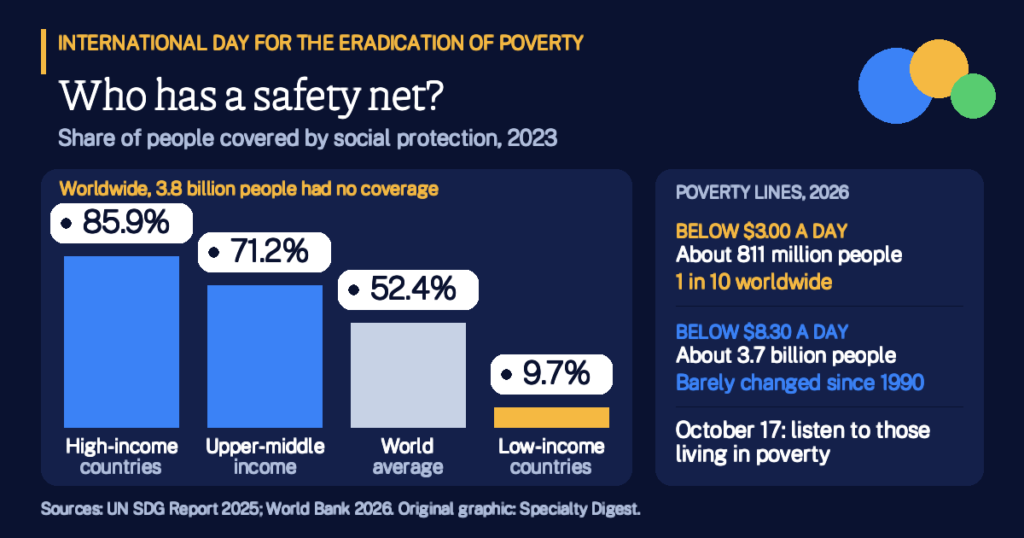
The World Bank’s Poverty, Prosperity, and Planet Report 2026, released on October 26, 2026, estimates that about 811 million people, one in ten worldwide, live on less than $3.00 a day in 2026. It also finds that 3.7 billion people live on less than $8.30 a day, a figure that has barely changed since 1990. Without stronger growth per person, the report warns, extreme poverty could be higher in 2030 than it is today.
The geography of the problem is shifting. The UN reports that by 2025 more than three-quarters of the world’s extremely poor lived in sub-Saharan Africa or in fragile and conflict-affected countries, and the World Bank projects that about 87 percent will by 2030. It also notes that more than half of the extremely poor live in just nine economies. At the same time, the UN finds that only one in five countries is on track to halve its national poverty rate by 2030.
The safety net gap
One of the best defenses against falling into poverty is social protection, meaning cash benefits such as child grants, pensions and support when a job is lost. In 2023, 52.4 percent of the world’s people were covered by at least one such benefit, up from 42.8 percent in 2015. That progress still leaves 3.8 billion people with no protection at all. The gap between rich and poor countries is stark.
- 3.8 billionpeople had no social protection in 2023
- 9.7%of people in low-income countries were covered in 2023
- 19.3%of GDP spent on social protection on average, 2023
- 2.0%of GDP spent in low-income countries, 2023
Example 2: the lost paycheck. Suppose a family of four lives on one wage and the earner loses the job. With no benefit, income drops to zero and the family must sell belongings, skip meals or pull a child from school. With even a modest cash payment for a few months, the family can cover rent and food while the earner looks for work. The figures are made up for illustration, but this is the mechanism that safety nets provide.
Who is left behind
Children carry a heavy share of the burden, since over half of the people in multidimensional poverty are under 18. Women are less likely to be covered by a safety net, at 50.1 percent compared with 54.6 percent for men in 2023. Conflict and fragility deepen the problem, because the places where help is needed most are often the hardest places to deliver it.
The cost of closing the gap is real but small next to the stakes. The UN estimates that low- and middle-income countries would need about $1.4 trillion more per year, or 3.3 percent of their combined GDP, to provide a basic social protection floor (2024 estimate).
Example 3: what a floor could cost. Imagine a country with a yearly economic output of $100 billion. At 3.3 percent, a basic floor would cost about $3.3 billion a year. Spread across a population of 20 million, that is about $165 per person per year. These round numbers are illustrative only, since real needs and costs differ widely by country.
How the day is marked, and what progress needs
Each year the UN Department of Economic and Social Affairs organizes an observance, often at UN Headquarters, and civil society groups such as ATD Fourth World hold events in many countries. The 2025 observance was titled “Ensuring Respect and Effective Support for Families.” Themes change from year to year, so check the UN observance page for the current one rather than relying on a fixed list.
What would speed progress? The World Bank argues that more and better jobs are the key to putting poverty reduction back on track. The UN points to broader safety nets, spending that reaches fragile settings, and a steady focus on the people who live in poverty, who are best placed to say what works. On October 17, the simplest act is also the most faithful to the day’s origin: listen to them.
Key Takeaways
- The day began with people in poverty. More than 100,000 gathered in Paris in 1987, and the UN adopted the day in 1992.
- The yardstick moved. The World Bank’s line is now $3.00 a day, which raised the count of people below it.
- The problem is still large. About 811 million people live below that line in 2026, and 3.7 billion live below $8.30.
- Poverty is more than income. 1.1 billion people are multidimensionally poor, and over half are children.
- Safety nets are uneven. 3.8 billion people had no social protection in 2023, and coverage in low-income countries was 9.7 percent.
- Fragile places are where the poor are concentrating. About 87 percent of the extremely poor are projected to live in sub-Saharan Africa or fragile settings by 2030.
- Progress is a choice. Jobs, safety nets and listening to those living in poverty are the tools the UN and the World Bank point to.
How solid is this? Poverty counts are modeled estimates that the World Bank revises as prices and survey data change, so figures from different releases (for example 838 million for 2022 and 811 million for 2026) are not directly comparable. Social protection and multidimensional poverty figures are from the cited UN reports. The three worked examples use round, made-up numbers to show an idea. See also World Food Day, the International Days hub and the International Days Calendar.
More in Society
- United Nations. International Day for the Eradication of Poverty: Background.
- UN DESA. International Day for the Eradication of Poverty.
- UN DESA. International Day for the Eradication of Poverty, 17 October 2025.
- United Nations. The Sustainable Development Goals Report 2025, Goal 1.
- World Bank. June 2025 Update to Global Poverty Lines.
- World Bank. More and Better Jobs Key to Putting Poverty Reduction Back on Track (26 October 2026).
- UNDP. 2025 Global Multidimensional Poverty Index.