Djibouti is a small country in the Horn of Africa that sits directly on the Bab-el-Mandeb strait, the passage where the Red Sea narrows before opening into the Gulf of Aden and the Indian Ocean. It covers about 23,200 square kilometers (roughly 8,950 square miles), a little larger than Wales, and is home to approximately 1.2 million people as of 2025, according to the UN Population Fund. Bordered by Eritrea to the north, Ethiopia to the west and south, and Somalia to the southeast, Djibouti has built its economy and its foreign policy almost entirely around one fact: it sits beside one of the busiest and most contested shipping lanes on the planet.
Geography: From Desert Plains to Africa’s Lowest Point
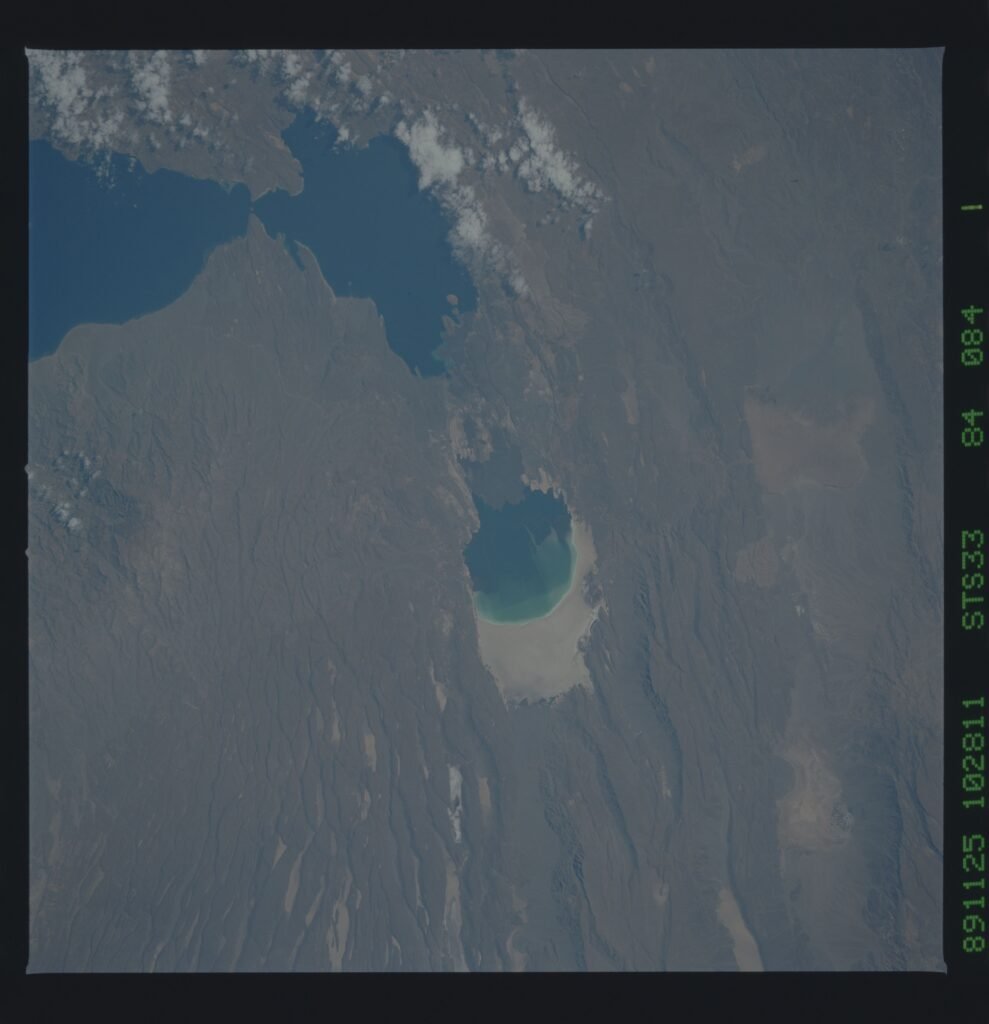
Much of Djibouti’s interior consists of stony desert plains, dormant volcanic fields, and fault-line depressions carved by the tectonic rift slowly splitting the Horn of Africa from the rest of the continent. The country’s defining natural feature is Lake Assal, a crater lake in the Danakil Desert that sits about 155 meters (510 feet) below sea level, making it the lowest point on the African continent and one of the lowest land surfaces on Earth outside the major ocean basins, according to NASA’s Earth Science and Remote Sensing records. Lake Assal’s water is roughly ten times saltier than the ocean, and its shoreline is rimmed with white salt flats and dark volcanic rock.
Djibouti’s coastline runs along the Gulf of Tadjoura and the Gulf of Aden, giving the country deepwater access that far exceeds what its small land area would suggest. That coastline, combined with the country’s position on the Bab-el-Mandeb strait, only about 18 miles wide at its narrowest point, is the single most important fact about Djibouti’s geography, and it explains nearly everything else about the country’s economy and its role in world affairs.
A Brief History
Djibouti’s modern borders trace back to French colonial expansion in the Horn of Africa in the late nineteenth century, when France established the colony of French Somaliland to secure a coaling station on the route to its territories in Asia. The colony was renamed the French Territory of the Afars and Issas in 1967, reflecting Djibouti’s two largest ethnic communities, before voters approved independence in a 1977 referendum. Djibouti became a fully sovereign republic on June 27, 1977, the last French colony on the African mainland to do so, with Hassan Gouled Aptidon as its first president, according to Encyclopaedia Britannica.
Gouled Aptidon governed until 1999, a period marked by tension between the Somali Issa majority and the Afar minority that erupted into civil war in the early 1990s between government forces and an Afar-led rebel movement. A peace agreement in the mid-1990s brought the conflict to a formal close. Ismail Omar Guelleh succeeded Gouled Aptidon in 1999 and has led the country since, a continuity that has given Djibouti a degree of political stability that is rare among its neighbors.
Government and Economy Today
Djibouti is a presidential republic. Executive authority rests with the president, and legislative power sits with an elected National Assembly. The People’s Rally for Progress, the party of both of Djibouti’s post-independence presidents, has held power continuously since 1977.
Djibouti’s economy is built almost entirely on its role as a transit hub. Landlocked Ethiopia, a country of more than 120 million people, routes the great majority of its foreign trade through Djibouti’s ports, and container terminals, free trade zones, and a Chinese-financed railway connecting Djibouti City to Addis Ababa have turned logistics and port services into the backbone of the national economy. The World Bank reported that Djibouti’s economy grew 6.5 percent in 2025, down slightly from 7.0 percent in 2024, with growth expected to ease to 5.9 percent in 2026 as disruptions to Red Sea shipping and regional tensions weigh on port traffic. Inflation fell to near zero in early 2025, the fiscal balance moved into a surplus of 0.9 percent of GDP, and public debt declined to below 65 percent of GDP.
That growth has not translated evenly into jobs. The World Bank notes that unemployment remains high and labor force participation low, particularly among young people and women, because growth is concentrated in capital-intensive port and logistics operations that employ relatively few workers. Poverty in Djibouti is predominantly urban and closely tied to weak labor market outcomes, leaving many households vulnerable to swings in food and energy prices.
People and Culture
Djibouti’s population is composed mainly of two communities, the Somali Issa and the Afar, along with smaller Arab, Ethiopian, and European minorities. French and Arabic are the country’s official languages, while Somali and Afar are the languages most widely spoken in daily life. The large majority of Djiboutians are Sunni Muslim, and Islam shapes much of daily social life, including dietary practice and the rhythm of the workweek.
Many Djiboutians, particularly the Afar and the Issa, trace their heritage to pastoral, nomadic traditions built around herding camels, goats, and cattle across arid terrain, though urbanization has concentrated most of the population in Djibouti City today. UNESCO has supported projects to document and safeguard traditional Afar and Somali practices, including traditional games, as part of a wider regional effort to record intangible cultural heritage in the Horn of Africa. Chewing khat, a mild stimulant leaf imported daily from Ethiopia, is a widespread and long-established social custom in Djiboutian life.
What Djibouti Is Known For
Djibouti is best known internationally for two closely related things: Lake Assal’s extreme geography, and its role as host to more foreign military bases than any other single country in the world. The reason is the same in both cases: the same tectonic and geographic forces that carved out Lake Assal’s saline basin also positioned Djibouti beside the Bab-el-Mandeb strait, and that strait is what draws the militaries.
The Bab-el-Mandeb strait, only about 18 miles wide at its narrowest point, is one of the world’s most important maritime chokepoints. Between roughly 12.5 and 20 percent of global maritime trade and an estimated 3.8 million barrels of oil per day pass through the strait, according to an analysis published in the Yale Review of International Studies. Ships bound to or from the Suez Canal have no practical alternative route, which makes access to the waters beside Djibouti a matter of direct interest to naval powers.
France, the former colonial power, retains a base under a defense agreement dating to independence. The United States operates Camp Lemonnier, its main base in Africa, established in the early 2000s to support counterterrorism and counter-piracy operations. China opened its first overseas military base in Djibouti in August 2017, sited only a few miles from Camp Lemonnier, after formally announcing the project in January 2016. The facility, leased for a reported 20 million dollars a year under a ten-year agreement, was the first overseas military installation the Chinese government has ever formally sanctioned. Italy, Japan, Germany, and Spain also maintain a military presence in the country.
Why Djibouti Matters
Djibouti’s importance is out of proportion to its size for a straightforward reason: geography. It occupies one of the few points on Earth where a change in access, security, or control could measurably affect global oil transport and shipping costs, which is why it hosts one of the world’s most concentrated clusters of foreign military bases despite being one of Africa’s smallest countries. It is also indispensable to landlocked Ethiopia’s economy, giving Djibouti outsized diplomatic leverage in the Horn of Africa relative to its population of roughly 1.2 million.
At the same time, Djibouti illustrates a pattern common to small states positioned at global chokepoints: growth driven by transit fees and strategic rents has not solved underlying problems of unemployment and resource scarcity, and the same location that guarantees international attention also ties Djibouti’s fortunes to conflicts it does not control, from Red Sea shipping disruptions to instability in Ethiopia and Somalia. Understanding Djibouti means understanding how thoroughly geography can shape a country’s politics, economy, and place in the world.
Key Takeaways
- Djibouti is a small Horn of Africa nation of about 1.2 million people, positioned directly on the Bab-el-Mandeb strait between the Red Sea and the Indian Ocean.
- Lake Assal, in Djibouti’s interior, sits about 155 meters (510 feet) below sea level, making it the lowest point in Africa.
- France colonized the territory as French Somaliland, later the French Territory of the Afars and Issas, before Djibouti became independent on June 27, 1977.
- Djibouti’s economy depends heavily on port and transit services for landlocked Ethiopia, with GDP growing 6.5 percent in 2025 even as unemployment remains high.
- The Bab-el-Mandeb strait carries roughly 12.5 to 20 percent of global maritime trade, which is why Djibouti hosts military bases from France, the United States, China, and several other countries.
- China’s base in Djibouti, opened in 2017, was the first overseas military installation ever formally sanctioned by the Chinese government.
Sources
- The World Bank, Djibouti Overview, undated.
- The World Bank, Djibouti’s Economy Shows Resilience Amid Global Uncertainty, May 7, 2026.
- International Monetary Fund, Djibouti: 2025 Article IV Consultation, Press Release and Staff Report, 2025.
- United Nations Population Fund (UNFPA), Djibouti, World Population Dashboard, 2025.
- UNESCO, Intangible Cultural Heritage, Djibouti, undated.
- NASA, Johnson Space Center Earth Science and Remote Sensing Unit, Astronaut Photograph STS033-84-84, Lake Assal, Djibouti, November 25, 1989.
- Encyclopaedia Britannica, History of Djibouti, undated.
- Encyclopaedia Britannica, Djibouti, undated.
- Yale Review of International Studies, On the Shores of Bab-el-Mandeb: Assessing China’s First Overseas Military Base in Djibouti and Chinese Grand Strategic Vision for the Horn of Africa and Indian Ocean, undated.
Key facts
- Djibouti's population reached approximately 1.2 million in 2025, according to the UN Population Fund4
- Lake Assal sits about 155 meters (510 feet) below sea level, the lowest point in Africa, according to NASA's Earth Science and Remote Sensing archive6
- The Bab-el-Mandeb strait beside Djibouti is only about 18 miles wide at its narrowest point yet carries an estimated 12.5 to 20 percent of global maritime trade and roughly 3.8 million barrels of oil per day9
- Djibouti's economy grew 6.5 percent in 2025, driven mainly by port and logistics services tied to Ethiopia's trade, according to the World Bank2
- China's naval support base in Djibouti, opened in August 2017, was the first overseas military installation ever formally sanctioned by the Chinese government9
Quick checkWhat geographic feature makes Djibouti one of the most strategically important countries in the world despite its small size?Show answer
Djibouti sits directly on the Bab-el-Mandeb strait, a passage only about 18 miles wide that carries an estimated 12.5 to 20 percent of global maritime trade, which is why France, the United States, China, and several other countries all maintain military bases there.
Sources
- The World Bank. Djibouti Overview. Undated (accessed 2026-09-23)
- The World Bank. Djibouti's Economy Shows Resilience Amid Global Uncertainty. 2026-05-07 (accessed 2026-09-23)
- International Monetary Fund. Djibouti: 2025 Article IV Consultation-Press Release; and Staff Report. 2025 (accessed 2026-09-23)
- United Nations Population Fund (UNFPA). Djibouti, World Population Dashboard. 2025 (accessed 2026-09-23)
- UNESCO. Intangible Cultural Heritage, Djibouti. Undated (accessed 2026-09-23)
- NASA, Johnson Space Center Earth Science and Remote Sensing Unit. Astronaut Photograph STS033-84-84, Lake Assal, Djibouti. 1989-11-25 (accessed 2026-09-23)
- Encyclopaedia Britannica. History of Djibouti. Undated (accessed 2026-09-23)
- Encyclopaedia Britannica. Djibouti. Undated (accessed 2026-09-23)
- Yale Review of International Studies. On the Shores of Bab-el-Mandeb: Assessing China's First Overseas Military Base in Djibouti and Chinese Grand Strategic Vision for the Horn of Africa and Indian Ocean. Undated (accessed 2026-09-23)
Editorially reviewed by Specialty Digest Editorial TeamLast reviewed September 23, 2026Researched and drafted with AI assistanceReport an issue