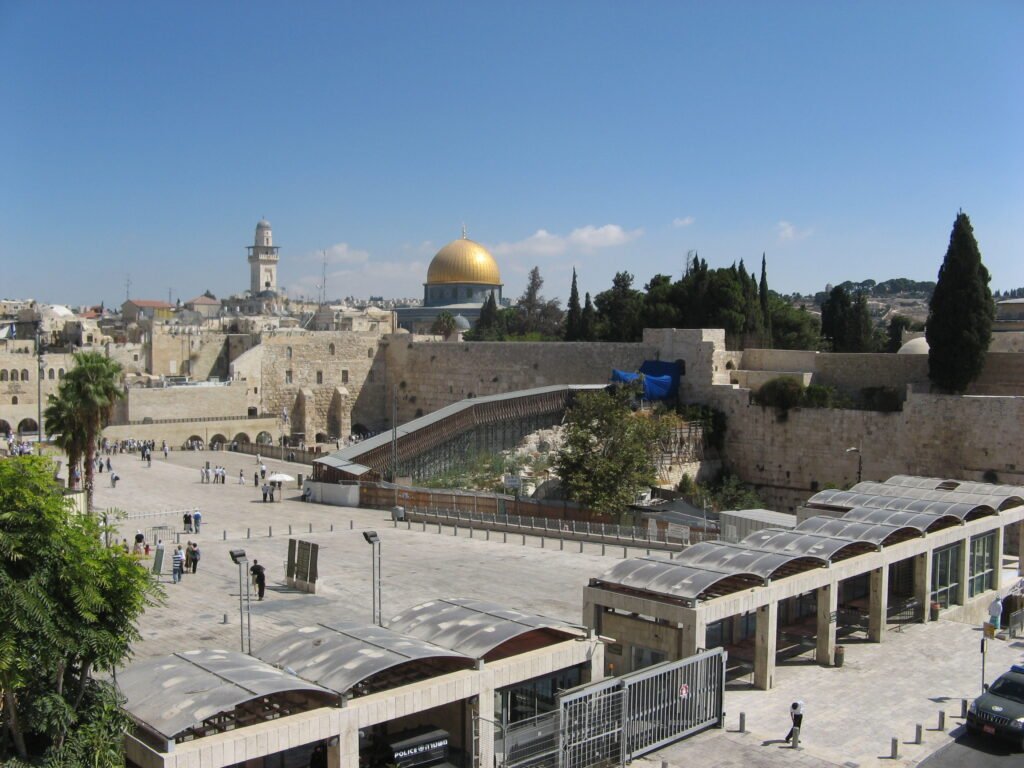
Israel is a country in the Middle East on the eastern shore of the Mediterranean Sea, home to sites central to Jewish, Christian and Muslim religious history and to one of the world’s most prominent technology economies. It sits at the meeting point of Africa, Asia and Europe, a location that has made it a center of trade, religion and conflict for thousands of years.
Where Is Israel Located?
Israel lies in Western Asia along the eastern Mediterranean coast, bordered by Lebanon to the north, Syria to the northeast, Jordan to the east and Egypt to the southwest, with the Palestinian territories of the West Bank and Gaza Strip adjoining its territory. Its landscape ranges from a fertile coastal plain to the Negev desert in the south, the Jordan Rift Valley, the Sea of Galilee, and the Dead Sea, whose shoreline marks the lowest point on Earth’s land surface.
A Brief History
The region has been continuously significant to Jewish, Christian and Muslim history for millennia, home in turn to ancient Israelite kingdoms and successive empires including Roman, Byzantine, Islamic caliphates and the Ottoman Empire. Following the collapse of Ottoman rule after the First World War, the territory became the British Mandate of Palestine. In 1947, the United Nations General Assembly adopted a plan to partition the mandate into separate Jewish and Arab states, and Israel declared independence on May 14, 1948, followed immediately by war with neighboring Arab states. Israel has since fought several further wars and remains in an unresolved conflict with the Palestinians over borders, statehood and the status of Jerusalem and the occupied territories, an issue the United Nations and other international bodies continue to address without a final settlement.
Government and Economy Today
Israel is a parliamentary democracy with a unicameral parliament, the Knesset, elected by proportional representation; a president fills a largely ceremonial head-of-state role while a prime minister leads the government. Israel designates Jerusalem as its capital, but this status is not universally recognized: many countries and international bodies consider the city’s final status unresolved pending a broader settlement, and foreign embassies have historically been based in or near Tel Aviv. According to the World Bank, Israel is a high-income economy, with a technology and venture-capital sector so prominent the country is often nicknamed the “Start-Up Nation.”
Culture and People
Israel’s population was approximately 10.1 million in 2025, according to the World Bank. Society is religiously and culturally diverse, with a Jewish majority alongside Arab, Druze and other minority communities, and Hebrew and Arabic both in wide use. Jerusalem’s Old City contains sites sacred to three major religions within a small area, including the Western Wall, the holiest site at which Jews are permitted to pray, the Church of the Holy Sepulchre, revered by Christians as the site of Jesus’s crucifixion and burial, and the Dome of the Rock and Al-Aqsa Mosque, sacred to Muslims.
What Is Israel Known For?
Israel is best known internationally for its concentration of sites central to Jewish, Christian and Muslim religious history, especially in Jerusalem; for the Dead Sea’s extreme salinity and low elevation; and for a technology sector that has made it one of the world’s leading centers for start-ups and innovation per capita.
Key Takeaways
- Israel lies on the eastern Mediterranean in Western Asia, bordered by Lebanon, Syria, Jordan and Egypt, with the West Bank and Gaza adjoining its territory.
- It declared independence on May 14, 1948, following the 1947 United Nations partition plan for the British Mandate of Palestine.
- Jerusalem’s status as Israel’s capital is internationally disputed, and the wider conflict with the Palestinians over borders, statehood and the occupied territories remains unresolved.
- Israel is a high-income, technologically advanced economy, often called the “Start-Up Nation.”
- Jerusalem’s Old City holds sites central to Judaism, Christianity and Islam, including the Western Wall.
Key facts
Quick checkWhy is Jerusalem's status as Israel's capital internationally disputed?Show answer
Israel designates Jerusalem as its capital, but many countries and international bodies consider the city's final status unresolved pending a broader Israeli-Palestinian settlement, and foreign embassies have historically been based in or near Tel Aviv.
Sources
- World Bank. Israel, Population total. 2025 (accessed Accessed 2026)
Editorially reviewed by Specialty Digest Editorial TeamLast reviewed September 27, 2026Researched and drafted with AI assistanceReport an issue