Montenegro is a small country in the Western Balkans, on the Adriatic coast of southeastern Europe, bordering Croatia, Bosnia and Herzegovina, Serbia, Kosovo, and Albania. With a population of roughly 623,000 people, according to the World Bank, it is one of Europe’s smallest nations by population, known for its dramatic coastline of fjord-like bays set against steep mountains that rise almost directly from the sea.
Where Is Montenegro Located?
Montenegro sits on the Adriatic Sea in the Western Balkans, covering about 13,900 square kilometers, according to World Bank data. Its terrain is defined by a narrow coastal strip that gives way rapidly to the rugged Dinaric Alps, including Mount Durmitor, and by the Bay of Kotor, a deeply indented inlet often compared to a fjord even though it was formed by river erosion and later flooded by the sea rather than by glacial action. The capital, Podgorica, lies inland in a valley south of the mountains.
A Brief History of Montenegro
Montenegro traces its identity as a distinct political entity back to the medieval principality of Zeta and later to a long running resistance against Ottoman expansion, during which it retained a degree of autonomy under the rule of prince-bishops from the House of Petrovic-Njegos. It was recognized as an independent state at the Congress of Berlin in 1878, before becoming a kingdom in 1910 and later joining the Kingdom of Serbs, Croats and Slovenes after the First World War. Montenegro became a constituent republic of socialist Yugoslavia and, after the wars of the 1990s, remained federated with Serbia until a 2006 referendum in which citizens voted to restore full independence.
Government and Economy
Montenegro is a parliamentary republic bordering five countries in the Western Balkans. According to the World Bank, its economy is small, open, and service based, which leaves it highly vulnerable to external shocks, and it relies on fiscal policy and structural reforms to maintain macroeconomic stability. Montenegro has formally applied to join the European Union and has been engaged in accession negotiations, although the World Bank notes that rule of law challenges have slowed the process and remain a key development constraint. Tourism along the Adriatic coast is a central pillar of the national economy.
Culture and People
Montenegrin, a South Slavic language closely related to Serbian, Croatian, and Bosnian, is the official language, and Orthodox Christianity is the predominant religion, alongside significant Muslim and Catholic minorities reflecting the country’s mixed Balkan heritage. Montenegrin identity has historically centered on a strong warrior and clan based tradition tied to centuries of resistance against Ottoman rule, alongside a maritime and trading culture along the Adriatic coast that connects it to the wider Mediterranean world.
What Is Montenegro Known For?
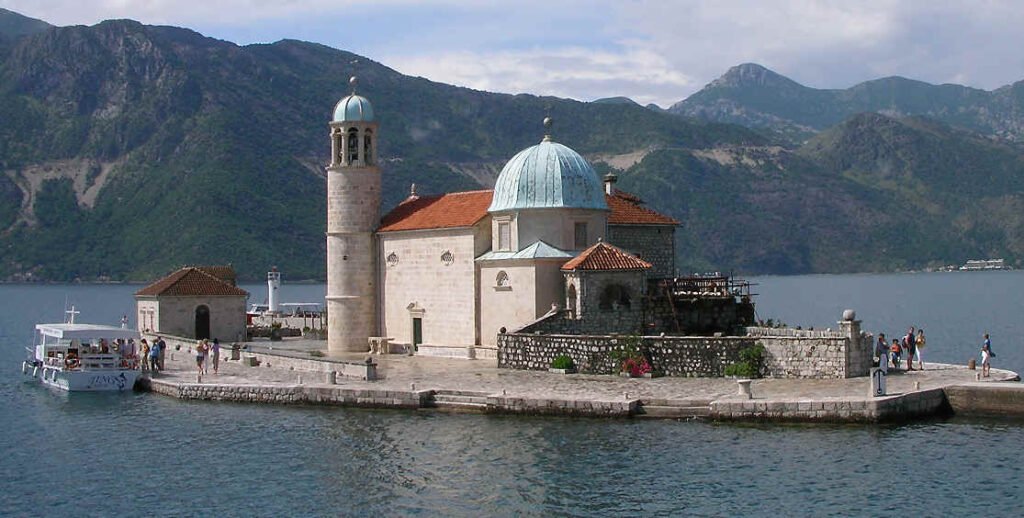
Montenegro’s single most recognizable landmark is Our Lady of the Rocks, a small artificial islet in the Bay of Kotor crowned by a Roman Catholic church, built up over centuries by local sailors who, according to tradition, deposited rocks and eventually sank old ships loaded with stone around a small reef where an icon of the Virgin Mary was said to have been found. The current church dates to the seventeenth century, and the islet, paired with its natural twin, Sveti Dorde, remains one of only two artificial islands in the Adriatic and the defining image of the Bay of Kotor, itself inscribed on the UNESCO World Heritage List for its natural and cultural significance.
Why Montenegro Matters
Montenegro’s 2006 return to independence made it one of Europe’s youngest states, and its subsequent pursuit of European Union and NATO membership, which it joined in 2017, has made it a closely watched case in the Western Balkans’ broader path toward European integration. Its Adriatic coastline, wedged between mountains and sea, also gives it an outsized role in regional tourism relative to its small size.
Key Takeaways
- Montenegro is a small Adriatic country in the Western Balkans with a population of about 623,000 people.
- It was recognized as independent at the Congress of Berlin in 1878 and restored full independence by referendum in 2006.
- The World Bank describes Montenegro’s economy as small, open, and service based, and highly exposed to external shocks.
- Montenegro has pursued European Union membership and joined NATO in 2017.
- Our Lady of the Rocks, an artificial islet church in the Bay of Kotor, is Montenegro’s single most iconic landmark.
Sources
Key facts
Quick checkIn what year did Montenegro restore full independence by referendum?Show answer
2006.
Sources
- The World Bank. Montenegro Overview. Undated (accessed 2026-09-28)
- The World Bank. World Development Indicators, Montenegro. 2025 (accessed 2026-09-28)
Editorially reviewed by Specialty Digest Editorial TeamLast reviewed September 28, 2026Researched and drafted with AI assistanceReport an issue