Words rarely stay only words. The United Nations notes that the spread of hateful rhetoric can be an early warning of violence, including atrocity crimes. The International Day for Countering Hate Speech, observed every year on June 18, asks the world to notice that pattern early, while a response is still cheap and a community is still whole. It is a close companion of the International Day for Tolerance, because tolerance is what hate speech wears away.
From a 2019 strategy to a 2021 day
The day grew out of a plan. On June 18, 2019, UN Secretary-General António Guterres launched the United Nations Strategy and Plan of Action on Hate Speech at UN Headquarters in New York and designated the Special Adviser on the Prevention of Genocide as its focal point. Two years later, in July 2021, the General Assembly adopted resolution 75/309, on promoting inter-religious and intercultural dialogue and tolerance in countering hate speech. It proclaimed June 18 as the International Day for Countering Hate Speech, choosing the anniversary of the Strategy.
The resolution calls on all relevant actors, including states, to increase their efforts to address the problem in line with international human rights law. The UN invites governments, international organizations, civil society groups and individuals to hold events that promote ways to identify, address and counter hate speech. A later resolution, A/RES/79/316, adopted in June 2025, encourages member states to consider initiatives for interreligious and intercultural dialogue, tolerance, understanding and cooperation.
What counts as hate speech
The Strategy explains that, in its context, hate speech means any kind of communication in speech, writing or behavior that attacks or uses pejorative or discriminatory language with reference to a person or a group on the basis of who they are. That includes religion, ethnicity, nationality, race, color, descent, gender or another identity factor. The same document is candid about a limit: there is no international legal definition of hate speech.
That candor matters. Hate speech is a category of harm that societies describe in different ways, and the UN approach is to name it, measure it and respond with a mix of law, education and public voices, while protecting free expression.
Where the law draws the line
The Strategy states that international law does not prohibit hate speech as such. It prohibits incitement to discrimination, hostility and violence. Hate speech that stays below that threshold is not something international law requires states to prohibit. UNESCO adds that states must prohibit the most severe forms under Article 20 of the International Covenant on Civil and Political Rights, with the Rabat Plan of Action serving as guidance.
The Strategy also insists that it does not mean limiting or prohibiting freedom of speech. One of its four key principles is that the answer to hateful speech is more speech, not less. The others are shared responsibility, digital citizenship, and the need for more data and research.
Example 1: the moderator’s pile. Imagine a community forum receives 1,000 reports in a month. On review, perhaps 100 posts call for violence or discrimination against a group and are removed and escalated. Several hundred more are insulting but fall short of incitement; they get warnings, context labels or replies from other members. The numbers are round and illustrative, but the sorting shows why the line matters: different harms call for different tools.
What the Strategy asks governments and the UN to do
The Strategy sets out 13 commitments for the UN system. They include monitoring and analyzing hate speech, addressing its root causes, drivers and actors, engaging and supporting victims, convening relevant actors, engaging with media, using technology, using education, leveraging partnerships and supporting member states. It is a plan of work, not a slogan, and it is why the Day is paired with practical events rather than only statements.
Example 2: a classroom response. Suppose a teacher of 30 students hears a dehumanizing nickname spreading about a new classmate. Instead of only punishing, she discusses where such words lead, asks students to describe how they would feel, and invites the classmate to share if they wish. This mirrors the education commitment: build the skills to recognize and reject hatred. The scene is invented to illustrate the idea.
The numbers: hate speech online
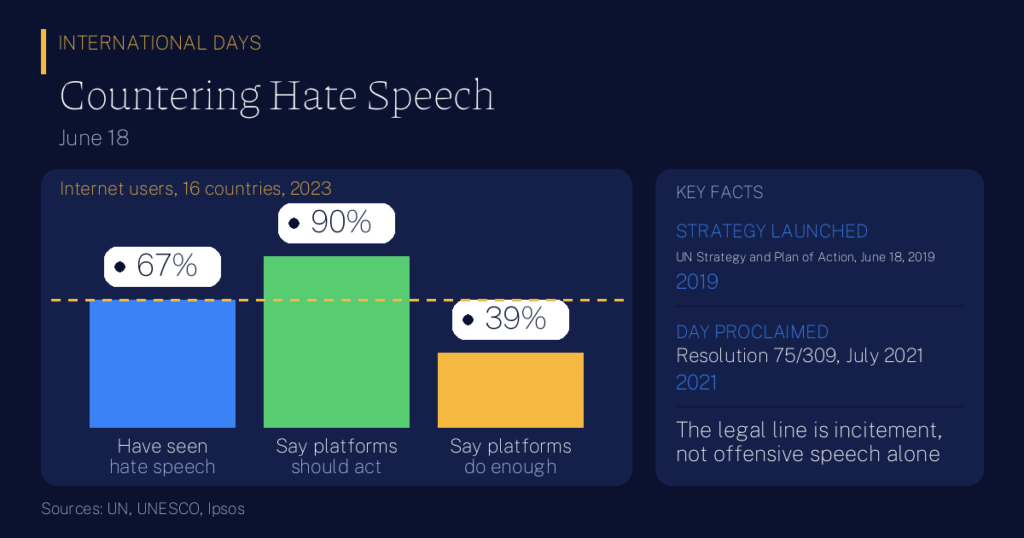
Data on hate speech are scarce, so surveys of public experience are valuable. In 2023, Ipsos surveyed about 8,000 internet users aged 18 and over in 16 countries for UNESCO, with fieldwork from August 22 to September 25. The countries were Algeria, Austria, Bangladesh, Belgium, Croatia, the Dominican Republic, El Salvador, Ghana, India, Indonesia, Mexico, Romania, Senegal, South Africa, Ukraine and the United States. Averages are simple averages across those countries, not population-weighted, and describe what respondents report, not a count of all hate speech.
- 67%say they have encountered hate speech online
- 74%of under-35s have encountered it
- 56%get news mainly from social media feeds
- 58%name Facebook where hate speech is most prevalent
The same survey found strong appetite for action. Across the countries, 90 percent said social media platforms should address disinformation and hate speech, and 88 percent said governments and regulators should. Yet only 39 percent said platforms are doing enough, while 54 percent said they are not.
Who is affected and what helps
The UN describes hate speech that stigmatizes and dehumanizes minorities, migrants, refugees, women and any so-called other, and it cites xenophobia, racism, intolerance, violent misogyny, antisemitism and anti-Muslim hatred. In the UNESCO survey, respondents most often named LGBT+ people (33 percent), ethnic or racial minorities (28 percent) and women (18 percent) when asked who suffers most.
UNESCO stresses education and media and information literacy, and calls for transparency from platforms about reports, algorithms and policies. In 2023 it and the UN Office on Genocide Prevention and the Responsibility to Protect published the first guide for policy-makers and teachers on educational responses to hate speech. If you are targeted online, use the platform’s reporting tools, save screenshots and links, and tell someone you trust or a local support organization. If you are threatened with violence, contact local emergency services.
Example 3: the power of a few. If two in three of 100 friends have seen hateful posts, about 67 of them have. Suppose 10 of those 67 reply with calm, factual messages or report the post. The numbers are made up, but the idea is not: a small share of people acting can change what the rest of a community sees.
How the day is marked
The UN invites governments, civil society and individuals to hold events. The UN observance page for 2026 lists a high-level event hosted by the Permanent Mission of Morocco and the UN Office on Genocide Prevention and the Responsibility to Protect. UN News reported that the 2025 observance focused on the link between hate speech and artificial intelligence, quoting Mr. Guterres: hate speech is poison in the well of society. Each year’s emphasis can change, so check the official UN page for the current one.
Key Takeaways
- The Day has a plan behind it. It marks the anniversary of the 2019 UN Strategy and Plan of Action on Hate Speech.
- Hate speech has no single legal definition. The UN uses a working description based on attacks on people for who they are.
- The legal line is incitement. International law prohibits incitement to discrimination, hostility and violence, not all offensive speech.
- The answer is more than bans. The Strategy stresses education, monitoring, victim support and more speech, not less.
- Online exposure is common. In 2023, 67 percent of surveyed internet users in 16 countries had encountered hate speech.
- People want action. About nine in ten say platforms should address it, and most doubt they do enough.
- Everyone has a role. Reporting, replying calmly and supporting targets are small acts that add up.
How solid is this? The legal and historical points come from UN and UNESCO documents. The survey figures are 2023 averages across 16 countries and reflect what internet users there report, not a global count. The three worked examples use round, made-up numbers. See also the International Days hub and the International Days Calendar.
More in Society
- UN General Assembly. Resolution A/RES/75/309, Promoting inter-religious and intercultural dialogue and tolerance in countering hate speech (July 2021).
- United Nations. International Day for Countering Hate Speech.
- United Nations. United Nations Strategy and Plan of Action on Hate Speech (2019).
- UN News. Hate speech on notice as UN chief launches new plan (June 2019).
- UN News. Hate speech is poison in the well of society, says Guterres (June 2025).
- UNESCO. What you need to know about hate speech.
- Ipsos for UNESCO. Survey on the impact of online disinformation and hate speech (September 2023).