Every meal tells a story that begins long before it reaches the table. Someone grew the ingredients, someone moved them, someone chose how to cook them, and someone decided what to do with the leftovers. Sustainable Gastronomy Day, observed every June 18, asks us to read that whole story. It celebrates food as culture, as livelihood and as a shared duty to the planet. The day matters because the world makes enough food to feed everyone, yet 645 million people were affected by hunger in 2025, while an estimated 1.05 billion tonnes of food went to waste in 2022. It is a close companion of World Pulses Day, which spotlights one humble food that does so much for diets and soils.
A resolution born at the table
On November 23, 2016, the United Nations General Assembly adopted by consensus a resolution titled “Sustainable Gastronomy Day” and designated June 18 as the date. According to UNESCO, the text was co-authored by Peru and 37 other member states. It acknowledges gastronomy as a cultural expression related to the natural and cultural diversity of the world, and it states that all cultures and civilizations contribute to sustainable development and are crucial enablers of it.
The resolution invites UNESCO and FAO to facilitate the observance in collaboration with other organizations of the United Nations system. It invites all member states, UN bodies and civil society to mark the day in line with national priorities, and it says the costs are to be met from voluntary contributions. It also links gastronomy to the three dimensions of sustainable development, including agricultural development, food security, nutrition, sustainable food production and the conservation of biodiversity.
What “sustainable gastronomy” means
Gastronomy is more than fine dining. It is the full relationship between people, their food and their surroundings. FAO describes sustainable gastronomy as cuisine that takes into account where the ingredients come from, how the food is grown and how it gets to our markets and eventually to our plates. That definition turns a meal into a chain of four questions, and a sustainable kitchen, whether in a village or a capital, tries to answer each one well.
Example 1: the neighborhood restaurant. Suppose a restaurant spends $1,000 a week on vegetables and shifts 60 percent of that to growers within 50 miles. About $600 a week now circulates among nearby farms, the produce arrives fresher, and the menu follows the seasons. The numbers are round and illustrative, but they show how one kitchen can answer the first three questions at once.
The numbers: food that never gets eaten
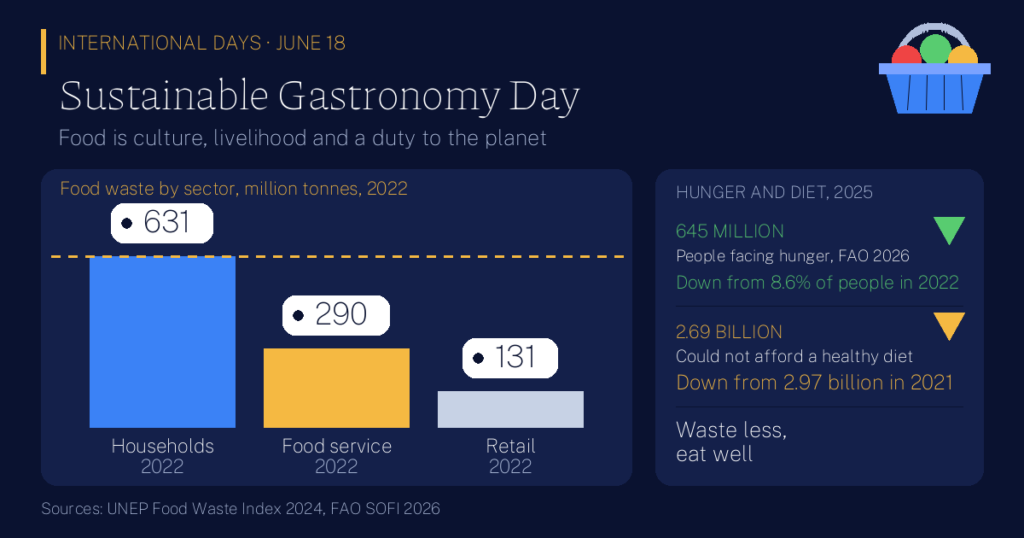
The most striking fact about modern food is how much of it is never eaten. The UN Environment Programme’s Food Waste Index Report 2024 estimated that 1.05 billion tonnes of food went to waste in 2022. Households accounted for 631 million tonnes, food service for 290 million tonnes and retail for 131 million tonnes. UNEP puts the average at 79 kilograms of food wasted per person each year and notes that more than one billion meals are left uneaten every day.
Waste also starts earlier. FAO estimates that around 13 percent of food is lost in the supply chain between harvest and the point of sale, and UN News reports that about 19 percent of the food available to consumers was wasted at the retail, food service and household stages. Countries have pledged to halve per capita global food waste by 2030, yet FAO says there has been no tangible progress in reducing food losses since 2015.
Example 2: the family fridge. Imagine a household that throws away $15 of spoiled food each week. Over a year that is $780, enough for several weeks of groceries. Planning meals, freezing leftovers and storing produce properly could cut that bill sharply. The figures are round and illustrative, yet they mirror the pattern UNEP found: most waste happens at home.
- 631 milliontonnes of food wasted by households, 2022
- 79 kgof food wasted per person each year (UNEP)
- 28%of the world’s agricultural land grows food that is never eaten (FAO)
- 66.6%of Africa’s people could not afford a healthy diet, 2025
Hunger and the cost of a healthy plate
Waste sits beside want. FAO’s State of Food Security and Nutrition report, released in July 2026, found that 645 million people were affected by hunger in 2025, about 7.8 percent of the world, down from 8.1 percent in 2024 and 8.6 percent in 2022. For 2030, FAO projects that roughly 510 to 520 million people may still face hunger.
The larger gap is quality. In 2025, 2.69 billion people, or 32.7 percent of the world, could not afford a healthy diet, an improvement from 2.97 billion, or 37.4 percent, in 2021. The average global cost of a healthy diet in 2025 was 4.28 dollars per person per day in purchasing power parity terms, and in Africa 66.6 percent of people could not afford one.
Example 3: the school canteen. Picture a canteen serving 200 lunches a day with $2 of food in each. If 15 percent is thrown away, $60 is lost daily, or $10,800 over a 180-day school year. Redirect half of that to fresh produce and the school gains $5,400 of better food without raising fees. The numbers are round and illustrative, but they show why waste and nutrition are one problem.
Climate, land and cultural memory
Food that rots in a landfill releases methane. UNEP warned in 2026 that rotting food waste causes up to 10 percent of total global greenhouse gas emissions, about five times the emissions of the entire aviation sector. FAO estimates that 1.4 billion hectares, around 28 percent of the world’s agricultural land, is used to produce food that is never eaten. Every discarded meal therefore wastes land, water, labor and energy as well as the food itself.
Culture belongs in this picture too. Traditional cuisines carry knowledge about local crops, seasons, preservation and sharing that took generations to build. UNESCO’s Creative Cities Network, which included 408 cities in more than 100 countries in 2025, designates Cities of Gastronomy, and its 2025 cohort included Lucknow, Zaragoza and Cuenca. Protecting food heritage helps protect the biodiversity and the farming skills that feed it.
How the day is marked
Observance is voluntary and local, which suits the subject. FAO suggests four everyday actions: support farmers, try local foods when traveling, keep culinary traditions alive and avoid food waste. People share the hashtag #SustainableGastronomyDay, and FAO offers free campaign materials. In 2026, FAO and the World Food Forum framed Sustainable Gastronomy Week around the theme “Celebrating Food Heritage,” reminding us that by choosing wisely we can help shape healthier diets, protect the planet and build a more food-secure future.
Key Takeaways
- Gastronomy is culture and sustainability together. The 2016 UN resolution treats cuisine as an expression of natural and cultural diversity.
- Four questions guide a sustainable meal. Where the food comes from, how it is grown, how it travels and what is left on the plate.
- Waste is a household problem. Households produced 631 million of the 1.05 billion tonnes wasted in 2022.
- Hunger and waste coexist. 645 million people faced hunger in 2025 while enormous amounts of food went uneaten.
- Affordability is the hidden barrier. 2.69 billion people could not afford a healthy diet in 2025.
- Climate and land costs are large. UNEP links rotting food waste to up to 10 percent of global emissions.
- Small acts count. Buy local, plan meals, store food well and keep family recipes alive.
How solid is this? Waste figures are UNEP estimates using 2022 data, hunger and diet figures come from FAO’s 2026 report, and the emissions share is reported by UNEP without a stated year. We refer to the 2016 resolution by its title and adoption date. The three worked examples use round, made-up numbers to show an idea. See also the International Days hub and the International Days Calendar.
More in Society
- UNESCO, United Nations General Assembly invites UNESCO and FAO to promote sustainable gastronomy
- FAO, Sustainable Gastronomy Day
- FAO, Sustainable Gastronomy Day 2026: Celebrating Food Heritage
- UN News, With 783 million people going hungry, a fifth of all food goes to waste (UNEP Food Waste Index Report 2024)
- UN News, Rotting food waste emits 5 times more greenhouse gases than planes (2026)
- FAO, The State of Food Security and Nutrition in the World 2026
- UNESCO, Creative Cities Network welcomes 58 new member cities (2025)