An earthquake lasts seconds, yet its consequences can last for generations. Each April 29, the world pauses to remember the people killed or hurt by earthquakes, to stand with the families and communities left to rebuild, and to ask a practical question: what would it take to make the next one less deadly? The International Day in Memory of the Victims of Earthquakes is one of the newest days on the United Nations calendar. It joins grief to prevention, and it rests on a hard truth. We cannot stop the ground from shaking, but we can decide what the shaking meets: strong buildings or weak ones, prepared communities or unready ones. It is a close relative of World Tsunami Awareness Day, since many of the same fault lines drive both hazards.
A day born in 2025
In April 2025, the UN General Assembly designated April 29 as the International Day in Memory of the Victims of Earthquakes, in resolution A/RES/79/285. According to the UN Office for Disaster Risk Reduction (UNDRR), Chile, the Philippines and Uzbekistan introduced the resolution. It invites member states, UN organizations and other international bodies to collaborate on the commemoration, and it invites UNDRR to facilitate the observance. The text reaffirms the 2030 Agenda for Sustainable Development and recalls the Sendai Framework for Disaster Risk Reduction 2015-2030, the global plan for cutting disaster losses.
UNDRR describes two needs the day is meant to serve. The first is support for victims, including international assistance for recovery and long-term psychosocial support. The second is awareness: helping people understand earthquake risks and how to reduce them. Because the day is so new, it does not yet have a long record of yearly themes, and this article reports only what the resolution and the UN observance page say.
Why earthquakes become disasters
An earthquake is a natural hazard, but a disaster is made by what the hazard strikes. Dense housing, weak construction, poor planning and thin emergency services turn shaking into catastrophe. UN disaster officials have said the death and suffering in seismic zones must be addressed by applying high standards for construction. That is the central idea behind the day: loss is not only fate, it is also a result of choices made years before the ground moves.
The scale of past loss shows why. The UN observance page notes that since 1900 there have been at least 12 major earthquakes, each of which killed more than 50,000 people. It adds that earthquakes account for more than a quarter of global disaster losses over recent decades, amounting to trillions of dollars in damage.
Example 1: reading the share. Imagine a region that records 1,000 disaster deaths in a decade and, like the world over 1998 to 2017, loses 56 percent of them to earthquakes. That is 560 deaths. If stronger buildings cut quake deaths by a quarter, 140 lives would be saved. The numbers are round and illustrative, but they show how a single prevention measure can outweigh many smaller ones.
The numbers behind the day
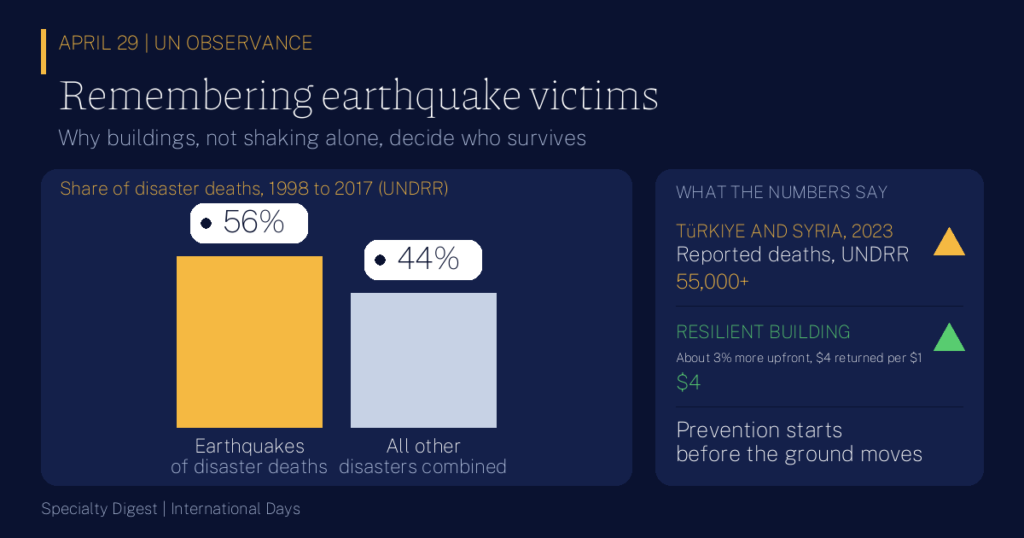
Between 1998 and 2017, UNDRR counted 563 earthquakes, including related tsunamis, that together caused 747,234 deaths. That was 56 percent of the 1.3 million deaths from all disasters in those two decades. Earthquakes are rarer than floods or storms, yet when they strike without warning in crowded places, the toll can dwarf other hazards.
- 12major earthquakes since 1900 that each killed over 50,000 people (UN)
- 747,234earthquake deaths from 1998 to 2017 (UNDRR)
- 56%of all disaster deaths in that period (UNDRR)
- Over 55,000deaths in Türkiye and Syria, 2023 (UNDRR)
Who is left behind
The earthquakes that struck Türkiye and Syria on February 6, 2023 show how a toll can grow as rescuers reach more places. UN News reported that an OCHA overview described close to 2,000 deaths on the first day, and a later UNICEF update that day cited more than 2,300. By February 7, the Government of Türkiye reported at least 3,381 deaths, while Syrian health authorities reported at least 769. UNDRR now describes the disaster as having killed over 55,000 people.
Earthquakes also strike hardest where people already struggle. UN News noted that before the 2023 quakes, around 4.1 million people in northwest Syria relied on humanitarian assistance. A shock on top of existing need is why recovery support and long-term psychosocial care are named in the UN resolution. More recently, UNDRR reported that the earthquake that struck Myanmar on March 28, 2025 had killed over 3,700 people as of April 24.
Example 2: why early numbers rise. Suppose rescuers reach 20 of 100 collapsed buildings in the first hours and count 200 victims. Even if the rest are similar, the count could approach 1,000 before every site is searched. The figures are round and illustrative, but they explain why official tolls climb for days, and why the final number is always larger than the first headline.
Building so the next one costs fewer lives
Prevention is where the day turns from memory to action. The UN observance page cites the World Bank: making infrastructure more resilient costs about 3 percent more upfront but returns $4 for every $1 invested, by reducing damage and disruption. Few public investments offer that kind of return, and the benefits include lives, not only dollars.
Example 3: a school retrofit. Suppose a district spends $3 million extra to strengthen schools that would otherwise cost $100 million to build. At the World Bank ratio, that extra $3 million would return about $12 million in avoided damage and disruption. The numbers are round and illustrative. The ratio comes from the World Bank, and real projects vary widely by place and design.
How the day is marked
UNDRR facilitates the observance, and governments, schools and community groups are invited to take part. Marking the day can mean memorials for those lost, drills at schools and workplaces, and public talks on safer construction. It can also mean learning your local guidance on what to do before, during and after shaking. People affected by a disaster can seek psychosocial support through local health services and humanitarian organizations, and the resolution itself names long-term support as a need.
Key Takeaways
- The day is new. The General Assembly designated April 29 in April 2025, in resolution A/RES/79/285.
- It has two purposes. Support victims and families, and raise awareness of earthquake risk and how to reduce it.
- Earthquakes are deadly. They caused 56 percent of disaster deaths from 1998 to 2017, per UNDRR.
- Tolls rise over time. Early counts are estimates, and the 2023 Türkiye and Syria toll passed 55,000.
- Buildings decide outcomes. The shaking cannot be stopped, but construction standards can be raised.
- Resilience pays. About 3 percent more upfront returns $4 per $1, according to the World Bank.
- Recovery is long. Psychosocial support and international assistance matter long after the headlines fade.
How solid is this? Death tolls are reported figures that were revised over time, and the 1998 to 2017 totals come from CRED data used by UNDRR. The $4 return is a World Bank estimate cited by the UN and varies by project. The three worked examples use round, made-up numbers to show an idea. See also the International Days hub and the International Days Calendar.
More in Science
- United Nations, International Day in Memory of the Victims of Earthquakes
- UNDRR, A new international day to protect against earthquakes
- UN General Assembly, resolution A/RES/79/285
- UNDRR, Economic Losses, Poverty and Disasters 1998-2017 (2018)
- UN News, Türkiye and Syria earthquakes, February 6, 2023
- UN News, Türkiye and Syria earthquakes, February 7, 2023