Every year on January 27, the United Nations asks the world to pause and remember. The International Day of Commemoration in Memory of the Victims of the Holocaust honors the six million Jews murdered by the Nazi regime, along with the other groups targeted by racist hatred. It is not only a day of mourning. It is a day of teaching, because this history shows how prejudice, left unchallenged, can grow into the destruction of people on a vast scale. The day belongs with the UN’s wider work on tolerance and on the remembrance of genocide victims and its prevention.
How January 27 became a day of memory
The date was chosen with care. On January 27, 1945, Soviet troops liberated the Auschwitz-Birkenau camp, according to UNESCO. More than one million people were murdered in that vast complex alone, most of them Jews. The anniversary of that liberation became the anchor for a global day of remembrance.
The decision came decades later. On November 1, 2005, the General Assembly adopted resolution 60/7 without sending it through a Main Committee. The text does several things. It designates January 27 as an annual International Day of Commemoration. It urges member states to develop educational programmes that will inculcate future generations with the lessons of the Holocaust, in order to help prevent future acts of genocide. It rejects any denial of the Holocaust as a historical event, either in full or in part. And it asks the Secretary-General to create an outreach programme called “The Holocaust and the United Nations.”
Example 1: counting the years. Imagine someone who was 10 years old when the camp was liberated in 1945. In 2026, the year of the 81st anniversary, that person would be 91. The numbers are illustrative, but they show why the day matters now: the generation that can speak from direct experience is passing, and remembrance must increasingly be carried by teachers, museums, recordings and families.
What the day asks us to remember
The UN describes the Holocaust as the genocide that killed around six million Jews, some two-thirds of the Jewish population of Europe. The programme’s materials also remember Roma and Sinti, and other groups targeted by racist hatred. Remembering is not only a matter of numbers. Each figure was a person with a name, a family and a future.
The programme the General Assembly asked for is now run by the UN Department of Global Communications. Each year it supports UN Information Centres around the world with guidance and materials, and in 2026 more than 22 of them held events. UNESCO adds the education side. It pays tribute to the victims each January and reaffirms its commitment to counter antisemitism, racism and other forms of intolerance. Its International Program on Holocaust and Genocide Education, run with the United States Holocaust Memorial Museum, works with teachers and ministries of education on training and policy guidelines.
The 2026 theme: dignity and human rights
The 2026 theme was “Holocaust Remembrance for Dignity and Human Rights.” The UN’s own framing is blunt: more than eighty years after the Holocaust, it says, we witness daily assaults on our fellow global citizens, and denial and distortion of the Holocaust persist. The link to human rights is deliberate. The Holocaust began with the stripping away of dignity and rights, long before the camps, and rebuilding that dignity became a founding purpose of the postwar order.
At the UN observance in the General Assembly Hall on January 27, 2026, survivors gave testimony and Secretary-General António Guterres delivered his tenth Holocaust Remembrance Day address. He said that remembrance is a duty and a promise, and told the audience, “You are here because you choose hope over hate.” General Assembly President Annalena Baerbock spoke of the duty to speak out, even louder than before, when signs of dehumanization emerge.
Denial and distortion in the digital age
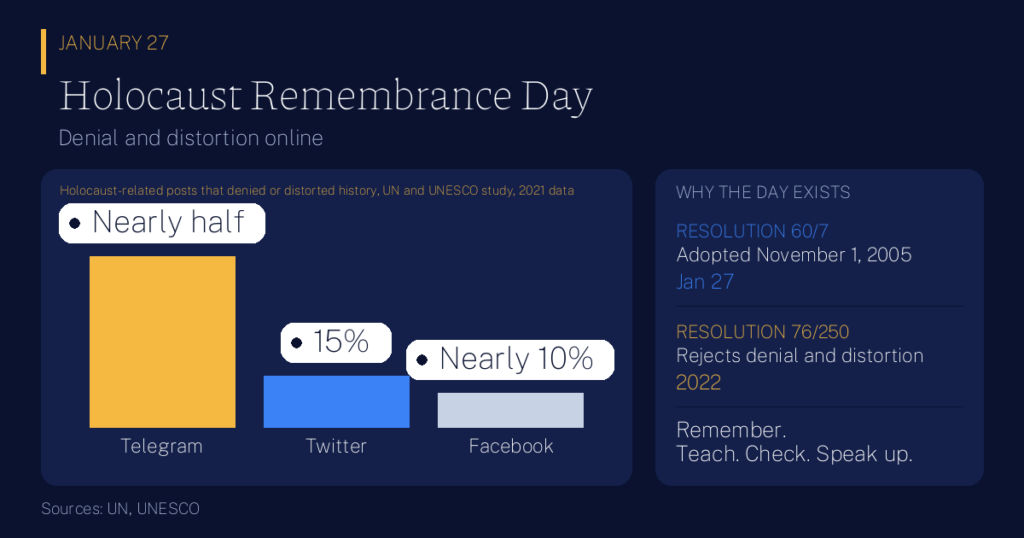
The 2005 resolution already rejected denial. In January 2022 the General Assembly went further, adopting resolution 76/250 by consensus. It expresses concern about the growing prevalence of Holocaust denial or distortion through information and communications technologies. It urges states to reject without reservation any denial or distortion of the Holocaust, and it calls on social media companies to take action against such content.
The concern rests on evidence. A 2022 report by the UN and UNESCO, called “History under attack,” analyzed almost 4,000 items collected in June and July 2021. It found that nearly half of Holocaust-related content on Telegram denied or distorted the history. On Twitter the share was 15 percent, and on Facebook nearly 10 percent. Guterres called the findings an urgent wake-up call. The report concluded that reducing such content depends largely on whether platforms take effective action.
Example 2: what a percentage means. Suppose a researcher looks at a sample of 200 Holocaust-related posts on a platform where 15 percent deny or distort the history. That is 30 posts, or roughly one in every seven. The sample is made up for illustration, but it shows why even a modest share is serious when millions of people scroll past such posts.
What remembrance asks of ordinary people
The UN’s answer is education, and the answer is practical. People can learn the history from reliable sources such as museums, archives and the UN and UNESCO teaching materials. They can check claims before sharing them, and they can report denial and hateful content to the platform where they find it. Teachers can use survivor testimony and original documents so that students meet individuals rather than statistics. Anyone who is targeted by hate should reach out to trusted community organizations or local authorities; support is available and silence is not required.
Example 3: one lesson, one source. Picture a class of 30 students. Each reads a different short testimony or document, then shares one fact and one question with the group. By the end, the class has met 30 voices instead of one summary number. The class is imagined, but the method follows what the resolution asks: education that gives future generations the lessons of the Holocaust.
Key Takeaways
- The date marks a liberation. January 27 recalls the 1945 liberation of Auschwitz-Birkenau by Soviet troops.
- The day is young but firm. Resolution 60/7, adopted November 1, 2005, set the date and rejected any denial of the Holocaust.
- The scale is stated plainly. The UN counts around six million Jewish victims, some two-thirds of Europe’s Jewish population.
- Education is the core duty. The resolution urges states to teach the lessons of the Holocaust to prevent future genocide.
- Denial has moved online. A 2022 UN and UNESCO study found nearly half of Holocaust-related Telegram content denied or distorted the history.
- Remembrance is about dignity today. The 2026 theme ties the past to human rights and to the protection of everyone’s dignity.
- Everyone can act. Learn from reliable sources, check before sharing, and report hateful content.
How solid is this? The dates, resolution texts and quotations come from UN and UNESCO documents. The social media percentages come from one 2022 study of data gathered in 2021, and the report does not reduce them to a single global rate. The three worked examples use round, made-up numbers to illustrate an idea. See also the International Days hub and the International Days Calendar.
More in History
- UN General Assembly. Resolution A/RES/60/7, Holocaust remembrance (1 November 2005).
- United Nations. Holocaust and the United Nations Outreach Programme: observance.
- United Nations. 2026 Holocaust Remembrance and Education.
- UN News. Remembering the Holocaust: You are here because you choose hope over hate (27 January 2026).
- UN Outreach Programme on the Holocaust. UN General Assembly approves resolution condemning Holocaust denial (resolution 76/250, January 2022).
- UN Department of Global Communications and UNESCO. History under attack: Holocaust denial and distortion on social media (2022).
- UNESCO. International Day of Commemoration in Memory of the Victims of the Holocaust.