Some crimes are so grave that the world agreed to name them, define them and promise to stop them. Genocide is one. Every year on December 9, the United Nations marks the International Day of Commemoration and Dignity of the Victims of the Crime of Genocide and of the Prevention of this Crime. The day does two things at once. It honors victims, and it asks governments and communities to learn how such crimes begin so that they can be prevented. This article stays close to what the United Nations itself says: the law, the duties it creates and the practical work of prevention.
One word, one treaty, one day
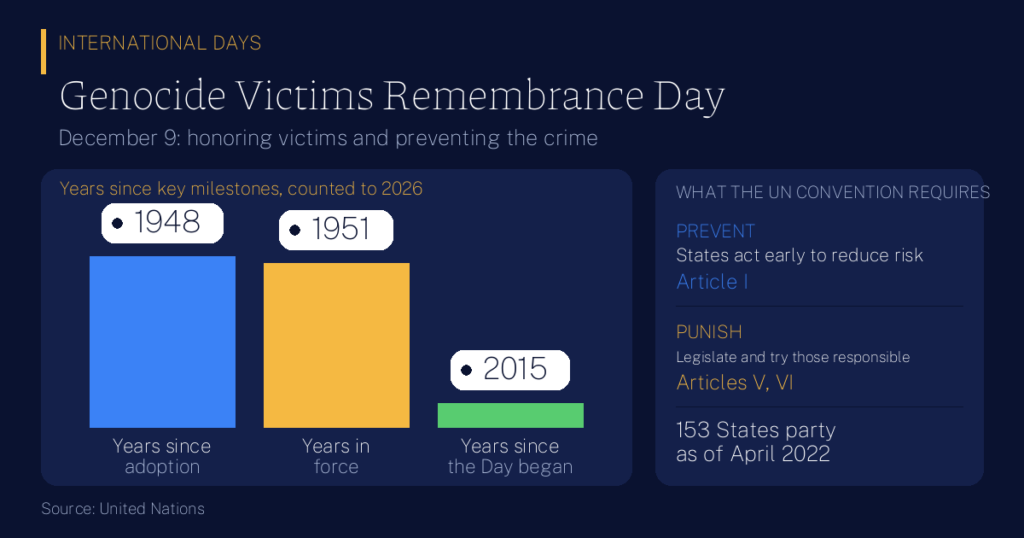
The word is recent. The UN fact sheet on the Convention credits the Polish lawyer Raphael Lemkin with coining genocide in 1944, joining the Greek geno with the Latin cide, and with contributing greatly to drafting the treaty that followed. On December 9, 1948, the General Assembly adopted the Convention on the Prevention and Punishment of the Crime of Genocide. It entered into force on January 12, 1951. That is why the day falls on December 9, the date of adoption.
The observance itself is newer. By resolution 69/323 of September 29, 2015, the General Assembly established December 9 as the International Day of Commemoration and Dignity of the Victims of the Crime of Genocide and of the Prevention of this Crime. According to the UN, the purpose is to raise awareness of the Convention and its role in combating and preventing the crime, and to commemorate and honor its victims. Each year the UN Office on Genocide Prevention and Responsibility to Protect organizes events to mark the day.
What the Convention actually defines
Everyday use of the word genocide is often broader than the legal meaning. The Convention gives a precise definition in Article II. Genocide means any of five acts committed with intent to destroy, in whole or in part, a national, ethnical, racial or religious group, as such. The five acts are killing members of the group, causing serious bodily or mental harm to its members, deliberately inflicting conditions of life calculated to bring about its physical destruction, imposing measures intended to prevent births, and forcibly transferring children of the group to another group.
Two features matter most. The first is intent: the acts must be committed with the aim of destroying a group, which is what separates genocide from other grave crimes. The second is the list of protected groups. According to the UN fact sheet, the definition does not include political groups or so called cultural genocide. Related atrocities, such as war crimes, ethnic cleansing and crimes against humanity, are treated separately, although the UN’s prevention work looks at the risk of all of them together.
Example 1: why intent matters. Imagine a town of 1,000 people where 100 residents are killed in a dispute over land. The loss is grave and may be a serious crime, but without evidence of an aim to destroy a protected group as such, it does not meet the legal definition of genocide. If the same 100 were targeted because they belonged to one protected group, and the aim was that group’s destruction, the legal analysis changes. The numbers are round and illustrative, and real determinations are made by courts on evidence.
Two duties: prevent and punish
The title of the Convention names both halves. According to the UN, it establishes a duty for States Parties to prevent and punish the crime of genocide, set out in Article I. The fact sheet lists further duties: to enact legislation that gives the Convention effect (Article V), and to try persons charged with genocide in a competent national court or an international penal tribunal (Article VI). It also notes that the International Court of Justice found the duty to prevent has extraterritorial scope. In plain terms, the duty is not limited to what a state does inside its own borders.
Prevention is also an institutional job. The Special Advisers on the Prevention of Genocide and on the Responsibility to Protect collect information on situations with a risk of genocide, war crimes, ethnic cleansing and crimes against humanity, and they may issue public statements or brief the Security Council when they judge it would reduce the risk. The UN has also published 2024 policy guidance on promoting dialogue and mediation to prevent genocide. The emphasis throughout is on acting before violence, not after it.
Example 2: acting before a crisis. Suppose a government hears credible reports that hateful speech against one community has grown for a year. It can raise concerns through diplomacy, support independent courts and media, fund local mediation and share what it knows with UN bodies. Each step is modest, and none requires waiting for violence. The scenario is illustrative and does not describe any real country.
The facts that can be counted
Counting is hard for a crime this grave, so this article relies on what the UN states plainly. As of April 2022, the UN fact sheet reports that 153 States had ratified or acceded to the Convention. Figures about victims of particular events differ by source and are contested in places, so we leave them to courts, historians and the bodies that study them rather than quoting a single number here.
- 153States party to the Convention, as of April 2022
- 78 yearssince the Convention was adopted in 1948, counted to 2026
- 5acts listed in Article II
- 4protected groups named in Article II
Why remembrance is part of prevention
The full name of the day pairs two ideas: dignity for victims and prevention of the crime. Remembering is not only grief. It keeps the record accurate, challenges denial and shows how ordinary institutions, from schools to media to local government, can either resist hatred or give way to it. The UN describes its 2026 event, held on December 9, 2026 at United Nations Headquarters in New York and livestreamed on UN WebTV, as looking at the path forward in implementing the Convention. It highlights reduced investment in prevention, new technologies including artificial intelligence, and attacks on the international legal system. The UN also notes that 2028 will bring the 80th anniversary of the Convention.
Example 3: a classroom hour. A school of 400 students sets aside one hour. Four groups of 100 read a survivor’s published testimony, learn the five acts in Article II and discuss how a community can notice early warning signs. Done with care, one hour reaches 400 young people with accurate history. The numbers are round and illustrative.
How people can mark the day
Marking the day can be quiet. You can follow the UN event, read the Convention, which is short, or visit a memorial or museum near you. Community groups and volunteers can host readings, support survivor commemorations and share accurate information. This subject can be heavy. If it affects you, a trusted counselor, faith leader or local support line can help, and taking breaks is reasonable.
Key Takeaways
- The day has two purposes. It honors victims and promotes prevention of the crime.
- Dates are fixed. The Convention was adopted on December 9, 1948 and entered into force on January 12, 1951.
- The Day is newer than the treaty. Resolution 69/323 of September 29, 2015 created it.
- The legal definition is precise. Five acts, committed with intent to destroy a national, ethnical, racial or religious group.
- States have two duties. The Convention requires them to prevent and to punish, and the prevention duty reaches beyond borders.
- Early action matters most. UN prevention work focuses on warning signs, dialogue and mediation before violence begins.
How solid is this? Dates, the resolution and the legal definition come from the UN observance page and the UN fact sheet on the Convention. The count of 153 States party is as of April 2022 and may have changed since. We quote no casualty figures, and the three worked examples use round, made-up numbers. See also the International Days hub and the International Days Calendar.
More in History
- United Nations, International Day of Commemoration and Dignity of the Victims of the Crime of Genocide
- UN Office on Genocide Prevention and Responsibility to Protect, Genocide Convention fact sheet
- United Nations, 1948 Convention on the Prevention and Punishment of the Crime of Genocide
- OHCHR, Convention on the Prevention and Punishment of the Crime of Genocide
- UN Audiovisual Library of International Law, Genocide Convention
- United Nations, Policy Guidance 2024: Promoting Dialogue and Mediation to Prevent Genocide