On June 16, 1976, schoolchildren in Soweto, South Africa, walked out of their classrooms to protest the quality of the education they were given. The day ended in violence, and young people lost their lives. Africa remembers them every year on the Day of the African Child. It is a memorial, but it is also a yearly check on whether the continent’s children are in school, safe, healthy and heard. The 2026 theme turns to something as basic as a tap and a toilet, which makes the day a close companion of World Water Day and World Toilet Day.
From Soweto to a continental day
According to the African Committee of Experts on the Rights and Welfare of the Child (ACERWC), the day was instituted in 1991 by the Assembly of Heads of State and Government of the Organisation of African Unity, now the African Union, in memory of the student uprising of June 16, 1976. The students marched to protest poor-quality education and to ask to be taught in their own languages. UNICEF describes the protest as a response to the imposition of Afrikaans as a language of instruction. The ACERWC records that hundreds of schoolchildren were killed.
Language was central to the story. Being taught in a language a child does not speak at home makes every lesson harder, and the students of 1976 understood that. Educators still point to the same problem today, which is one reason learning matters as much as enrollment.
Two legal milestones frame the day. The African Charter on the Rights and Welfare of the Child was adopted by the OAU Heads of State and Government on July 11, 1990, and came into force on November 29, 1999. The ACERWC calls the day an advocacy tool for enhancing the visibility of the Charter. Each year the Committee chooses a theme drawn from consultations with children, and the day is marked at national and continental level.
What the Charter adds
The Charter is Africa’s regional counterpart to the global Convention on the Rights of the Child. UNICEF notes that it has 48 articles, and it defines a child as anyone under 18. Its strength is that it was written by African states for African conditions, and it is monitored by the ACERWC, which reviews how governments are doing. Because the day exists to give the Charter visibility, each theme asks a practical question of governments: where do the promises stand today?
How many children, and where the gaps are
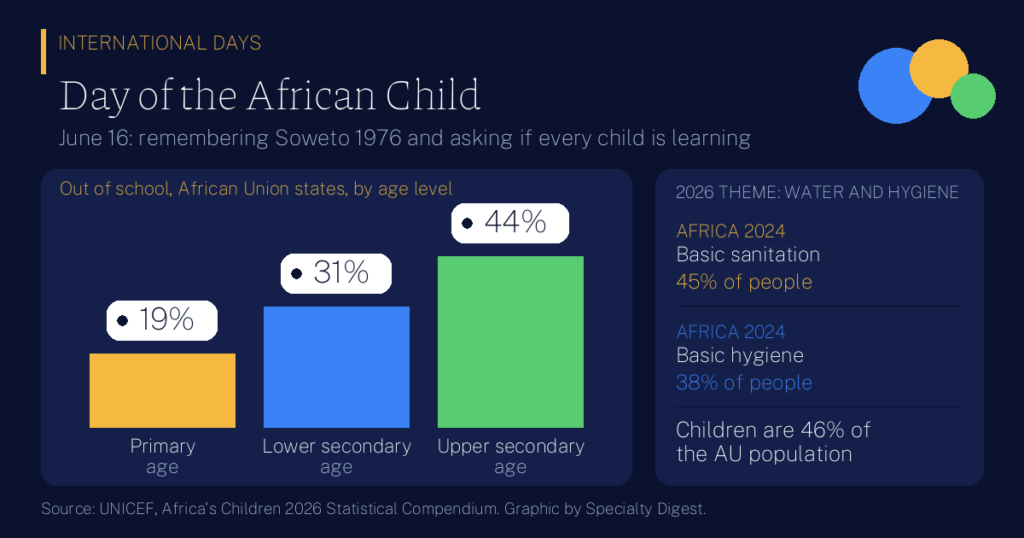
Africa is the youngest continent. UNICEF’s 2026 statistical compendium reports that in 2024 nearly 691 million children under 18 lived in African Union member states, around 46 percent of the AU population. Decisions about schools, clinics and water systems are therefore decisions about almost half the people.
- 691 millionchildren under 18 in AU member states, 2024
- 46%of the AU population is under 18
- 48articles in the African Charter
- 99%of children worldwide face at least one climate hazard, UNICEF 2026
Education was the spark in 1976, and it remains the clearest gap. In the same compendium, the out-of-school rate for AU states is 19 percent at primary age, 31 percent at lower secondary age and 44 percent at upper secondary age, using the latest available data for each country. The world averages are 10, 15 and 31 percent. The gap is wide at every level, and it grows as children get older.
Example 1: a class that thins out. Picture 100 children of each age group in a district that matches the AU averages. About 81 of the primary-age group are in school, 69 of the lower secondary group and 56 of the upper secondary group. The numbers are round and illustrative, but they show how a classroom can lose nearly half its students as they move toward the final years.
Water, sanitation and hygiene: the 2026 theme
The 2026 theme is “Ensuring universal access to water, sanitation, and hygiene for every child in Africa.” The ACERWC links it to the African Union’s 2026 Theme of the Year on water and sanitation. The compendium gives the starting point. In 2024, at least basic drinking water reached 71 percent of people in Africa, basic sanitation 45 percent and basic hygiene 38 percent. In schools, the 2023 figures were 49 percent for basic drinking water, 57 percent for basic sanitation and 42 percent for basic hygiene.
Why does this belong in a children’s day? A child with no water at school cannot wash hands, and a child with no private toilet may stay home. For girls, the effect can be especially strong, a pattern UN agencies describe in many countries. The story is also about climate. UNICEF’s 2026 report finds that nearly 99 percent of children worldwide are exposed to at least one climate hazard, and floods and droughts strike water and sanitation first. In Burundi, UNICEF reported that in 2025 it helped connect 74 schools and 34 health centers to drinking water networks, a sign of what targeted investment can do.
Example 2: the water walk. Suppose a child walks 30 minutes each way to fetch water before school, five days a week for 40 school weeks. That is about 200 hours a year, roughly 25 eight-hour days of time that could go to study or rest. The figures are round and illustrative, not a national average.
Example 3: a school’s toilets. Imagine a school of 500 pupils with 10 latrines, or one for every 50 children. If half are broken and nobody is paid to fix them, five latrines serve 100 pupils each. The numbers are made up for illustration, but they show why budgets must include upkeep, not only construction.
A theme for every year
The yearly themes read like a checklist of what a child needs: justice, protection, learning, a safe digital world and a fair share of public money.
- 2020Access to a child-friendly justice system in Africa
- 2022Eliminating harmful practices affecting children
- 2023The rights of the child in the digital environment
- 2024Education for all children in Africa: the time is now
- 2025Planning and budgeting for children’s rights
- 2026Universal access to water, sanitation and hygiene
How the day is marked
Governments, schools, civil society and UN agencies hold events on June 16, often with children speaking for themselves. The day also reaches well beyond education. Past themes have covered justice, harmful practices and digital safety, which shows how a child’s rights depend on one another. A useful way to take part is to ask local leaders what the year’s theme means in your own district. If a child is in danger, contact local child protection services or a national child helpline.
Key Takeaways
- The day honors Soweto. It remembers the students who marched on June 16, 1976, and was instituted in 1991.
- It has a legal backbone. The African Charter was adopted in 1990 and entered into force on November 29, 1999.
- Africa is young. Nearly 691 million children lived in AU member states in 2024.
- Schooling still thins out. Out-of-school rates rise from 19 percent at primary age to 44 percent at upper secondary age.
- Water is the 2026 focus. Basic sanitation reached 45 percent of people in 2024, and hygiene 38 percent.
- Children shape the agenda. Themes come from consultations with children, so your questions to leaders matter.
How solid is this? The statistics are regional estimates from UNICEF’s Africa’s Children 2026 compendium, covering AU member states, and the out-of-school figures use the latest year available for each country, so years differ. The three worked examples use round, made-up numbers to show an idea. See also World Water Day, the International Days hub and the International Days Calendar.
More in Society
- ACERWC, About the Day of the African Child
- ACERWC, Day of the African Child themes
- ACERWC, Day of the African Child 2026
- ACERWC, Charter ratifications (adoption and entry into force)
- UNICEF Ghana, Everything You Need to Know About the Day of the African Child
- UNICEF, Africa’s Children 2026: Statistical Compendium
- UNICEF Burundi, Day of the African Child 2026