A family’s moving pictures once meant a roll of film and a projector. Today they are files, and in between sit film reels, magnetic tapes and wax cylinders, many of them quietly falling apart. World Day for Audiovisual Heritage, observed every year on October 27, asks the world to notice what is at stake: the recorded sound and moving images that hold the voices, faces, music and events of more than a century. Unlike a book, a recording cannot be read without a machine, and when the machine or the medium fails, the memory goes with it. The day is a close cousin of the International Day for Universal Access to Information, because a recording nobody can play is information nobody can reach.
Why October 27
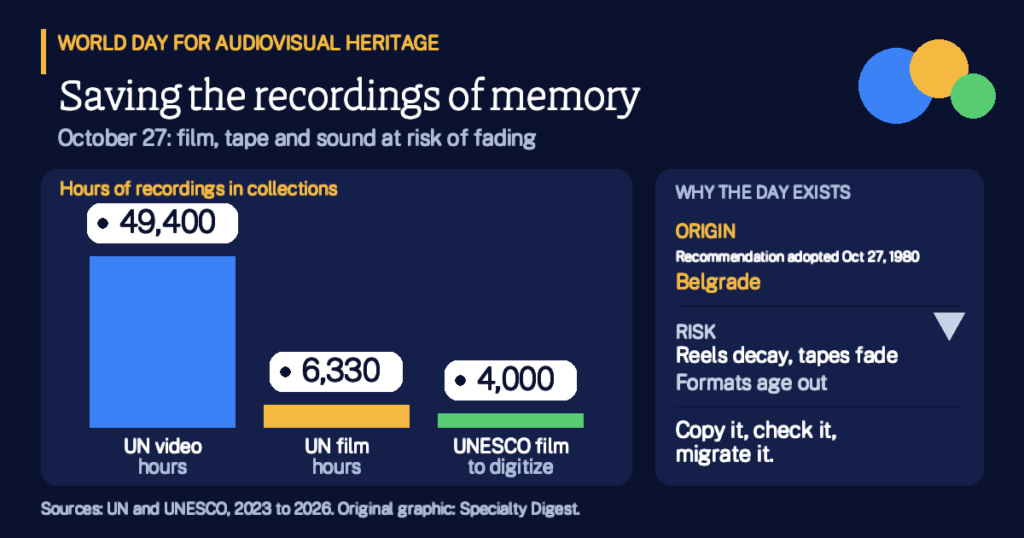
The date comes from a document, not a famous recording. On October 27, 1980, in Belgrade, the 21st session of UNESCO’s General Conference adopted the Recommendation for the Safeguarding and Preservation of Moving Images. Its preamble warned that many elements of the moving image heritage have disappeared due to deterioration, accident or unwarranted disposal. A recommendation is guidance rather than a binding treaty, but it put the problem on the international agenda.
Later, the General Conference at its 33rd session adopted 33 C/Resolution 53, proclaiming October 27 as World Day for Audiovisual Heritage in commemoration of that 1980 text. UN materials describe the anniversary as a timely opportunity to launch a movement, and UNESCO called October 27, 2025 the 20th anniversary of the day. The wider effort sits inside UNESCO’s Memory of the World Programme, created in 1992, and its 2015 Recommendation concerning the preservation of, and access to, documentary heritage including in digital form.
What counts as audiovisual heritage
Audiovisual heritage means recorded sound and moving images: film, radio and television programs, field recordings, music, home video and born-digital video. It includes the grand and the humble, from a national broadcaster’s news archive to a village elder’s recording of a song. What unites them is fragility. UNESCO puts it plainly: film reels decay, tapes demagnetize and digital formats quickly become obsolete. Acetate film can suffer what archivists call vinegar syndrome, a chemical breakdown, and older nitrate film calls for specialized storage.
Notice that digital is not a cure. A file stored on a drive nobody maintains, in a format no software opens, is as lost as a cracked reel. Preservation is a continuing job.
Example 1: the shelf of tapes. Suppose a community radio station holds 1,000 tapes of interviews from the 1990s. Imagine staff test a sample and find that one in five no longer plays cleanly. That would mean about 200 recordings at risk, each one a local voice that cannot be re-recorded. The numbers are round and illustrative, but the logic is real: the longer the wait, the more tapes fail, and copying a tape in time costs far less than losing it.
The numbers behind the day
Be careful with numbers here. The sources used for this article give no single global count of lost recordings, so none is quoted. What can be cited is the scale of specific collections. In 2023, UNESCO Archives estimated that about 4,000 hours of moving images on about 12,500 reels of 16 mm and 35 mm film remained undigitized. The UN’s observance page reports that the UN Audiovisual Library holds over 6,330 hours of historical film and 49,400 hours of video. And in 2026, UNESCO described work to preserve and digitize approximately 45,000 analogue tape recordings from Radio Mogadishu in Somalia.
- 12,500film reels at UNESCO Archives awaiting digitization, 2023 estimate
- 45,000analogue tapes in the Radio Mogadishu preservation work, 2026
- Nearly 300wax-cylinder recordings in Sweden’s Karl Tirén joik collection
- 1,700+hours in the Philippines’ José Maceda Collection
Each figure marks a place where someone decided that saving the record was worth the effort.
Example 2: the digitizing queue. Take UNESCO Archives’ 4,000 hours. If a team could digitize 10 hours of film in a working day, an assumed round figure, the job would take 400 working days, about a year and a half of full-time work, before cataloging and storage. Real speeds vary with the condition of the film, but the arithmetic shows why backlogs last for years.
Why it matters: stories only these records tell
Recordings carry what documents cannot: a voice, an accent, a laugh, a ritual performed exactly as it was. UNESCO’s 2025 observance highlighted examples. In Sweden, the Karl Tirén collection holds nearly 300 wax-cylinder recordings of joik, the traditional Sami song. In the Philippines, the José Maceda Collection spans over 1,700 hours. And of the 1906 film The Story of the Kelly Gang, only 17 minutes survive, a reminder of how thin the record of early cinema can be.
Recordings also serve as evidence and public memory. Broadcast archives show how a nation covered its own history, and UNESCO’s 2026 observance described archives such as ZNBC in Zambia as threatened by natural disasters, unfavorable storage conditions and outdated formats. A flooded storeroom does not tell a famous speech from an ordinary day.
Who risks being left behind
Wealthy institutions can afford climate-controlled vaults and digitizing labs. Many public broadcasters, community stations and small archives cannot, and they may hold copies that exist nowhere else. The cases UNESCO has highlighted, such as Radio Mogadishu and the Zambian broadcaster, show where the gaps are. The danger is quiet: nobody notices a loss until someone asks to hear the recording.
How the day is marked, and what progress needs
Events are shared by UNESCO field offices and the Coordinating Council of Audiovisual Archives Associations (CCAAA), which brings archive associations together. Activities include screenings, exhibitions and talks; in 2025, UNESCO Archives and CCAAA hosted a special film screening. The theme has stayed close to one image in recent years, that of a window.
- 2020Your Window to the World
- 2023Your Window to the World
- 2025A Window to the World
- 2026Your Window to the World
Progress needs money for digitizing, people with the skills to do it, and policies that treat recordings as heritage worth keeping. Individuals can help too. Gather family tapes and films, label who and when, and copy them to at least two places before the player breaks.
Example 3: a family archive. Imagine a household with 30 old camcorder tapes of about one hour each. Suppose a digitizing service charged $25 a tape, an assumed price. The total would be $750 for 30 hours of memories, plus a little for storage on two separate drives. The numbers are round and illustrative, yet the cost is modest next to the cost of the memories failing.
Key Takeaways
- The date comes from a 1980 document. October 27 marks the adoption of UNESCO’s Recommendation for the Safeguarding and Preservation of Moving Images.
- Every medium is fragile. Film reels decay, tapes demagnetize and digital formats become obsolete.
- Digital is not a final answer. Files need copying, checking and migrating to stay readable.
- Backlogs are large. UNESCO Archives alone estimated about 4,000 hours of film still to digitize in 2023.
- Stories can survive in fragments. Of the 1906 film The Story of the Kelly Gang, only 17 minutes remain.
- Anyone can act. Label and copy family tapes to two places before the player fails.
How solid is this? Figures are those reported by UNESCO and the United Nations, with the year given where the source gives one; the UN Audiovisual Library numbers are undated on the UN page. No global estimate of lost recordings is quoted because none was found in the sources. The three worked examples use round, made-up numbers to show an idea. See also the International Days hub and the International Days Calendar.
More in History
- United Nations, World Day for Audiovisual Heritage
- UNESCO, World Day for Audiovisual Heritage
- UNESCO, World Day for Audiovisual Heritage: Protecting memory at risk (2025)
- UNESCO, World Day for Audiovisual Heritage celebrates a living window to the world (2026)
- UN Chronicle, A Disappearing World: The Fight to Save Our Audiovisual Heritage (2023)
- UNESCO Legal Affairs, Recommendation for the Safeguarding and Preservation of Moving Images (1980)