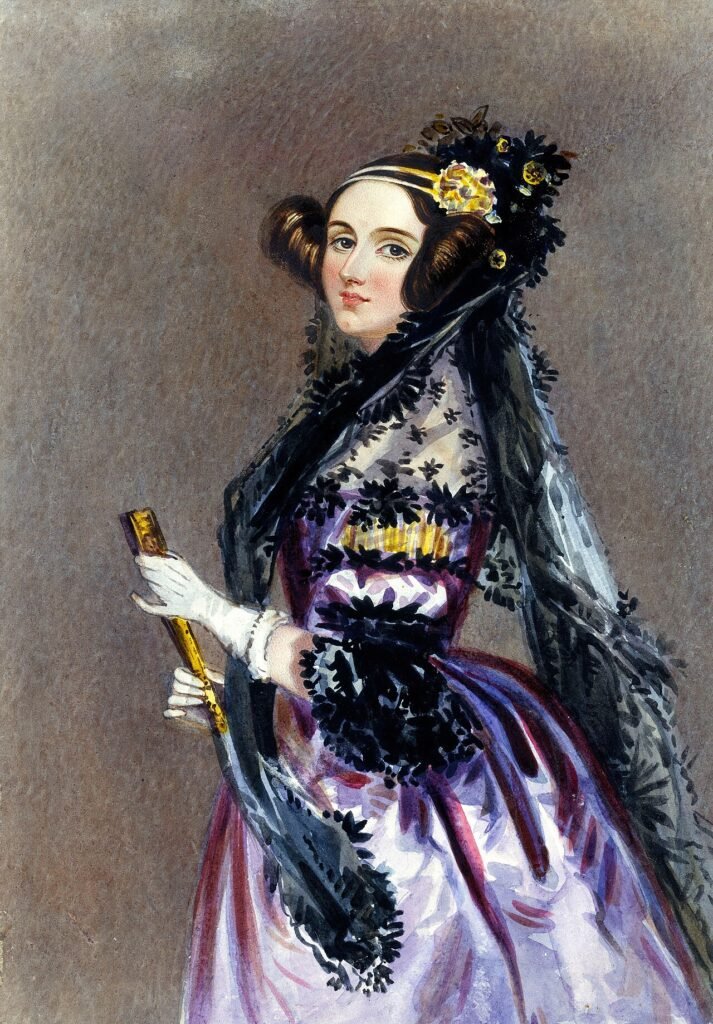
Ada Lovelace (1815 to 1852), born Augusta Ada Byron, was an English mathematician best known for her 1843 notes on Charles Babbage’s proposed Analytical Engine. The notes are widely cited as an early description of how a general-purpose computer could be given instructions. She was the only legitimate child of the poet Lord Byron.
Early life of Ada Lovelace
Ada was born in December 1815. Her parents, Lord Byron and Annabella Milbanke, had married in January 1815 and separated a month after she was born. Byron left England in April 1816, and Ada never saw her father again.
Her mother had sole custody, and Ada was made a ward in Chancery in 1817. Lady Byron tried to raise her daughter so that she would not become a poet like her father, and she steered her toward mathematics and science. Ada was taught by private tutors, including William King, who was hired in 1829, and she suffered poor health, including a bout of measles in that year. Advanced mathematics was an unusual course of study for a young woman of her time, so her progress depended on private tutors and on friends such as Somerville.
In 1833 she was presented at court, and on June 5 that year she met Charles Babbage at a party. In 1834 she met the mathematician Mary Somerville, who sent her books, set her problems and talked with her about mathematics. On July 8, 1835, she married William King, who became Earl of Lovelace in 1838, making her the Countess of Lovelace. They had three children. In 1841 she began more advanced study with Augustus De Morgan.
Because Lady Byron controlled her education, Ada’s training reflected her mother’s wishes, at least in part, as well as her own early interests.
Career and major work of Ada Lovelace
Babbage showed Ada a small working section of his calculating engine soon after they met, and she was fascinated. Ten years later she turned that interest into her best-known work. Babbage had designed the Analytical Engine, a proposed mechanical machine that could be set to carry out different calculations and was never completed. Babbage planned to control it with punched cards, a technique already used to direct patterns in weaving looms.
An Italian engineer, Luigi Menabrea, had written an article in French in 1842 describing the Analytical Engine. In 1843 Lovelace published an English translation, and she added extensive notes of her own. The work appeared in Richard Taylor’s Scientific Memoirs, volume 3, and the author was given only as AAL. The notes were a substantial addition to the translation, explaining what the engine was, what it might do and how its operations could be arranged.
Her later years were marked by illness. She fell out with her mother around 1850 after discovering that her mother had misled her for years about her father. In January 1852 she was in great pain from cancer, and she died in 1852, still in her thirties.
Ideas and contributions of Ada Lovelace
The Analytical Engine was designed to be general purpose, meaning it could be given different sets of instructions instead of being built for a single calculation. The Computer History Museum presents Lovelace’s notes as a key early statement of this idea. The notes describe how the engine could be directed through a sequence of operations, which is why people often call her an early programmer.
Her notes also considered what such a machine could and could not do. She argued that it could carry out only what it was instructed to do, which later writers called Lovelace’s objection. Alan Turing discussed this point in 1950 when he asked whether machines can think, so her remark became part of the debate about artificial intelligence.
She also suggested that such a machine might one day work on symbols other than numbers, for example musical notes. That speculation anticipates the many uses of computers beyond arithmetic, from text and images to sound.
Her work also shows the idea of an algorithm as a step-by-step procedure that a machine can follow. In her notes, planning the order of operations is a distinct skill, separate from building the hardware.
How much did Lovelace contribute?
Historians disagree about how to weigh her contribution. Babbage worked closely with her and had designed the engine, and some scholars argue that much of the technical content reflects his ideas. Others point to her own mathematical training, her careful reading of the machine and her willingness to publish a bold argument under her initials.
Because her work survives in print, historians can compare her notes with Menabrea’s article and with Babbage’s own papers, and that comparison is the main way the authorship debate is studied. Because the Analytical Engine was never built, none of the programs in her notes could be run in her lifetime. Her work is therefore valued as an early statement of ideas that were realized much later, not as a record of working software. Readers should treat the title of first programmer as a popular summary rather than a settled historical judgment.
Legacy of Ada Lovelace
Some of her letters have been collected and published in book form, which lets readers study her own words about the engine and about mathematics.
Lovelace died young, and her notes received little attention for decades. In the twentieth century computing pioneers and historians rediscovered them, and her reputation grew. A modern programming language named Ada, developed for the U.S. Department of Defense, honors her.
She is now a symbol for women in science and technology, and many schools and events carry her name.
More in Computer Science
Key facts
- Ada Lovelace was born Augusta Ada Byron in December 1815, the only legitimate child of the poet Lord Byron and Annabella Milbanke, and died in 1852.1
- She met Charles Babbage on June 5, 1833, and was entranced by a demonstration of a small working section of his calculating engine.1
- She married William King on July 8, 1835, and became Countess of Lovelace when he was created an earl in 1838.1
- In 1843 she published an annotated translation of Luigi Menabrea's article on Babbage's Analytical Engine, signed AAL.1
- Her notes were published in Richard Taylor's Scientific Memoirs, volume 3.1
Related concepts
Quick checkWhy is Ada Lovelace called the first computer programmer?Show answer
Her 1843 notes on Babbage's Analytical Engine described how the machine could be given a sequence of instructions, which is why she is often called an early programmer. Historians still debate how much of the technical content was hers and how much came from Babbage.
Sources
- MacTutor History of Mathematics, University of St Andrews, Augusta Ada King, Countess of Lovelace, https://mathshistory.st-andrews.ac.uk/Biographies/Lovelace/
- Computer History Museum, Babbage's Engine: Ada Lovelace, https://www.computerhistory.org/babbage/adalovelace/
Editorially reviewed by Specialty Digest Editorial TeamLast reviewed November 4, 2026Researched and drafted with AI assistanceReport an issue