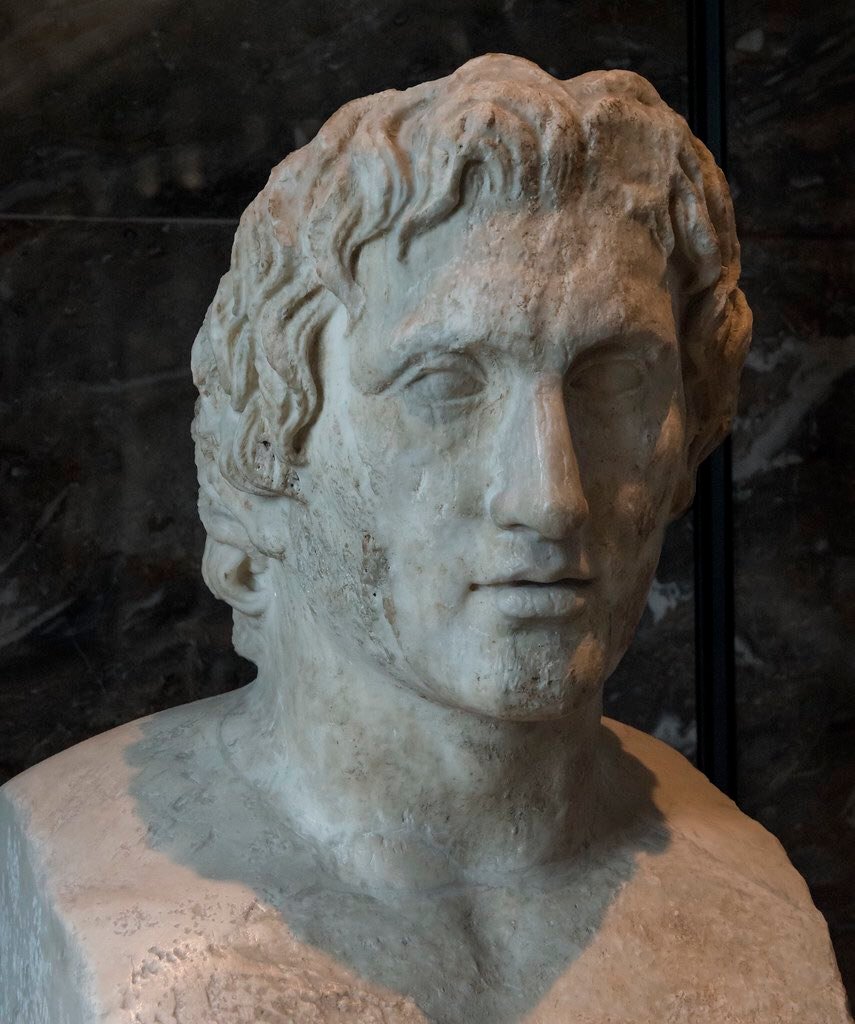
Alexander the Great, or Alexander III of Macedon, was a king who lived from 356 BCE to 323 BCE and conquered the Persian Empire. Beginning as king of Macedonia in 336 BCE, he led his army through Anatolia, Egypt, Mesopotamia and Persia to the Indus valley before his death in Babylon. His campaigns spread Greek culture across a vast area and helped begin the Hellenistic period.
Early life of Alexander the Great
Alexander was born on 21 July 356 BCE, according to the World History Encyclopedia. He was the son of King Philip II of Macedon, who had turned a weaker kingdom into a strong state with a powerful army. At the age of about 13 or 14 he began to study with Aristotle, whom Philip hired as his tutor. The World History Encyclopedia says he studied with the philosopher until the age of 16.
Among his childhood friends were Ptolemy, Cassander and Hephaestion, who later became his generals and companions. He is said to have tamed the horse Bucephalus as a boy of 11 or 12. Another companion, the historian Callisthenes, a great-nephew of Aristotle, later joined the army as court historian. In 336 BCE Philip was assassinated, and Alexander took the throne.
Career and major work of Alexander the Great
Alexander crossed into Asia Minor in 334 BCE with about 32,000 infantry and 5,100 cavalry, and defeated Persian satraps at the Battle of the Granicus River in May. In 333 BCE he defeated the larger army of King Darius III at the Battle of Issus. He then turned south, and in 332 BCE besieged the city of Tyre, building a causeway from the mainland to reach it. The World History Encyclopedia reports that the survivors were sold into slavery after the city fell.
In 331 BCE Alexander took Egypt and founded the city of Alexandria. At the oasis of Siwa he was proclaimed a son of the god Zeus-Ammon. He then met Darius again at Gaugamela, east of the Tigris, and defeated him. According to Livius.org, the Babylonian Astronomical Diary records that Darius was abandoned by his own men.
Alexander entered Babylon and Susa, and in the winter of 330 BCE he fought his way through the Persian Gates, a pass in the Zagros mountains, and reached Persepolis. His army sacked the Persian capital, and the palace was burned. Darius was killed that year by his own officers during his flight. In the following years Alexander campaigned in Bactria and Sogdia, where he founded another city named Alexandria on the Iaxartes River in 329 BCE.
In the spring of 326 BCE he crossed the Indus and defeated King Porus at the river Jhelum, known as the Battle of the Hydaspes. He wanted to continue east and crossed two more rivers, but Livius.org reports that his soldiers refused to go any farther. Alexander gave way and turned back, leading the army toward Babylon.
Ideas and contributions of Alexander the Great
Alexander is known for his military skill and his attempts to govern a vast area made up of different peoples. The World History Encyclopedia says that he did not impose Greek ideas on conquered peoples but allowed local customs to continue. He founded new cities, several named Alexandria, which became centers of trade and learning. The World History Encyclopedia credits him with both military genius and diplomatic skill in handling the peoples he conquered, and says his campaigns carried Greek culture, language and thought from Asia Minor and Egypt to Mesopotamia and India.
Livius.org describes how, in the second half of his reign, Alexander made Babylon his capital and adopted Persian court ceremony. These changes caused tension with his Macedonian and Greek officers, who disliked the new customs. His interest in learning reflected Aristotle’s influence. According to Worthington, quoted by the World History Encyclopedia, Alexander carried an edition of Homer prepared by Aristotle and tried to record what he learned on his campaigns as scientifically as possible.
Death of Alexander the Great
Hephaestion, Alexander’s closest friend, died at Ecbatana in October of 324 BCE, according to Livius.org. Alexander himself died in Babylon on 10 or 11 June 323 BCE, at the age of 32. The World History Encyclopedia says the cause of death is unknown, and that he left no clear successor. Historians have suggested illness or poison, but the evidence does not support a firm conclusion.
Legacy of Alexander the Great
After his death, his generals, known as the Diadochi, divided his empire and fought for supremacy. They continued to blend Greek culture with that of the Near East, and the period from 323 to 31 BCE is known as the Hellenistic Period. One of his generals, Ptolemy, founded the dynasty that would later produce Cleopatra.
Cities he founded, especially Alexandria in Egypt, remained important for centuries. His conquests also extended Greek language and thought from Asia Minor and Egypt to Mesopotamia and India.
Controversies and criticism of Alexander the Great
The World History Encyclopedia notes that modern writers have taken a more critical approach to Alexander than earlier ones. Critics point to the destruction of Persepolis and the treatment of the people of Tyre, many of whom were killed or enslaved. Livius.org states that on more than one occasion Alexander massacred people who had already surrendered, and that he also killed the Cossaeans, a mountain tribe, after Hephaestion’s death.
Sources also disagree about details. Accounts of the fire at Persepolis differ about who started it and why, and ancient writers did not agree on the cause of his death. Many of the surviving histories were written centuries later, so historians treat them with care.
More in History
Key facts
- Alexander was born on 21 July 356 BCE and died on 10 or 11 June 323 BCE in Babylon.1
- He became king of Macedonia in 336 BCE after the assassination of his father, Philip II.1
- He crossed into Asia Minor in 334 BCE and defeated Darius III at Issus in 333 BCE and Gaugamela in 331 BCE.1
- His soldiers refused to go farther east after the Battle of the Hydaspes in 326 BCE.2
- After his death his generals, the Diadochi, divided the empire and began the Hellenistic Period.1
Related concepts
Quick checkHow did Alexander the Great die?Show answer
He died in Babylon in June 323 BCE at the age of 32. The cause is unknown, and historians have suggested illness or poison without firm evidence.
Sources
- World History Encyclopedia, Alexander the Great, https://www.worldhistory.org/Alexander_the_Great/
- Livius.org, Alexander the Great, https://www.livius.org/articles/person/alexander-the-great/
Editorially reviewed by Specialty Digest Editorial TeamLast reviewed November 4, 2026Researched and drafted with AI assistanceReport an issue