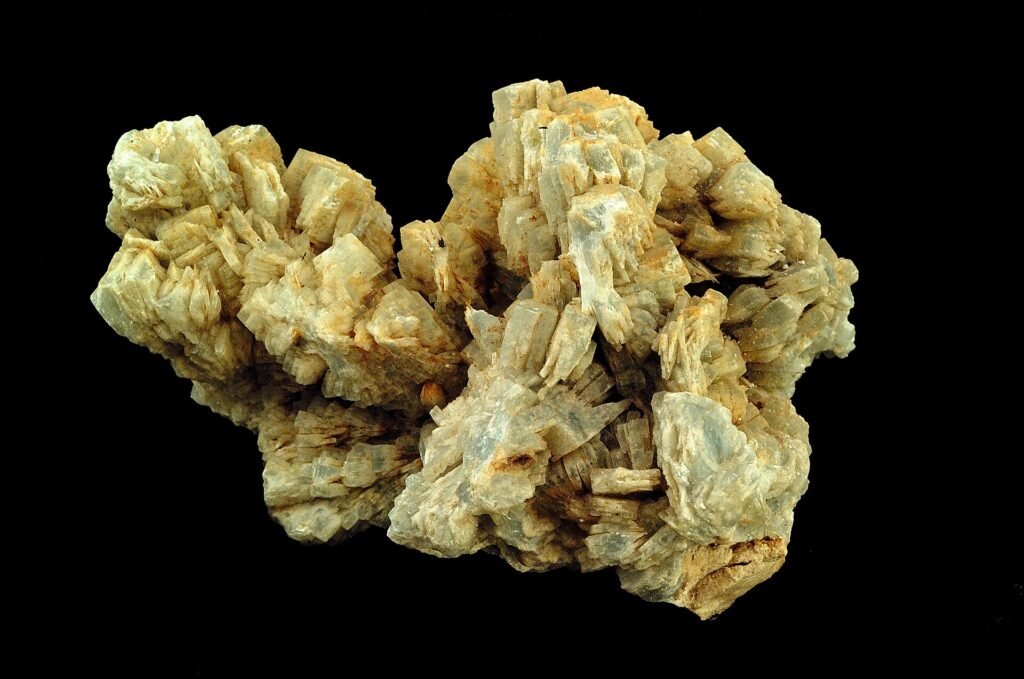
Barium is the chemical element with atomic number 56 and the symbol Ba. It is a soft, silvery metal in the alkaline earth group that tarnishes rapidly in air and reacts with water. Barium never occurs uncombined in nature, and its compounds are used in oil and gas drilling, glassmaking and medical X-ray imaging.
History of barium
In the early 1600s Vincenzo Casciarolo of Bologna, Italy, found some unusual pebbles. If they were heated to redness during the day, they would shine through the night. The pebbles were the mineral barite, which is barium sulfate (BaSO4), and they became known as Bologna stone.
When Carl Scheele investigated Bologna stone in the 1760s, he realized that it was the sulfate of an unknown element. Meanwhile the mineralogist William Withering had found another curiously heavy mineral in a lead mine in Cumberland, England, which was clearly not a lead ore. He named it witherite, and it was later shown to be barium carbonate (BaCO3).
Neither the sulfate nor the carbonate would give up the metal by the conventional method of smelting with carbon. Humphry Davy at the Royal Institution in London finally produced barium in 1808 by the electrolysis of barium hydroxide. Electrolysis uses an electric current to force a chemical change that heating alone cannot bring about.
The case of barium shows how a mineral can be known for centuries before the element inside it is understood. Casciarolo found his glowing pebbles in the early 1600s, the sulfate was linked to an unknown element in the 1760s, and the metal itself was not isolated until 1808.
Properties of barium
PubChem, drawing on IUPAC data, gives barium a standard atomic weight of 137.33. Its electron configuration is [Xe] 6s2, meaning that outside a filled core it has just two outer electrons, and these are easily lost. Barium sits in group 2 and period 6 of the periodic table. Its only common oxidation state is +2, the charge it carries in compounds after both outer electrons have been given away.
Barium is a solid at room temperature with a density of 3.62 grams per cubic centimeter. It melts at 1000 kelvin, which is about 727 degrees Celsius, and boils at 2170 kelvin, about 1897 degrees Celsius. The Royal Society of Chemistry describes it as a soft, silvery metal that rapidly tarnishes in air and reacts with water.
Barium has an electronegativity of 0.89 on the Pauling scale. That low value means its atoms attract electrons weakly, which fits their readiness to give electrons up. The first ionization energy, the energy needed to remove the first outer electron, is 5.212 electronvolts, or about 503 kilojoules per mole, and removing the second electron takes 965.223 kilojoules per mole. The non-bonded atomic radius is 268 picometers and the covalent radius is 206 picometers, so barium atoms are large.
These numbers explain much of barium’s behavior. Its two outer electrons are held loosely, so barium reacts readily with water and tarnishes quickly in air, and in compounds it is found as a positive ion with a charge of two.
Occurrence and production of barium
Barium occurs only in combination with other elements. The major ores are barite, which is barium sulfate, and witherite, which is barium carbonate. These are the same two minerals that figured in the discovery of the element.
Barium metal can be prepared by electrolysis of molten barium chloride, or by heating barium oxide with aluminum powder. In the second method the aluminum takes the oxygen from the oxide, leaving barium metal behind. Because the metal reacts with water and tarnishes quickly in air, the compounds are far more important than the metal itself.
Uses of barium
The Royal Society of Chemistry notes that barium is not an extensively used element. Most of it is used in drilling fluids for oil and gas wells. It is also used in paint and in glassmaking.
Medicine provides the best-known use. All barium compounds are toxic, but barium sulfate is insoluble and so can be safely swallowed. A suspension of barium sulfate is sometimes given to patients who suffer from digestive disorders, in a procedure called a barium meal or barium enema. Barium is a heavy element and scatters X-rays, so as the suspension passes through the body the stomach and intestines can be distinguished on an X-ray image.
Other compounds have narrower roles. Barium carbonate has been used in the past as a rat poison, and barium nitrate gives fireworks a green color. The contrast between harmless barium sulfate and the poisonous compounds that dissolve in water shows why chemists look at the compound and not just the element.
Isotopes of barium
Barium has seven naturally occurring isotopes. An isotope is a form of an element whose atoms have the same number of protons but different numbers of neutrons. The most abundant by far is barium-138, at 71.698 percent. Next come barium-137 (11.232 percent), barium-136 (7.854 percent), barium-135 (6.592 percent) and barium-134 (2.417 percent). Barium-130 and barium-132 are much rarer, at 0.106 percent and 0.101 percent.
The Royal Society of Chemistry lists the two rarest isotopes as radioactive. Barium-130 decays by double positron emission with a half-life, the time needed for half of a sample to decay, of 2.2 times 10 to the 21st years, and barium-132 decays by electron capture with a half-life of 1.3 times 10 to the 21st years. These half-lives are so long that natural barium is effectively stable.
Health and environmental effects of barium
Barium has no known biological role, although barium sulfate has been found in one particular type of algae. The Royal Society of Chemistry states that barium is toxic, as are its water-soluble or acid-soluble compounds.
In the body, the difference between a safe and a hazardous barium compound is whether it dissolves in the water or stomach acid it meets. Solubility therefore determines how a barium compound behaves in the body. Barium sulfate does not dissolve, which is the property that allows its use in X-ray imaging. This entry gives general background drawn from reference sources and is not advice.
More in Chemistry
Key facts
- Barium has atomic number 56, symbol Ba, and sits in group 2 and period 6 of the periodic table.2
- Barium occurs only in combination with other elements, mainly in the minerals barite and witherite.1
- Humphry Davy first produced barium metal in 1808 by electrolysis of barium hydroxide.1
- Most barium is used in drilling fluids for oil and gas wells.1
- Barium has seven naturally occurring isotopes, with barium-138 making up about 71.7 percent.1
Related concepts
Quick checkWhy can barium sulfate be swallowed safely when other barium compounds are toxic?Show answer
Barium sulfate is insoluble, so it passes through the digestive system without dissolving. Water-soluble and acid-soluble barium compounds are toxic.
Sources
- Royal Society of Chemistry, Periodic Table: Barium, https://periodic-table.rsc.org/element/56/barium
- National Center for Biotechnology Information, PubChem Periodic Table: Barium (element 56, including IUPAC-sourced atomic weight data), https://pubchem.ncbi.nlm.nih.gov/element/56
Editorially reviewed by Specialty Digest Editorial TeamLast reviewed November 4, 2026Researched and drafted with AI assistanceReport an issue