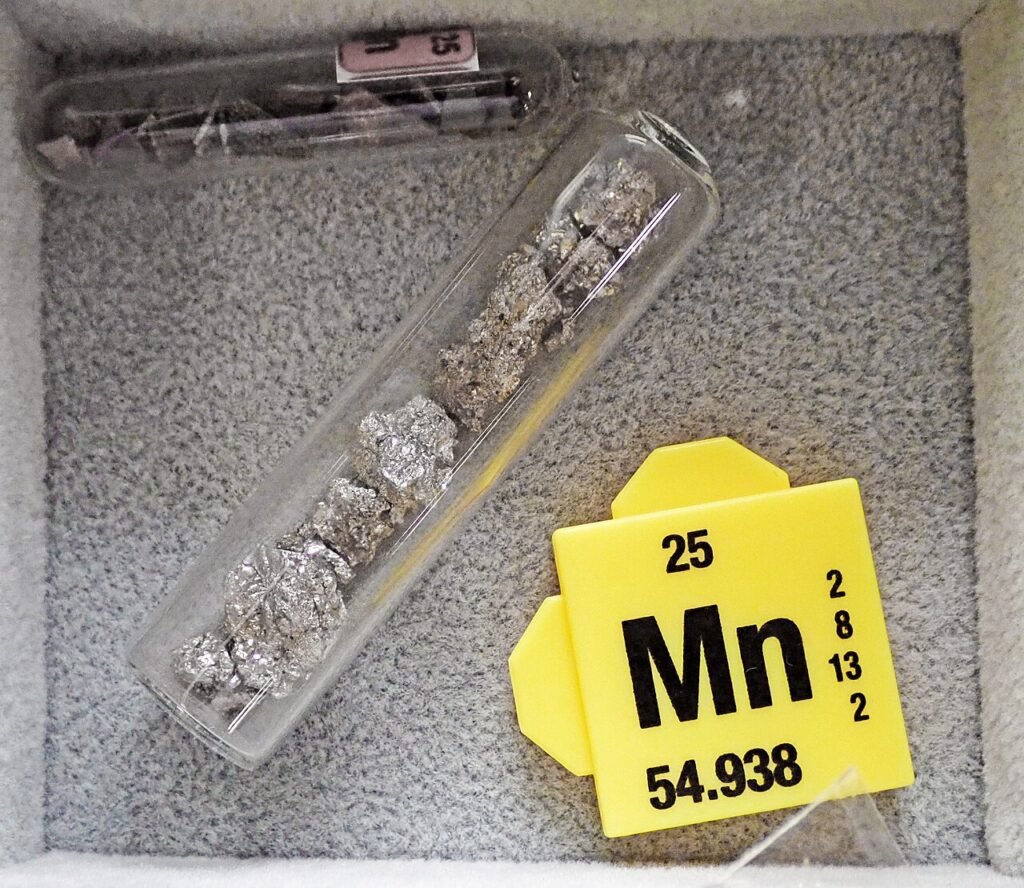
Manganese is the chemical element with atomic number 25 and the symbol Mn. It is a hard, brittle, silvery metal in group 7 of the periodic table, and almost all of it is used to make steel and other alloys. The element is also essential to living things, including humans.
History of manganese
People used manganese long before they knew it as an element. The black ore pyrolusite, which is manganese dioxide, was used by prehistoric cave painters in the Lascaux region of France around 30,000 years ago. In later centuries glassmakers used it to remove the pale greenish tint of natural glass.
In 1740 the Berlin glass technologist Johann Heinrich Pott investigated the ore chemically and showed that it did not contain iron, as had been assumed. From it he made potassium permanganate, one of the strongest oxidizing agents known. An oxidizing agent is a substance that readily takes electrons from other substances. Several chemists in the 1700s tried and failed to isolate the metal inside pyrolusite.
The Swedish chemist and mineralogist Johan Gottlieb Gahn is credited with being the first to do so, in 1774. The Royal Society of Chemistry adds that Ignatius Kaim, a student in Vienna, had already described making manganese metal in a dissertation written in 1771. The origin of the name is uncertain. It may come from the Latin word magnes, meaning magnet, or from magnesia nigra, the old name for the black ore.
Properties of manganese
Manganese has a standard atomic weight of about 54.938, and NIST lists it as 54.938044 with an uncertainty of 3 in the last digit. A manganese atom has 25 protons and an electron configuration of [Ar] 4s2 3d5, meaning the arrangement of argon plus two electrons in the 4s level and five in the 3d level.
At room temperature manganese is a solid with a density of 7.3 grams per cubic centimeter. PubChem gives a melting point of 1,519 kelvins, about 1,246 degrees Celsius, and a boiling point of 2,334 kelvins, about 2,061 degrees Celsius. In its pure form the metal is hard but brittle, and the Royal Society of Chemistry says it is too brittle to be of much use on its own.
Manganese is a transition metal that shows an unusually wide range of oxidation states, listed by PubChem as plus 7, plus 4, plus 3 and plus 2. An oxidation state is a number that tracks how many electrons an atom has lost or shared in a compound. PubChem also records an electronegativity of 1.55 on the Pauling scale, a first ionization energy of 7.434 electronvolts and an atomic radius of 197 picometers.
PubChem classes manganese as a transition metal. Because its atoms can lose different numbers of electrons, it forms compounds as different as the black ore manganese dioxide, in which manganese has an oxidation state of plus 4, and potassium permanganate, in which it is plus 7.
Occurrence and production of manganese
Manganese is the fifth most abundant metal in the Earth’s crust, and its minerals are widely distributed. The most common are pyrolusite, which is manganese dioxide, and rhodochrosite, which is manganese carbonate. The main mining areas are in China, Africa, Australia and Gabon.
The metal is obtained by reducing the oxide with sodium, magnesium or aluminum, or by the electrolysis of manganese sulfate. Reduction means removing oxygen from a compound, and electrolysis uses an electric current to drive a chemical change in a solution.
Manganese is also found far from any mine. Nodules of manganese minerals lie on the floor of the oceans, and they contain about 24 percent manganese along with smaller amounts of many other elements.
Pyrolusite, the same black ore that Lascaux painters used, remains one of the two most common manganese minerals today, which links the oldest use of the element to the newest.
Uses of manganese
Manganese is mainly used in alloys, especially steel. Ordinary steel contains about 1 percent manganese, which increases its strength and improves how easily it can be worked and how well it resists wear. Manganese steel contains about 13 percent manganese. It is extremely strong and is used for railway tracks, safes, rifle barrels and prison bars.
Drinks cans are made of an aluminum alloy that contains 1.5 percent manganese, which improves resistance to corrosion. Manganese forms highly magnetic alloys with aluminum, antimony and copper.
Several compounds have their own uses. Manganese(IV) oxide serves as a catalyst, as a rubber additive and as a way to remove the green color that iron impurities give to glass. Manganese sulfate is used to make a fungicide. Manganese(II) oxide is used in quantitative analysis, and it is also used to make fertilizers and ceramics.
Isotopes of manganese
NIST lists a single stable isotope for manganese, manganese-55, which makes up all of the natural element. An isotope is a form of an element with a particular number of neutrons, and the 55 is the combined count of protons and neutrons. Elements with one natural isotope are called monoisotopic. Because of this, the standard atomic weight of manganese is simply the mass of a single manganese-55 atom, about 54.93804.
Manganese in life and the environment
Manganese is an essential element in all known living organisms, and many enzymes contain it. One example is the enzyme that converts water molecules to oxygen during photosynthesis, which contains four manganese atoms. Some soils are low in manganese, so it is added to certain fertilizers and given as a food supplement to grazing animals.
The average human body contains about 12 milligrams of manganese. People take in about 4 milligrams a day from foods such as nuts, bran, whole-grain cereals, tea and parsley. The Royal Society of Chemistry notes that without it bones grow spongier and break more easily, and that it is also needed to make use of vitamin B1. The information here is general background rather than health advice.
Key facts
- Manganese has atomic number 25, symbol Mn, and sits in group 7 and period 4 of the periodic table.1
- Johan Gottlieb Gahn is credited with first isolating manganese metal in 1774.12
- Manganese is a solid at room temperature with a density of 7.3 grams per cubic centimeter.2
- Manganese has one stable isotope, manganese-55, so it is a monoisotopic element.3
- Manganese is the fifth most abundant metal in the Earth crust, and its most common minerals are pyrolusite and rhodochrosite.1
In the news
Quick checkWhat is manganese mainly used for?Show answer
Manganese is mainly used in alloys. Steel contains about 1 percent, manganese steel about 13 percent, and aluminum drinks cans about 1.5 percent manganese.
Sources
- Royal Society of Chemistry, Periodic Table: Manganese, https://periodic-table.rsc.org/element/25/manganese
- National Center for Biotechnology Information, PubChem Periodic Table: Manganese, https://pubchem.ncbi.nlm.nih.gov/element/25
- National Institute of Standards and Technology, Atomic Weights and Isotopic Compositions for Manganese, https://physics.nist.gov/cgi-bin/Compositions/stand_alone.pl?ele=Mn
Editorially reviewed by Specialty Digest Editorial TeamLast reviewed November 4, 2026Researched and drafted with AI assistanceReport an issue