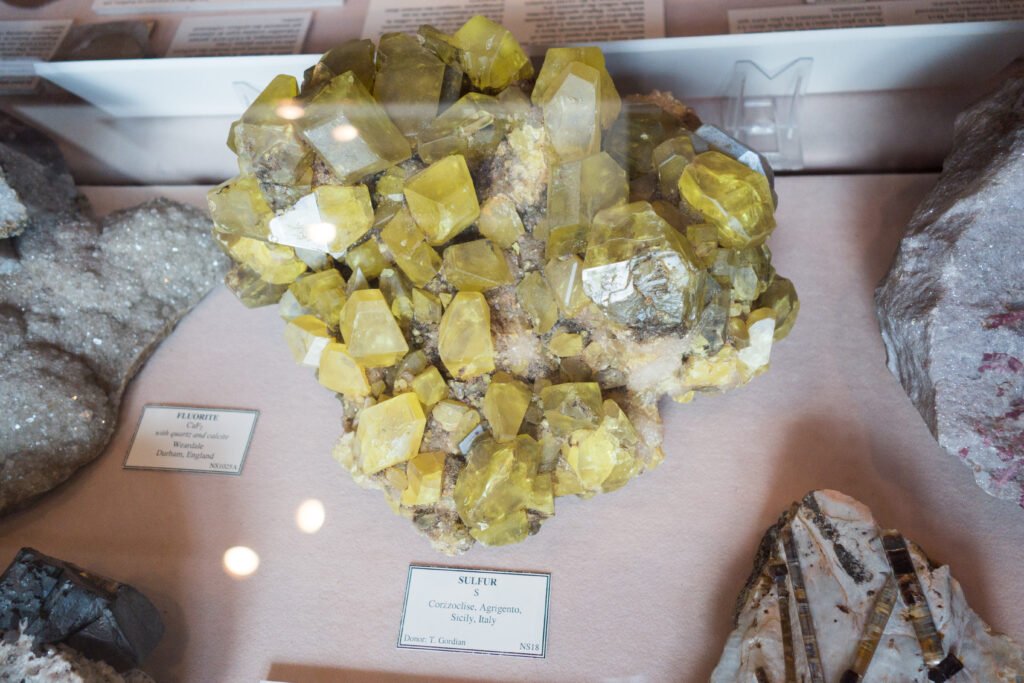
Sulfur is the chemical element with atomic number 16 and the symbol S. It is a bright yellow, brittle nonmetal in group 16 of the periodic table, found as crystals or powder at room temperature. Sulfur has been known since ancient times, and today most of it is used to make sulfuric acid.
History of sulfur
Sulfur is one of the few elements known since prehistoric times, and no single discoverer is recorded. It is mentioned about 15 times in the Bible, most famously in the account of the destruction of Sodom and Gomorrah. The ancient Greeks burned it as a fumigant.
Sulfur was mined near Mount Etna in Sicily and used to bleach cloth and to preserve wine. Both uses depended on burning it to form sulfur dioxide gas, which was absorbed by wet cloth or by grape juice. For centuries sulfur, together with mercury and salt, was believed to be a component of all metals, and this idea underpinned alchemy.
Antoine Lavoisier thought that sulfur was an element. In 1808 Humphry Davy claimed it contained hydrogen, but his sample was impure. The following year Louis-Joseph Gay-Lussac and Louis-Jacques Thénard showed it to be an element, and Davy eventually agreed. The Royal Society of Chemistry says the name comes either from a Sanskrit word or from the Latin sulfurium.
Properties of sulfur
Sulfur has a standard atomic weight of about 32.06, which IUPAC gives as an interval because natural samples vary slightly. Its electron configuration is [Ne] 3s2 3p4, so an atom needs two more electrons to fill its outer shell. Its common oxidation states are minus 2, +4 and +6, and PubChem lists an electronegativity of 2.58.
Sulfur melts at about 115 degrees Celsius and boils at about 445 degrees Celsius. Its density is around 2.07 grams per cubic centimeter. The element has many allotropes, which are different structural forms of the same element. The most familiar are alpha sulfur, with an orthorhombic crystal form, and beta sulfur, which is monoclinic. Both are built from crown-shaped rings of eight atoms, written S8.
Sulfur is a poor conductor of heat and electricity. When it burns in air it produces a blue flame and sulfur dioxide, a choking gas. It reacts with most metals to form sulfides, and the same type of chemistry explains why silver tarnishes and why many ores are sulfide minerals.
Occurrence and production of sulfur
Sulfur occurs naturally as the free element, often around volcanoes and hot springs, and this was once the main source for human use. It is also widely found in minerals such as iron pyrite, galena, gypsum and Epsom salts. Pyrite is the iron sulfide sometimes called fool’s gold.
For a long time elemental sulfur was recovered from underground deposits by the Frasch process, which forced superheated water or steam into the ground to melt the sulfur so that it could be pumped up as a liquid. Today nearly all sulfur comes from the purification of natural gas, crude oil and tar sands. Removing sulfur from fuels is required to cut pollution, so the element is largely a byproduct.
Uses of sulfur
Most sulfur is converted into sulfuric acid, which the Royal Society of Chemistry calls perhaps the most important chemical made by industrial societies. Its most significant use is in producing phosphoric acid, which supplies the phosphates needed in fertilizers. Sulfuric acid is also used in refining metals, making chemicals and manufacturing batteries.
Elemental sulfur is used in the vulcanization of rubber, a process that makes rubber harder and more durable. It is also used as a fungicide and as an ingredient in black gunpowder. Mercaptans are a family of organosulfur compounds, some of which are added to natural gas because of their strong smell, so that leaks are noticed quickly. Others go into silver polish, pesticides and herbicides.
Sulfites are used to bleach paper and to preserve many foods, and many detergents are sulfate derivatives. Calcium sulfate, known as gypsum, is mined at a scale of about 100 million tonnes a year for cement and plaster. Gypsum is also the main ingredient in plaster of Paris.
Isotopes of sulfur
Sulfur has four stable isotopes: sulfur-32, sulfur-33, sulfur-34 and sulfur-36. Sulfur-32 is the most common, at about 95 percent of natural sulfur, followed by sulfur-34 at about 4 percent. The other two are present in tiny amounts. An isotope is a version of an element with a particular number of neutrons.
Geochemists compare the ratios of these isotopes in rocks, water and air to trace where sulfur came from and how it has moved through the environment. Small shifts in the ratios record both biological activity and volcanic processes, and they have been used to study the history of oxygen in the atmosphere.
Sulfur in life and the environment
Sulfur is essential to all living things. Plants and algae take it up as sulfate from soil or seawater. It is used to make amino acids, which are the building blocks of proteins, and it is needed by some coenzymes, the helper molecules that work with each enzyme. The average person contains about 140 grams of sulfur and takes in about 1 gram a day, mainly in proteins.
Sulfur and sulfate are not toxic, but some compounds are. Carbon disulfide, hydrogen sulfide and sulfur dioxide can all be harmful. Hydrogen sulfide is especially dangerous and can cause death by paralyzing breathing.
Burning coal or unpurified oil releases sulfur dioxide, which in the atmosphere leads to acid rain. Acid rain can kill life in lakes, partly by dissolving toxic aluminum salts so that organisms take them up. This entry is general background rather than safety advice.
Key facts
- Array
Related concepts
In the news
- ScienceYardangs on Mars: Curiosity Photographs Wind-Carved Cliffs at Dawn
- BusinessSulfur in 2025: USGS Shows the Average Price Nearly Quadrupling to $180 a Ton
- BusinessSoda Ash in 2025: USGS Shows the U.S. Exports More Than Half of Its Output
- ScienceCat’s Head Nebula in Hubble and Webb Light: What NASA Shows Inside the Carina Nebula
- SciencePerseverance Measures Martian Dust Down to 100 Nanometers: What NASA Says About Protecting Crews
Quick checkWhat is most sulfur used for?Show answer
Most sulfur is converted into sulfuric acid, whose largest use is in making phosphoric acid for fertilizers.
Sources
- Array
Editorially reviewed by Specialty Digest Editorial TeamLast reviewed November 4, 2026Researched and drafted with AI assistanceReport an issue