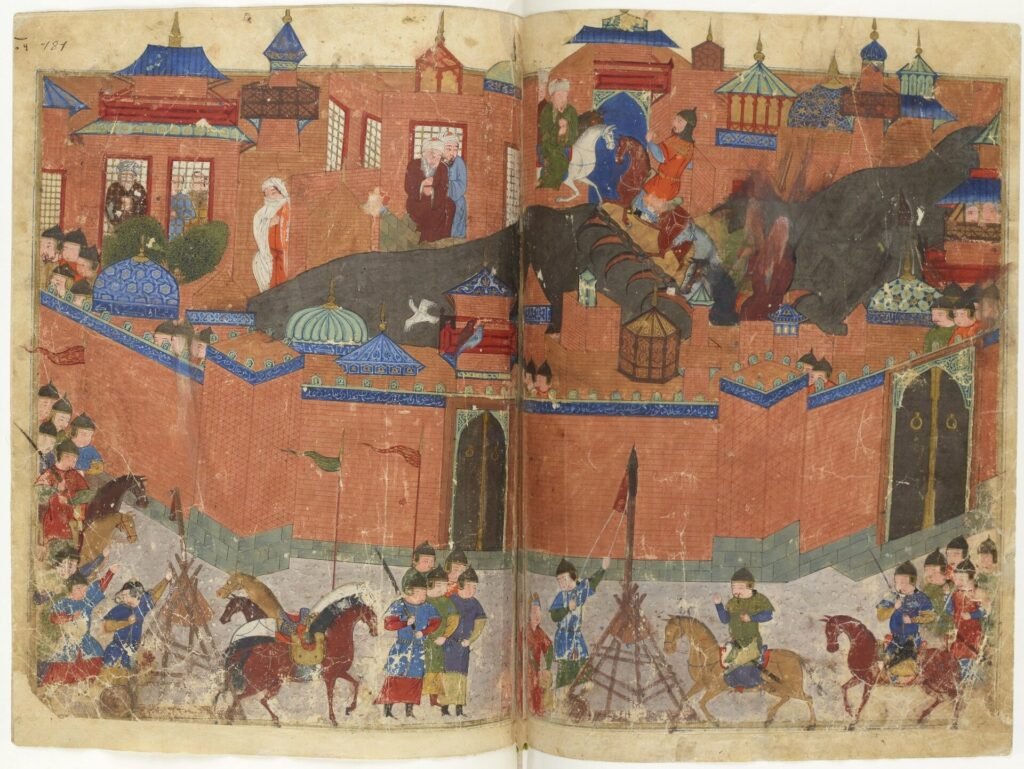
The fall of Baghdad in 1258 was the capture and sack of the Abbasid capital by a Mongol army under Hulagu Khan in early 1258. The conquest ended the Abbasid caliphate in Baghdad, which had ruled much of the Islamic world from the eighth century, and it is regarded as one of the great turning points of medieval Middle Eastern history.
Background to the fall of Baghdad
The Abbasid dynasty came to power in 750 after overthrowing the Umayyads, and its caliphs ruled from Baghdad, which became a center of trade and learning. The World History Encyclopedia notes that the House of Wisdom, a library and translation center, was set up there, and that Greek works were translated into Arabic. By the time of the Crusades the dynasty had lost much of its earlier power. A series of caliphs rebuilt a measure of military and political authority around Baghdad and parts of Iraq, but the caliphate was a smaller state than its early predecessor. When the Seljuk Turks besieged Baghdad in 1157, the city held firm and they had to retreat, which shows that it was still a strong fortress a century before the Mongols arrived.
The Mongol Empire, founded by Genghis Khan, had meanwhile expanded across Asia. The Great Khan Mongke sent his younger brother Hulagu, a grandson of Genghis Khan, to extend Mongol control over western Asia. Hulagu was given an army made up of two out of every ten soldiers in the empire. From 1253 he mobilized his forces, and in 1256 he destroyed the Nizari Ismailis, a rival power in Iran often called the Assassins.
Course of the siege and sack
Hulagu’s forces then moved against the Abbasid caliph, al-Mustasim. The World History Encyclopedia reports that Hulagu defeated the Abbasid army in January 1258 and that the Mongol army took Baghdad the following month after a brief siege. This entry gives only the months stated in the sources it relied on, because they do not agree on exact days.
The sack that followed lasted about a week. Tradition holds that up to 800,000 people were killed. A medieval chronicle quoted in a 2021 article in the journal Medical History says more than 800,000 were dead in Baghdad, not counting children thrown into the mud or those who died in canals, wells and cellars, or from hunger and fear. These numbers come from later accounts and cannot be checked independently, so they should be treated as a reflection of the shock caused by the event and not as exact counts.
The caliph was executed, and his family was largely killed. According to the World History Encyclopedia, only one boy, who was sent to Mongolia, and one princess, who became a slave in Hulagu’s household, survived. The execution of the caliph marked the end of the Abbasid caliphate as a ruling power in Baghdad.
Disease after the siege
Historians have recently paid more attention to the role of disease. The Medical History article notes that accounts from the period describe an epidemic in and around Baghdad after the sack. A Persian text called Mongol News, translated into English in 2018, says that pestilence struck during the siege, that so many died that bodies were thrown into the Tigris and that most of the Mongol army also fell sick. Other chroniclers report that survivors were struck by an epidemic caused, as they believed, by the stench of corpses and polluted water.
The article stresses that no contemporary eyewitness gave a clinically precise description of the illness, so scholars cannot be sure what disease it was. Some researchers have suggested that plague may have been present during Mongol sieges in the thirteenth century, a possibility that is still being studied. Medieval writers, in any case, believed the Mongols had caused disease by their destruction and not that they had carried it. The fifteenth-century Tunisian historian Ibn Qunfudh, for example, wrote that an illness in Tunis in 1258, which affected the local ruler, was said to have been caused by the stench of the people killed in Baghdad. The article uses such reports to show how widely news of the disaster and its aftermath spread through Syria, Egypt and North Africa.
Aftermath of the fall of Baghdad
After Baghdad, Hulagu advanced into Syria. In December 1259 his army besieged Aleppo, and the main city fell within a week. The Mongol advance was halted by the Mamluk sultanate of Egypt at the Battle of Ain Jalut in 1260. Hulagu then withdrew to concentrate on Persia, where he established the Ilkhanate, a state that lasted from 1260 to 1335. Hulagu died in 1265.
The Mamluks installed members of the Abbasid family as shadow caliphs in Cairo, but they were figureheads. In 1517 the Ottoman sultan Selim I conquered the Mamluk lands, and the caliphal title passed to the Ottomans. The World History Encyclopedia concludes that with the Abbasids the era of Arab supremacy over Islam came to an end.
Significance and legacy of the fall of Baghdad
The destruction of Baghdad ended the political center of the Abbasid world and shifted the balance of power in the Islamic world toward Cairo and, later, to Iran under the Ilkhanate. Under Mongol rule Islamic arts and scholarship nevertheless continued to thrive, and the World History Encyclopedia names the astronomer Nasir al-Din al-Tusi as one example from the Ilkhanid period.
The event is also remembered for its human cost. Because the main accounts come from later chroniclers, and because numbers of dead are often exaggerated in medieval writing, historians treat the figures with caution. The fall of Baghdad is still discussed as a symbol of both the vulnerability of great cities and the reach of the Mongol conquests.
Baghdad itself survived as a city in what is now Iraq, but it never again held the political position it had under the Abbasids.
More in History
Key facts
- Hulagu Khan, a grandson of Genghis Khan, led the Mongol army that took Baghdad in early 1258.1
- Hulagu defeated the Abbasid forces in January 1258 and captured Baghdad the following month after a brief siege.1
- Tradition holds that up to 800,000 people were killed in the week of slaughter that followed, a figure that cannot be verified.12
- The Abbasid caliph was executed, and the Mamluks later installed shadow caliphs in Cairo.13
- Hulagu founded the Ilkhanate, which lasted from 1260 to 1335.1
Related concepts
Quick checkWhat happened when the Mongols took Baghdad in 1258?Show answer
A Mongol army under Hulagu Khan captured the Abbasid capital in early 1258, sacked it for about a week and executed the caliph. This ended the Abbasid caliphate as a ruling power in Baghdad.
Sources
- World History Encyclopedia, Ilkhanate, https://www.worldhistory.org/Ilkhanate/
- Medical History (Cambridge University Press), Plague and the Fall of Baghdad (1258), vol. 65 issue 2, 2021, https://www.cambridge.org/core/journals/medical-history/article/plague-and-the-fall-of-baghdad-1258/C0E179EB4890C10BBFAE5C11DFC8DF36
- World History Encyclopedia, Abbasid Dynasty, https://www.worldhistory.org/Abbasid_Dynasty/
Editorially reviewed by Specialty Digest Editorial TeamLast reviewed November 4, 2026Researched and drafted with AI assistanceReport an issue