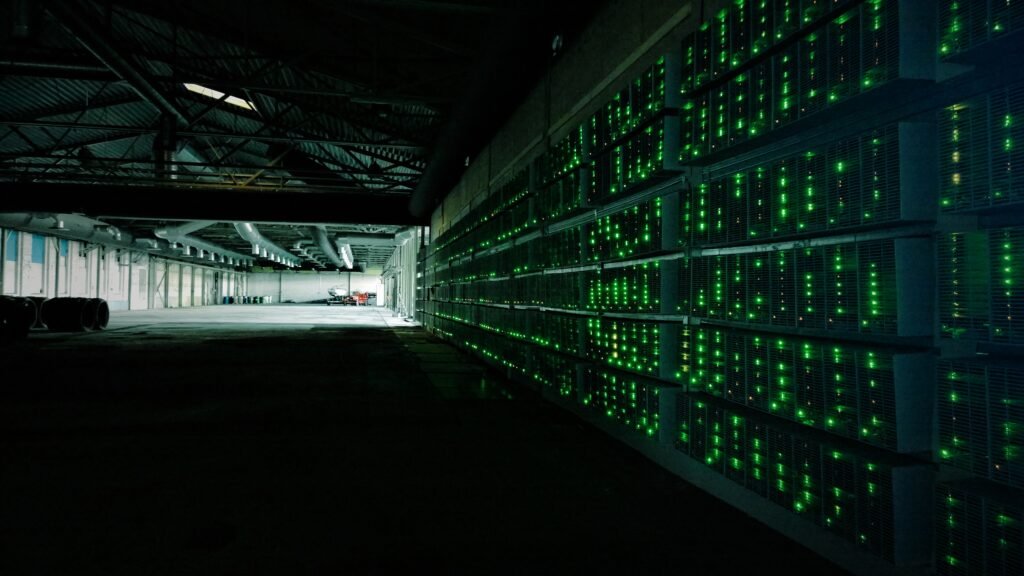
Blockchain is a distributed digital ledger in which records of transactions are grouped into blocks and each block is cryptographically linked to the one before it. Copies of the ledger are kept by many participants, usually without a central authority such as a bank, company or government. The design makes earlier records tamper evident, because changing one block breaks its link to every block that follows. Cryptocurrencies are the best-known use, but the same structure is studied for registries, supply chains and digital identity.
History of blockchain
The idea of linking records together to prove when they existed came before cryptocurrency. In 1991 Stuart Haber and W. Scott Stornetta described in the Journal of Cryptology practical procedures for time-stamping digital documents, so that it is infeasible to back-date or forward-date a document even if the time-stamping service itself colludes. Their problem was how to certify when a digital file was created or last changed.
On October 31, 2008, a person or group writing as Satoshi Nakamoto announced a paper on a cryptography mailing list that described an electronic cash system run entirely between peers, with no mint or other trusted party. The paper proposed that a network could timestamp transactions by hashing them into an ongoing chain of proof-of-work, forming a record that cannot be changed without redoing the work. That design became the model for later blockchains, and the Bitcoin network that followed made the term familiar.
Later projects adapted the structure for uses beyond payments. The U.S. National Institute of Standards and Technology (NIST) now publishes technical overviews, including NISTIR 8202, and studies how blockchain systems behave across use cases, protocols and cryptographic mechanisms.
How blockchain works
A blockchain begins with transactions, which are signed records of a transfer or change that participants want to log. Transactions are collected into a block. Each block carries a cryptographic fingerprint, called a hash, of the block before it. A hash is a fixed-length value computed from data by a one-way mathematical function, and even a tiny change to the data produces a completely different value.
Because every block contains the hash of its predecessor, altering an old block changes its hash and breaks the link in the next block. Anyone holding a copy of the ledger can then detect the change. As more blocks are added, older blocks become harder to modify, which NIST describes as tamper resistance.
Copies of the ledger are held on many computers, called nodes, that together form the blockchain network. New blocks are added according to validation and consensus rules, and conflicts between competing versions are resolved automatically by established rules. Consensus is the agreement process by which nodes decide which block comes next.
In Bitcoin, the consensus method is proof of work. Nodes must spend computing effort to find a valid block, and the network accepts the longest chain as the true record. Nakamoto’s paper argued that the longest chain shows both the sequence of events and that it came from the largest pool of computing power, so honest participants who control most of that power can outpace an attacker. Other networks use different methods, such as proof of stake, which selects block producers by the amount of cryptocurrency they have committed rather than by computing work.
Types of blockchain
Blockchains are commonly grouped by who may take part. A public, or permissionless, blockchain allows anyone to join the network, read the ledger and help validate new blocks. Bitcoin is the best-known example. A private, or permissioned, blockchain limits participation to approved members, which suits organizations that know one another but do not want to rely on a single operator.
The two types trade openness for control. Permissionless systems depend on incentives and on heavy computation or committed assets to deter cheating. Permissioned systems can use lighter agreement methods because participants are identified, but their trustworthiness rests on the members who run them.
Applications of blockchain
NIST notes that blockchain is the underlying technology for many cryptocurrency systems and can also be used in other applications, including manufacturing supply chains, data registries, digital identification and records management. In a supply chain, for example, each handoff of a product can be recorded in a shared ledger that suppliers, shippers and buyers can all inspect. The related practice of documenting who held an item and when is described in the entry on chain of custody, and the wider coordination problem is covered in supply chain management.
A blockchain can show that a record was written and has not changed since, but it cannot prove that the original entry was true. If inaccurate data is entered, the ledger preserves the inaccuracy faithfully. Systems that connect physical goods to digital records therefore still depend on trustworthy inputs, such as sensors, inspections or audited sources. The link between ledgers and encryption is also worth noting: digital signatures prove who authorized a transaction, while hashing protects the order of the records.
Advantages and disadvantages of blockchain
The main advantage is a shared record that several parties can trust without handing control to one of them. Because copies exist on many nodes, there is no single repository to attack or lose, and cryptographic links make tampering visible. For payments between strangers, the peer-to-peer design removes the need for a trusted intermediary to prevent the same coin from being spent twice.
The disadvantages are practical. Proof-of-work networks require large amounts of computing effort by design, and every participant storing a copy of the ledger raises storage and coordination costs. Most blockchains are also built so that published data cannot be easily edited or removed, which complicates cases where records must be corrected or deleted. NIST researchers are examining alternative data structures, such as a block matrix, that would allow deletion or updating while keeping reliability and security.
Security also rests on assumptions about the network, so weaknesses can appear in software, in how keys are stored, or in the rules of a particular system, even when the underlying ledger design is sound.
Blockchain vs. a conventional database
A conventional database is usually run by one administrator who can change or delete entries and who is trusted by its users. A blockchain spreads that control among many participants and makes changes visible. That is useful when several organizations must share records and none wants to depend on another’s database. When one organization controls the data and everyone already trusts it, a regular database is typically faster, cheaper and easier to maintain.
More in Computer Science
Key facts
- A blockchain is a distributed digital ledger of cryptographically signed transactions grouped into blocks, each linked to the previous block.1
- Haber and Stornetta published a method for digitally time-stamping documents in the Journal of Cryptology in 1991.3
- Satoshi Nakamoto announced a peer-to-peer electronic cash design based on a proof-of-work chain on October 31, 2008.4
- NIST lists manufacturing supply chains, data registries, digital identification and records management as possible uses.1
Related concepts
In the news
Quick checkWhat makes a blockchain tamper evident?Show answer
Each block is cryptographically linked to the previous block, so changing an earlier block changes its link and the change can be detected in later blocks. Older blocks also become harder to modify as new ones are added.
Sources
- National Institute of Standards and Technology, Blockchain, https://www.nist.gov/blockchain
- NIST Computer Security Resource Center, NISTIR 8202: Blockchain Technology Overview, https://csrc.nist.gov/pubs/ir/8202/final
- Haber S. and Stornetta W. S., How to time-stamp a digital document, Journal of Cryptology 3, 1991, https://link.springer.com/article/10.1007/BF00196791
- Nakamoto S., Bitcoin P2P e-cash paper, cryptography mailing list, October 31, 2008, https://www.metzdowd.com/pipermail/cryptography/2008-October/014810.html
Editorially reviewed by Specialty Digest Editorial TeamLast reviewed November 4, 2026Researched and drafted with AI assistanceReport an issue