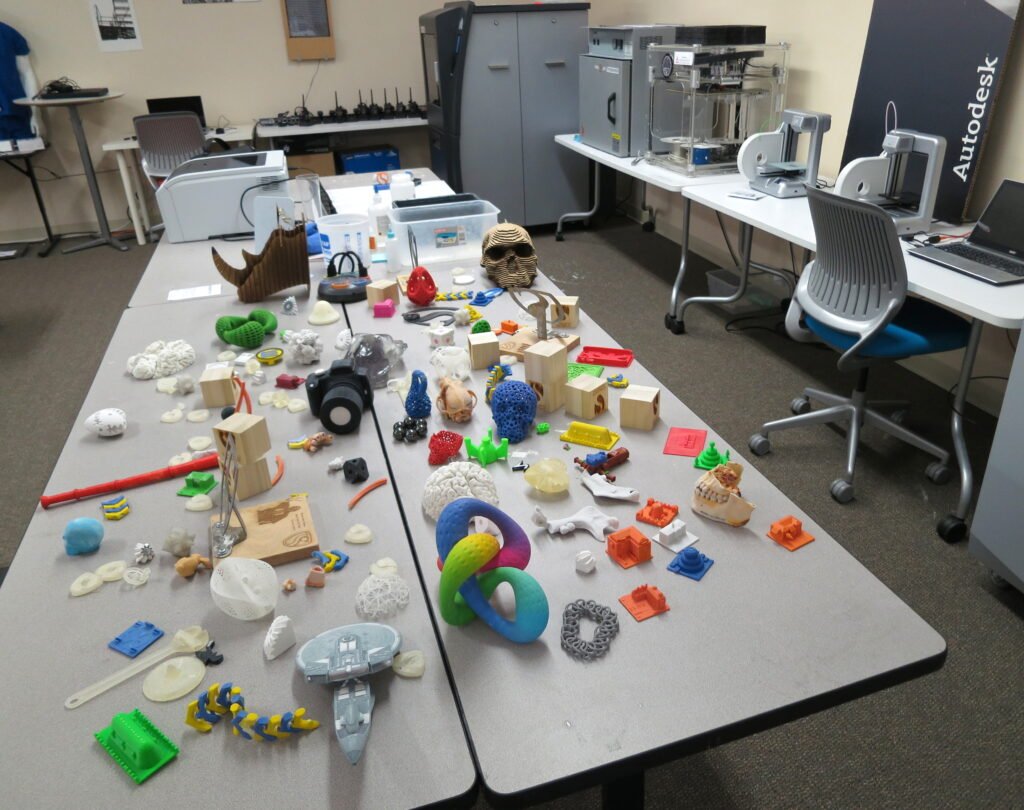
3D printing, also called additive manufacturing, is a family of processes that build a physical object from a digital design by adding material layer by layer. It contrasts with subtractive manufacturing, such as drilling, which makes a part by cutting material away. The technique is used for prototypes, tools and, increasingly, finished parts in medicine, aerospace and other industries.
History of 3D printing
Charles W. Hull filed a United States patent application for stereolithography on August 8, 1984, and the resulting patent, US 4,575,330, was published on March 11, 1986. It describes forming an object by creating successive cross-sectional layers at the surface of a fluid that changes its physical state when struck by radiation, so that each new layer bonds to the one before it. The patent’s original assignee was UVP, Inc.
For years the technology served mainly as a design and prototyping tool. A report from the U.S. Government Accountability Office (GAO) on a forum held in October 2014 says the focus was shifting toward the direct production of functional parts, meaning parts that do a job, such as medical implants or aircraft engine components, and are ready for distribution and sale.
How 3D printing works
Every process starts with a digital model, usually made in computer-aided design software or captured with a scanner. Software slices the model into thin horizontal layers and turns them into instructions for the printer. The machine then deposits, cures or fuses material one layer at a time until the object is complete, and the part is often cleaned, heat-treated or finished afterward.
Stereolithography, the method in Hull’s patent, uses light to harden a liquid, with each layer matching a cross-section of the object. In metal printing, the National Institute of Standards and Technology (NIST) describes building a shape from thin layers of metal powder, each melted into place by a laser or another focused energy source. Plastic printers more commonly push melted filament through a heated nozzle and lay it down in lines.
Types of 3D printing
Printers are usually grouped by how they create each layer. Material extrusion pushes softened plastic or paste through a nozzle. Vat photopolymerization, which includes stereolithography, cures liquid resin with light. Powder bed fusion spreads a thin layer of powder and melts or sinters chosen areas with a laser or electron beam, and it is common for both plastics and metals.
Two further families are worth knowing. Binder jetting prints drops of liquid glue onto a powder bed to bond a shape, and directed energy deposition melts material as it is fed to a focused heat source, which suits adding material to an existing part. Each family favors different materials, speeds, precision and part sizes.
The materials range from thermoplastic polymers to metal alloys and, in newer research that NIST highlights, ceramics. Researchers are also studying printing of personalized medications.
Applications of 3D printing
The GAO forum participants identified benefits in the medical, aerospace and defense sectors. In medicine, the technology is used to produce customized prosthetics and implants, including cranial implants. Because the part is made specifically for a patient, it fits better, which can lead to a better medical outcome.
In aerospace, participants described a complex jet engine fuel nozzle designed and produced as a single part, which reduces assembly time and cost for the engine. Designers can create shapes that are hard to cast or machine, and software-driven approaches such as parametric design pair naturally with this freedom.
Participants also pointed to possible future use in supply chain management, since a digital file can in principle be sent to a printer near where a part is needed. Prototyping remains a major use, because a designer can test a physical model within hours or days instead of waiting for tooling.
Advantages and disadvantages of 3D printing
The advantages follow from building up rather than cutting away. Complex internal channels and consolidated assemblies can be made in one piece, each part can be customized without new tooling, and little material is wasted by cutting. Making parts from a digital file also changes how designs are stored and shared.
The disadvantages are equally concrete. GAO forum participants named three groups of challenges: ensuring product quality, limited design tools and workforce skills, and supporting greater production of functional parts. Quality control of the process needs to improve, and the industry needs stronger supply chains of machines and materials. Printed parts often need post-processing, and the speed of layer-by-layer building can be slow for large production runs. Participants also raised the risk of infringing intellectual property rights, since a design can be copied as a file.
NIST says comprehensive measurements and standards will be critical for expanding industrial use, which is why it works on measurement science for additive manufacturing, including scans of printed metal cubes with an electron microscope to study their internal structure.
Participants discussed possible roles for government, such as coordinating standards setting, but there was no consensus on specific policy actions and many urged caution.
3D printing vs. traditional manufacturing
Conventional methods such as casting, molding and machining remain faster and cheaper for large numbers of identical parts. Additive methods tend to win when a part is complex, needs customization or is made in small quantities. GAO forum participants concluded that additive manufacturing will not replace conventional manufacturing but will be an additional tool for manufacturers to use when it makes sense on a cost-benefit basis. The same idea applies to machining, which still dominates where tight tolerances and smooth surfaces are required.
More in Mechanical Engineering
Key facts
- Additive manufacturing builds a part layer by layer, unlike subtractive processes such as drilling, which cut material away.3
- Charles W. Hull filed his stereolithography patent application on August 8, 1984, and US 4,575,330 was published on March 11, 1986.1
- GAO forum participants cited customized implants and a single-piece jet engine fuel nozzle as benefits of the technology.3
- NIST says comprehensive measurements and standards will be critical for expanding industrial use of additive manufacturing.2
Related concepts
Quick checkWho patented stereolithography, the first 3D printing method?Show answer
Charles W. Hull filed the application in 1984, and US patent 4,575,330 was published in 1986. The original assignee was UVP, Inc.
Sources
- US Patent 4,575,330, Apparatus for production of three-dimensional objects by stereolithography (C. W. Hull), https://patents.google.com/patent/US4575330A/en
- National Institute of Standards and Technology, Additive manufacturing, https://www.nist.gov/additive-manufacturing
- U.S. Government Accountability Office, 3D Printing: Opportunities, Challenges, and Policy Implications of Additive Manufacturing (GAO-15-505SP), https://www.gao.gov/products/gao-15-505sp
Editorially reviewed by Specialty Digest Editorial TeamLast reviewed November 4, 2026Researched and drafted with AI assistanceReport an issue