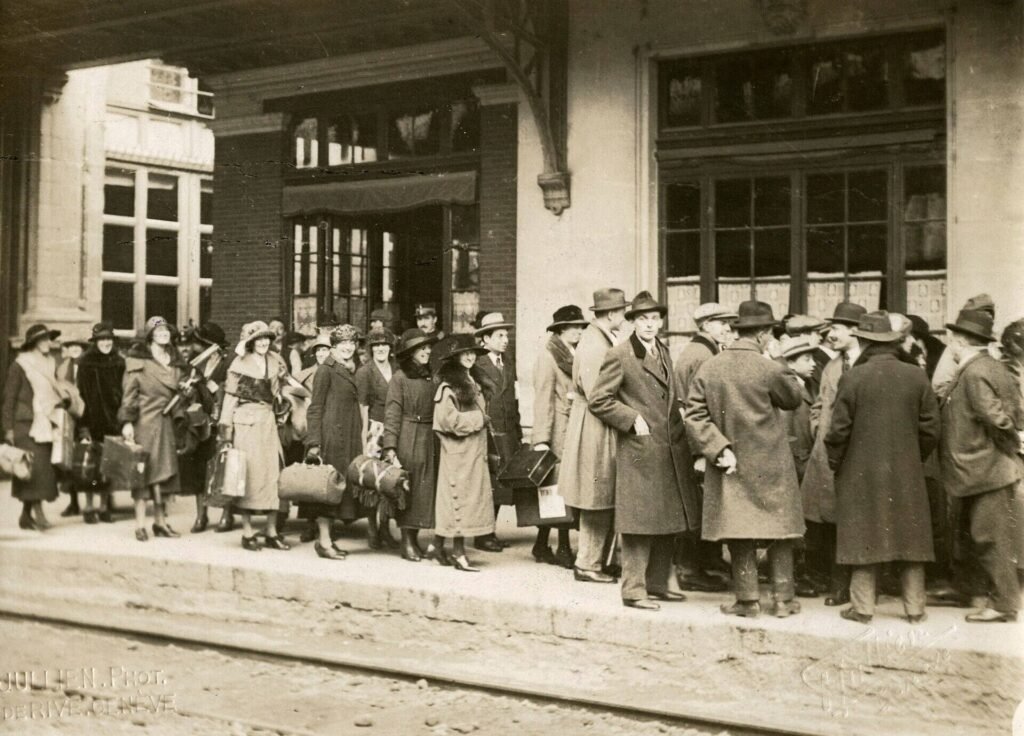
The League of Nations was the first intergovernmental organization founded to promote international cooperation and to achieve international peace and security. It operated from 1920 to 1946 with its headquarters in Geneva, Switzerland, and it is often called the predecessor of the United Nations.
History of the League of Nations
President Woodrow Wilson called for a “general association of nations” in the last of his Fourteen Points, which he set out to the U.S. Congress on 8 January 1918. After the First World War, he traveled to the Paris Peace Conference in January 1919 to press the idea. Wilson, Georges Clemenceau and David Lloyd George drafted the Covenant, the League’s charter, as Part I of the Treaty of Versailles.
The League officially came into existence on 10 January 1920. The Covenant had 26 articles covering membership, the functions of the main organs, the peaceful settlement of disputes and the obligations of members. On 15 November 1920, 41 member states gathered in Geneva for the first session of the Assembly, representing more than 70 percent of the world’s population.
The United States never joined. In March 1920 the U.S. Senate defeated the Treaty and Covenant by a vote of 49 to 35, after opposition led by Senator Henry Cabot Lodge. The U.S. Office of the Historian notes that most historians hold that the League worked less effectively without American participation.
Structure and membership of the League
The League had three main organs. The Assembly represented all member states on equal footing, with one vote each, and could deal with any matter within the League’s sphere of action affecting the peace of the world. It admitted new members, amended the Covenant and adopted the budget, which members financed according to their economic and financial position. Except where the Covenant said otherwise, its decisions required unanimity among members present.
The Council had permanent and non-permanent members. As designed in 1919, it consisted of five permanent and four rotating members. The Secretariat did the daily work from Geneva. The Assembly first met at the Palais des Nations in 1937, after earlier sessions in other Geneva buildings.
The League was open to any fully self-governing state, dominion or colony that met certain requirements and won a two-thirds majority vote. In total 63 states became members, with at most 60 at the same time. Germany joined in 1926 and left in 1933. The Assembly could meet at the request of members, as it did in 1926 when Germany applied.
What did the League of Nations do?
Under the Covenant, members agreed to settle disputes peacefully, renounce secret diplomacy, reduce armaments and comply with international law. Each pledged to respect the territorial integrity and political independence of all members. This made the League the first attempt at a system of collective security, built on the idea that an aggressor against one member should be treated as an aggressor against all.
The League supervised the mandate system, under which former German colonies and Ottoman territories were placed under the tutelage of mandatory powers until they could become independent states. It administered the Saar territory from 1920 until a plebiscite decided its future. It also supervised the constitution of the Free City of Danzig and the minority treaties signed after the Paris peace conference.
It handled some disputes successfully. Examples include the Åland Islands dispute in 1921, the Greco-Bulgarian border incident in 1925 and the Leticia dispute in 1934. In 1934 the Council also eased tensions between Budapest and Belgrade after the assassination of King Alexander I of Yugoslavia. In 1939 it supervised the evacuation of foreign combatants from Spain.
Cases involving the direct interests of a great power went less well, such as the dispute over Vilna in 1921 and the Corfu incident in 1923.
The League also achieved results in technical fields. A conference in Barcelona in 1921 produced conventions on freedom of transit and international waterways. In 1922 an intergovernmental conference called by the first High Commissioner for Refugees, Fridtjof Nansen, adopted the Nansen Passport, an identity document issued to refugees. Article 14 of the Covenant led to the Permanent Court of International Justice, the forerunner of the International Court of Justice.
Decline and criticism
The history of the League is often divided into three periods. The early years were marked by tension between great powers over its role after the American withdrawal. The second half of the 1920s brought optimism and what became known as the Spirit of Geneva.
The third period began as political and social tensions grew in the 1930s, after the Wall Street crash of October 1929. The League failed to intervene after Japan occupied Manchuria in 1931 and Italy invaded Abyssinia, now Ethiopia, in 1935. Those failures hurt its political credibility and marked the collapse of its collective security system.
In 1933 Nazi Germany withdrew, and the failure of the World Disarmament Conference of 1932 to 1934 weakened the League further. It could not contain the breakdown of the international order that led to the Second World War.
The Office of the Historian also points to the link between the Covenant and the Treaty of Versailles. Over time the treaty was discredited as unenforceable or too extreme in its provisions, and the League’s failure to enforce or revise it reinforced opposition to joining.
Dissolution and legacy
The League kept working during the war. Its Secretariat stayed in Geneva, and some staff worked in London, Washington and at Princeton University. The UN Charter came into existence on 24 October 1945, and the two organizations coexisted for a few months. In April 1946, 35 of the 46 remaining members met in Geneva and formally approved the League’s dissolution.
The United Nations officially has no connection with the League, but some assets passed to it, including the Palais des Nations. Work on refugees, health, drug trafficking, intellectual cooperation and economic development paved the way for later UN activities. The League of Nations Archives, about 15 million pages, are on UNESCO’s Memory of the World Register.
More in International Relations
Key facts
- The League officially came into existence on 10 January 1920, and its first Assembly met on 15 November 1920 with 41 members.1
- In total 63 states became members, with at most 60 at any one time.1
- The U.S. Senate rejected the Treaty of Versailles and Covenant by 49 to 35 in March 1920, so the United States never joined.2
- The League failed to act after the 1931 occupation of Manchuria and the 1935 invasion of Abyssinia.3
- In April 1946, 35 of 46 members met in Geneva and approved the League's dissolution.4
Related concepts
In the news
Quick checkWhy is the League of Nations called the predecessor of the United Nations?Show answer
It was the first intergovernmental body created to secure international peace, and its assets, such as the Palais des Nations, and many of its activities passed to the UN system. [4]
Sources
- 1. United Nations Office at Geneva, The League of Nations: Overview, https://www.ungeneva.org/en/about/league-of-nations/overview
- 2. U.S. Department of State, Office of the Historian, Milestones: The League of Nations, 1920, https://history.state.gov/milestones/1914-1920/league
- 3. United Nations Office at Geneva, The League at Work, https://www.ungeneva.org/en/about/league-of-nations/at-work
- 4. United Nations Office at Geneva, Transition to the United Nations, https://www.ungeneva.org/en/about/league-of-nations/transition
- 5. United Nations Office at Geneva, Main Organs of the League of Nations, https://www.ungeneva.org/en/about/league-of-nations/organs
- 6. International Court of Justice, History, https://www.icj-cij.org/history
Editorially reviewed by Specialty Digest Editorial TeamLast reviewed November 4, 2026Researched and drafted with AI assistanceReport an issue