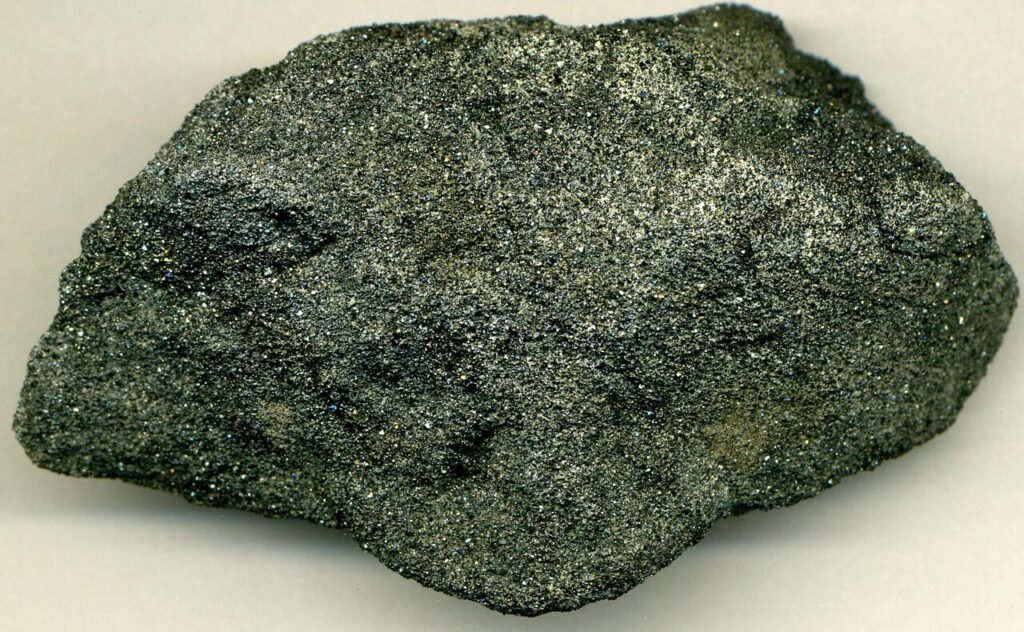
Chromium is the chemical element with atomic number 24 and the symbol Cr. It is a hard, silvery metal with a faint blue tinge, and it belongs to group 6 of the periodic table. Chromium is best known for two jobs: it is the ingredient that makes stainless steel resist rust, and it supplies the bright mirror finish of chrome plating.
History of chromium
Chromium was discovered by the French chemist Nicolas-Louis Vauquelin in Paris in the late 1790s. The Royal Society of Chemistry gives 1798 as the year, while PubChem lists 1797, so the exact date depends on the source. His starting point was a bright red mineral found in a Siberian gold mine in 1766 and known at the time as Siberian red lead.
The mineral is now called crocoite, and it is a form of lead chromate. Vauquelin analyzed it, dissolved it in acid, precipitated the lead and filtered it out. From the liquid that remained he isolated the new metal.
The compounds of the new element produced a striking range of colors in solution. For that reason Vauquelin named it chromium, from the Greek word chroma, meaning color. He later showed that the green color of emeralds is also caused by chromium.
Properties of chromium
Chromium has a standard atomic weight of 51.996, and NIST lists the value as 51.9961 with an uncertainty of 6 in the last digit. The atomic weight is the average mass of an atom of the element as it occurs in nature, measured against carbon-12. A chromium atom has 24 protons and an electron configuration of [Ar] 3d5 4s1. That notation means the atom has the electron arrangement of argon, the noble gas that precedes it, plus five electrons in the 3d level and one in the 4s level.
At room temperature chromium is a solid with a density of 7.15 grams per cubic centimeter. PubChem gives a melting point of 2,180 kelvins, which is about 1,907 degrees Celsius, and a boiling point of 2,944 kelvins, about 2,671 degrees Celsius. Both values are far higher than those of zinc, which melts at about 693 kelvins.
Chromium is a transition metal, meaning a metal from the central block of the periodic table whose atoms can form compounds in several oxidation states. Its common oxidation states are plus 6, plus 3 and plus 2. An oxidation state is a number that tracks how many electrons an atom has lost or shared in a compound.
PubChem also lists an electronegativity of 1.66 on the Pauling scale, a first ionization energy of 6.767 electronvolts, an electron affinity of 0.666 electronvolts and an atomic radius of 189 picometers. Electronegativity is the tendency of an atom to attract electrons in a bond, and electron affinity is the energy released when a neutral atom takes up one extra electron. When polished, chromium takes a mirror shine.
Chromium and manganese are neighbors in the periodic table. Chromium has the higher melting point, 2,180 kelvins against 1,519 kelvins for manganese, and a slightly lower density, 7.15 grams per cubic centimeter against 7.3.
Occurrence and production of chromium
Chromium is found mainly in the ore chromite. The Royal Society of Chemistry lists deposits in many places, including South Africa, India, Kazakhstan and Turkey. An ore is a rock or mineral that contains enough of a metal to make extracting it worthwhile.
Chromium metal is usually produced by reducing chromite with carbon in an electric-arc furnace. Reduction means removing oxygen from a compound, and an electric-arc furnace reaches very high temperatures by passing an electric arc through its charge of raw material. A second route reduces chromium(III) oxide with aluminum or silicon in place of carbon.
Uses of chromium
Most chromium goes into metals. It is used to harden steel, to manufacture stainless steel and to produce several other alloys. An alloy is a mixture of a metal with other elements, made to improve strength or other properties. Stainless steel is named for its resistance to rust, and the Royal Society of Chemistry notes that it contains at least 10.5 percent chromium.
Chromium plating gives steel a polished, mirror-like finish. Chromium-plated bumpers and other parts for cars and trucks were once very common, and it is also possible to plate plastics, which are often used in bathroom fittings.
Chromium compounds also serve as industrial catalysts and as pigments in bright green, yellow, red and orange. A catalyst is a substance that speeds up a chemical reaction without being used up. Rubies get their red color from chromium, and glass treated with chromium has an emerald-green color.
About 90 percent of all leather is tanned using chrome. The waste liquid from tanning is toxic, so alternatives are being investigated.
Isotopes of chromium
According to NIST, chromium has four stable isotopes: chromium-50, chromium-52, chromium-53 and chromium-54. Isotopes are forms of the same element whose atoms have different numbers of neutrons, and the number after the name is the total count of protons and neutrons.
Chromium-52 is by far the most common, at about 83.789 percent of natural chromium. The others make up about 4.345 percent (chromium-50), 9.501 percent (chromium-53) and 2.365 percent (chromium-54). Because one isotope dominates the mixture, the standard atomic weight sits close to 52.
Health and environmental effects of chromium
Chromium is an essential trace element for humans because it helps the body use glucose. People take in about 1 milligram a day, and foods such as brewer’s yeast, wheat germ and kidney are rich in it. The Royal Society of Chemistry also states that chromium is poisonous in excess, so its biological role is a matter of balance: needed in tiny amounts and harmful in large ones.
Environmental concern centers on industry. The waste liquid from chrome leather tanning is toxic, which is why other tanning methods are being investigated. The information here is general background rather than health or safety advice.
More in Chemistry
Key facts
- Chromium has atomic number 24, symbol Cr, and sits in group 6 and period 4 of the periodic table.1
- Chromium was discovered by Nicolas-Louis Vauquelin in Paris, in 1798 according to the Royal Society of Chemistry and 1797 according to PubChem.12
- Chromium is a solid at room temperature with a density of 7.15 grams per cubic centimeter.2
- Chromium has four stable isotopes, and chromium-52 makes up about 83.789 percent of natural chromium.3
- Stainless steel contains at least 10.5 percent chromium, and the main ore of chromium is chromite.1
In the news
Quick checkWho discovered chromium and where does its name come from?Show answer
The French chemist Nicolas-Louis Vauquelin discovered chromium in Paris in the late 1790s. He named it from the Greek word chroma, meaning color, because its compounds show many colors.
Sources
- Royal Society of Chemistry, Periodic Table: Chromium, https://periodic-table.rsc.org/element/24/chromium
- National Center for Biotechnology Information, PubChem Periodic Table: Chromium, https://pubchem.ncbi.nlm.nih.gov/element/24
- National Institute of Standards and Technology, Atomic Weights and Isotopic Compositions for Chromium, https://physics.nist.gov/cgi-bin/Compositions/stand_alone.pl?ele=Cr
Editorially reviewed by Specialty Digest Editorial TeamLast reviewed November 4, 2026Researched and drafted with AI assistanceReport an issue