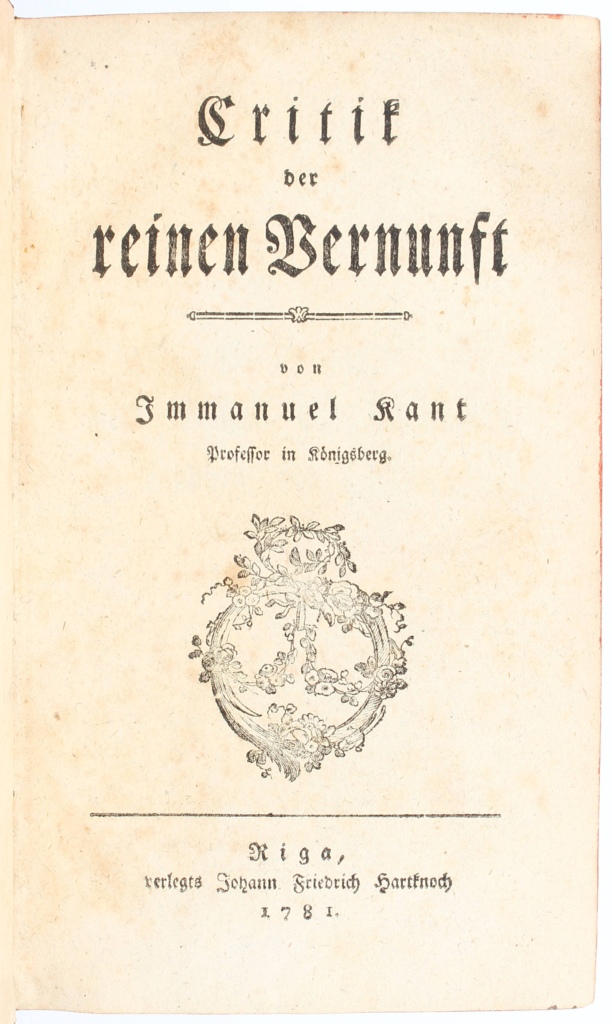
The Critique of Pure Reason is Immanuel Kant’s 1781 work of philosophy that asks what human reason can and cannot know independently of experience. Its answer is that knowledge is limited to the world as it appears to us, and that traditional metaphysical claims about the soul, the universe as a whole and God lie beyond those limits. It is the first of Kant’s three critiques and one of the most influential books in Western philosophy.
Background and composition of the Critique
Kant spent about a decade on the book. He published nothing else of significance between 1770 and 1781, and the Critique’s appearance in 1781 began the most productive stretch of his career. In his 1770 Inaugural Dissertation he still held that the understanding can grasp an intelligible world beyond the senses. He later rejected that view, and the Critique is partly the record of why.
In the preface to the second edition Kant compared the change of method he proposed to the Copernican revolution and argued that metaphysics should adopt a similar turn. His three guiding questions were what can I know, what ought I do, and what may I hope. The Critique of Pure Reason mainly addresses the first, and his later works take up the others.
The book also responds to a problem of its time. Kant wanted to reconcile the success of Newtonian science with traditional morality and religion, and to protect the standing that the Enlightenment gave to reason. His main targets were the Leibniz-Wolffian school of metaphysics, which claimed a priori knowledge of the soul, the world-whole and God, and the skepticism about causation associated with David Hume.
Early reviews were few and, in Kant’s judgment, uncomprehending. He therefore published the much shorter Prolegomena to Any Future Metaphysics in 1783 to explain the main points, and he brought out a substantially revised second edition of the Critique in 1787. Modern editions distinguish the first edition by the letter A and the second by the letter B.
Structure and content of the Critique
The Critique moves in three broad stages. The first, the Transcendental Aesthetic, deals with sensibility and argues that space and time are forms through which humans perceive objects, so that spatial and temporal features belong to how we experience things and not to things in themselves. The second, the Transcendental Analytic, deals with the understanding. Kant argues that judgment links ideas into an objective unity, and that the categories, such as cause and effect, are concepts the mind must apply for experience to be possible at all. Substance and causality are among them. Underlying the whole project is the question of how synthetic a priori judgments are possible, meaning judgments that add to our knowledge yet hold independently of experience, as in mathematics and the basic principles of natural science.
The third stage, the Transcendental Dialectic, is a critique of metaphysics. Kant argues that human reason naturally produces ideas of the soul, the world as a whole and God, and that these ideas create the illusion of knowledge about objects that no experience could confirm. Three chapters examine the illusions in turn. The Paralogisms of Pure Reason criticize rational psychology, the attempt to prove facts about the soul by reason alone. The Antinomies show that reason produces equally persuasive opposing arguments about the universe, such as whether it has a beginning in time. The final part addresses arguments for the existence of God.
Themes and interpretation of the Critique
The best-known theme is the comparison Kant drew with Copernicus. Instead of assuming that the mind simply conforms to objects, he proposed that objects as we experience them must conform to the forms that our faculties supply. Like the heliocentric revolution in astronomy, this approach counts the contribution of the observer in explaining what is observed.
A consequence is Kant’s limit on knowledge. Human cognition reaches appearances only, he says, and leaves the thing in itself as something real but unknown to us. This position is called transcendental idealism, and interpreters continue to debate whether it describes two worlds or two ways of considering one world.
A second theme is the defense of science and freedom together. By confining scientific knowledge to the domain of experience, Kant left room, in his later works, for moral freedom and faith that science cannot refute. The related question of agency appears in the entry on free will, and the study of knowledge in epistemology.
Reception and legacy of the Critique
The book was slow to find readers, yet within a decade it dominated German philosophy. Kant followed it with the Groundwork of the Metaphysics of Morals in 1785, the Critique of Practical Reason in 1788 and the Critique of the Power of Judgment in 1790. These works together are what scholars call his critical period, which lasted from 1781 to 1798.
The Critique reshaped later debates about knowledge, mind and the limits of science. Later German thinkers either developed its ideas or tried to overcome its restriction of knowledge to appearances. Its terminology, including a priori, synthetic and transcendental, entered the standard vocabulary of philosophy. Its rejection of traditional proofs for the soul and God also changed how theology and philosophy relate.
The two editions differ in the preface and in the Transcendental Deduction, so scholars usually cite passages by both A and B pagination.
Critics have challenged parts of Kant’s position, including whether anything can be said about a thing in itself if it cannot be known, and philosophers still argue about how the arguments of the Analytic are meant to work.
The book is hard to read. Its sentences are long, its vocabulary is technical, and it exists in two versions that differ in places. Most students begin with a guide or with the Prolegomena before turning to the full text.
More in Philosophy
Key facts
- Kant published the Critique of Pure Reason in 1781 after about a decade of work, with a revised second edition in 1787.1
- He published nothing else of significance between 1770 and 1781.1
- Early reviews were few and, in Kant's view, uncomprehending, so he wrote the shorter Prolegomena in 1783 to clarify it.1
- The book argues that human knowledge is limited to appearances and that things in themselves cannot be known.1
- Its Transcendental Dialectic criticizes claims to a priori knowledge of the soul, the world as a whole and God.12
Related concepts
Quick checkWhat did Kant mean by saying that knowledge is limited to appearances?Show answer
The forms that structure our experience come from our own faculties, so we know things as they appear to us, not as they are in themselves.
Sources
- 1. Stanford Encyclopedia of Philosophy, Immanuel Kant, https://plato.stanford.edu/entries/kant/
- 2. Stanford Encyclopedia of Philosophy, Kant's Critique of Metaphysics, https://plato.stanford.edu/entries/kant-metaphysics/
Editorially reviewed by Specialty Digest Editorial TeamLast reviewed November 5, 2026Researched and drafted with AI assistanceReport an issue