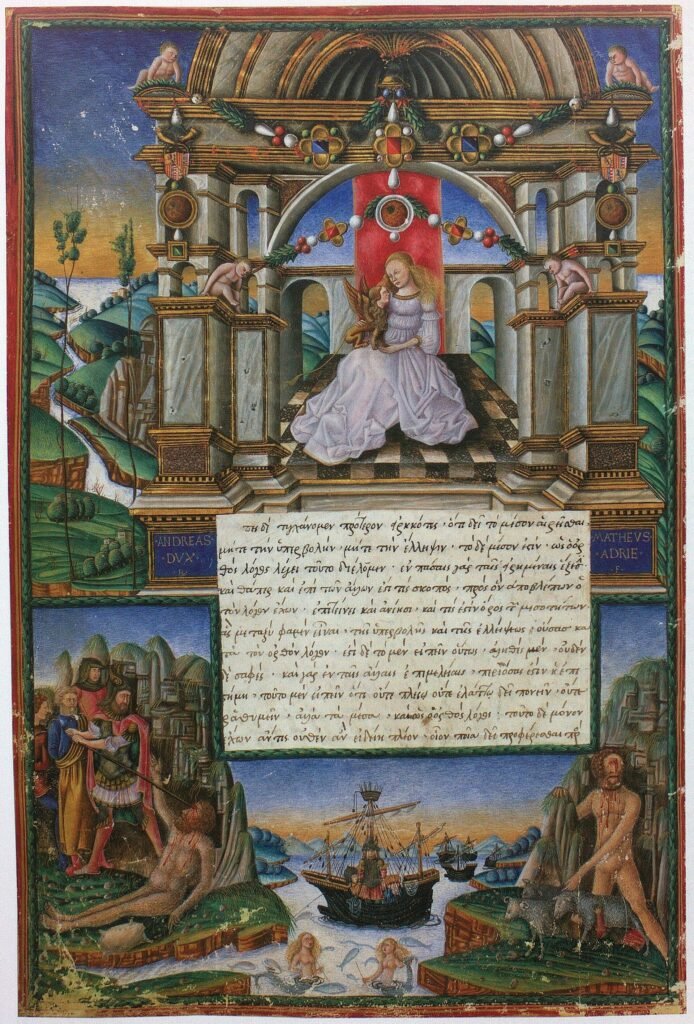
The Nicomachean Ethics is Aristotle’s treatise on how human beings can live well, built around happiness, the virtues of character and intellect, pleasure and friendship. It is the later of his two surviving works on ethics and the one that scholars usually study. Its central claim is that a good life consists in the active exercise of virtue guided by practical wisdom, not in rules applied mechanically.
Background and composition of the Nicomachean Ethics
Aristotle, who lived from 384 to 322 BCE, wrote two ethical treatises, the Nicomachean Ethics and the Eudemian Ethics. He did not use either title himself. The labels were added later, perhaps because the Eudemian Ethics was edited by his friend Eudemus and the Nicomachean Ethics by his son Nicomachus.
The two works cover much of the same ground. Both begin with eudaimonia, a word usually translated as happiness or flourishing, and then examine aretê, meaning virtue or excellence, and the traits of character a person needs for life at its best. Three books of the Eudemian Ethics reappear in the Nicomachean Ethics as Books V, VI and VII, and most scholars assume that the Nicomachean version is the later and improved one. A third work in complete editions, the Magna Moralia, has a disputed author.
The inquiry is tied to politics from the start. In the Politics Aristotle refers back to a work called ta ethika, meaning writings about character, which was probably the Eudemian Ethics.
Only the Nicomachean Ethics explores the close relation between ethical inquiry and politics, examines Solon’s claim that no one should be counted happy until dead, and gives arguments that the philosophical life is better than the political one. Before Aristotle no one had written systematic ethical treatises. Plato’s Republic, for example, does not treat ethics as a separate subject.
Summary of the Nicomachean Ethics
The work begins with a question about the highest good for human beings, and Aristotle answers that it is eudaimonia. He notes that people commonly value three kinds of life: one devoted to pleasure, one to politics and one to knowledge and understanding. In Book I he quickly dismisses the life of physical pleasure as vulgar.
The middle books examine the virtues of character, such as courage, temperance and justice. Aristotle treats them as complex rational, emotional and social skills, formed by upbringing and practice. Book VI turns to the intellectual virtues. It admits that the earlier talk of a mean needs supplementing, because it is not yet clear what right reason is or what standard it follows. The answer is practical wisdom, the ability to see in each situation which course of action is best supported by reasons.
Two books, VIII and IX, treat friendship. Aristotle distinguishes friendships by what they rest on: usefulness, pleasure or the goodness of the friend’s character, and he ranks the last as the fullest kind. He regards friends as part of a flourishing life, not an optional extra.
Later books take up weakness of will, which Aristotle calls akrasia, then pleasure and friendship. In Book X he returns to the three lives. He concedes that amusements are desirable in themselves but gives them a subordinate role, since people seek relaxation to return to more important activities. He then weighs politics against philosophy and argues for the superiority of the life of understanding.
Themes and interpretation of the Nicomachean Ethics
Ethical virtue, in Aristotle’s account, is a hexis, a stable state or disposition, that leads a person to have appropriate feelings and to act well. Because older translations rendered hexis as habit, many readers believe Aristotle reduces virtue to routine. The Internet Encyclopedia of Philosophy argues that this is a mistake, since a hexis is an active condition in which a person chooses an action knowingly and for its own sake.
The doctrine of the mean holds that every ethical virtue lies between two states, one of excess and one of deficiency. Courage, for example, lies between recklessness and cowardice. The mean is not an arithmetic average or a rule of moderation in everything. Aristotle stresses that ethical theory offers no decision procedure, that many generalizations hold only for the most part, and that the right action depends on the situation.
Aristotle also departs from his teacher Plato. He rejects the thesis, common in Plato’s early dialogues, that virtue is only a kind of knowledge. Virtue involves appropriate emotional responses, so a person cannot become good simply by studying. He likewise denies that complete virtue requires a training in mathematics and the sciences to grasp what goodness itself is.
The work presents ethics as a practical study. We study it, Aristotle says in effect, to improve our lives, so its main concern is the nature of human well-being.
Reception and legacy of the Nicomachean Ethics
The Nicomachean Ethics became the standard text of its subject. Medieval philosophers in the Islamic world and in Latin Christendom, including Thomas Aquinas, wrote commentaries and built their own accounts of virtue on it. In the twentieth century, philosophers dissatisfied with theories centered on duty or consequences revived a virtue-centered approach, and Aristotle’s work remains its main ancient source in modern ethics.
Scholars still debate several questions about the text, including the order in which Aristotle wrote his ethical treatises, how the account of practical wisdom fits with the praise of contemplation in Book X, and how precisely the function argument shows what human well-being is.
The treatise is also a reminder of how much depends on translation. Two of its most quoted ideas, virtue as habit and the golden mean, are widely misunderstood in popular summaries, and careful readers return to the Greek terms. It continues to be read in philosophy courses, in political theory and in professional ethics.
More in Philosophy
Key facts
- Aristotle wrote two ethical treatises, the Nicomachean Ethics and the Eudemian Ethics, and did not use either title himself.1
- The Nicomachean title may come from his son Nicomachus, who edited it.1
- Books IV to VI of the Eudemian Ethics reappear as Books V to VII of the Nicomachean Ethics.1
- Aristotle lived from 384 to 322 BCE.2
- The work compares three kinds of life: devoted to pleasure, to politics, and to knowledge and understanding.1
- Only the Nicomachean Ethics argues that the philosophical life is superior to the political life.1
Related concepts
In the news
Quick checkWhy is it called the Nicomachean Ethics?Show answer
The title was added later, perhaps because Aristotle's son Nicomachus edited the work.
Sources
- 1. Stanford Encyclopedia of Philosophy, Aristotle's Ethics, https://plato.stanford.edu/entries/aristotle-ethics/
- 2. Internet Encyclopedia of Philosophy, Aristotle: Ethics, https://iep.utm.edu/aristotle-ethics/
Editorially reviewed by Specialty Digest Editorial TeamLast reviewed November 5, 2026Researched and drafted with AI assistanceReport an issue