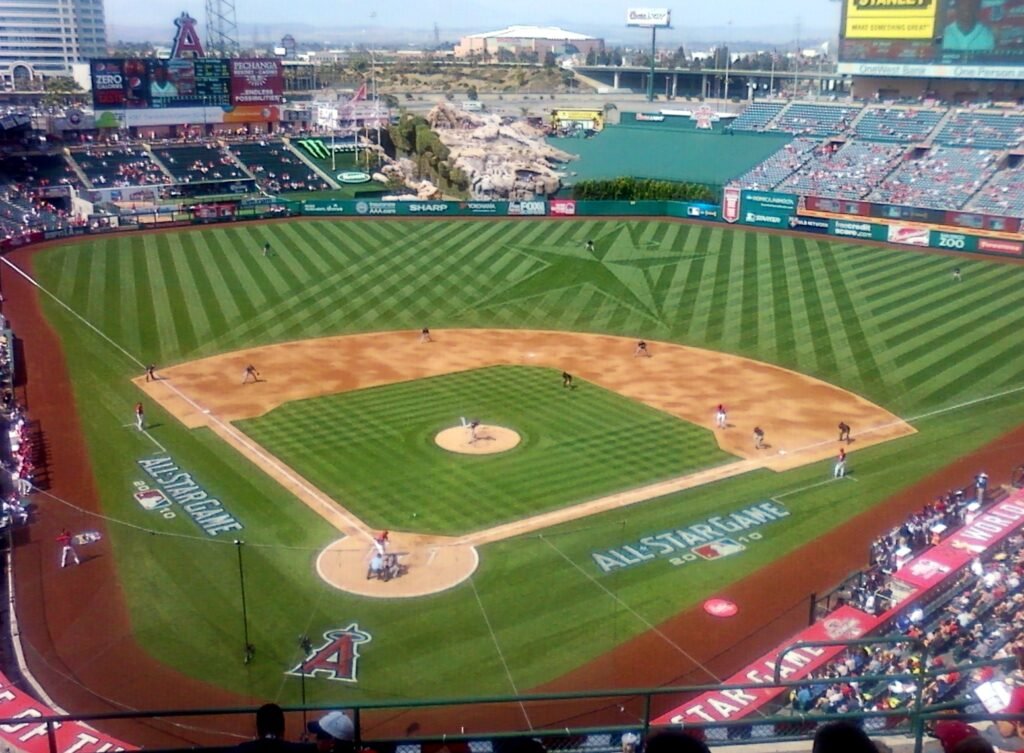
Baseball is a bat-and-ball team sport in which two teams of nine alternate between batting and fielding over nine innings. The batting team tries to score runs by hitting a pitched ball and circling the bases of a 90-foot diamond. The sport took its modern shape in the United States in the 19th century, and it is played professionally from North America to East Asia.
History of baseball
Baseball was not created in a single moment or place. Britannica notes that the game was not actually invented in the United States and lists older bat-and-ball games such as rounders and town ball among its roots. The popular story crediting Abner Doubleday with inventing it is a myth.
The earliest surviving written rules come from the New York Knickerbocker Base Ball Club. Its constitution and bylaws, adopted on September 23, 1845, contained twenty rules. The Library of Congress says the club compiled them in 1845 and that they were first printed for the public in 1848.
The Knickerbocker rules differ from today’s game. Distances between the bases were measured in paces, with 42 paces from home to second base, and a runner was put out by being touched with the ball rather than struck by it. Foul balls were defined relative to first and third base, which settled which hit balls counted as in play. The game ended when a team reached 21 counts, or aces. The club’s first recorded game was on October 6, 1845, and its first match game, on June 19, 1846, ended with the New York Club winning 23 to 1.
Alexander Cartwright is often called the author of these rules. William Wheaton claimed in an 1887 interview that he devised the diamond layout and the rule of throwing to a baseman, which questions Cartwright’s credit for them. The Society for American Baseball Research (SABR) also found no known documentary evidence that Cartwright wrote the rules, and it notes that the Hall of Fame plaque’s description of 90-foot bases and nine-inning games does not match the 1845 text.
Rival versions existed. A 1859 book described the Massachusetts Game, but by the mid-1860s the New York game had won out and been adopted nationwide. The journalist Henry Chadwick wrote for the New York Clipper, which printed accounts of games. Pitchers were no longer required to throw underhand after 1884.
Rules and how baseball is played
After a game ended 12 to 12 in a tie because of darkness in 1856, the Knickerbockers formed a committee to standardize the length of games. It settled on nine innings and nine players a side. MLB’s history of the rules says the number of players determined the number of innings.
Three strikes were already part of the 1845 Knickerbocker rules, according to MLB, although called strikes did not arrive until 1858. Called balls were introduced in 1863, initially only for every third unfair pitch, and the number needed for a walk settled at four in 1889. Home plate became a 12-inch square in 1887.
The basic contest is simple. The fielding team’s pitcher throws to a batter, who tries to hit the ball into fair territory and reach base safely. The nine innings and nine players chosen in 1856 still define the format. Pitching rules kept changing around that core. A relaxed arm motion arrived in 1872, overhand pitching was allowed in 1884, and in 1885 the National League required a rubber or marble home plate.
Equipment and venues
The infield is a square with sides of 90 feet. The pitching rubber is 60 feet, 6 inches from home plate, measured from the back point of the plate, and it sits 10 inches above the level of home plate.
MLB’s rules set minimum fence distances for professional parks built after June 1, 1958: at least 325 feet down each foul line and 400 feet to center field. Some clubs have been allowed shorter dimensions.
The outfield is the area between the foul lines extending from two sides of the infield square. Beyond the infield and the foul lines, the rules leave the shape of a ballpark to individual clubs, subject to those minimum fence distances.
Governing bodies and major competitions
Professional baseball organized quickly after the New York game spread. The National League was formed in 1876 and the American League in 1901, and the first World Series was held in 1903. Jackie Robinson made his Major League debut in 1947.
At the international level, the World Baseball Softball Confederation (WBSC) represents baseball and softball in the Olympic program. The IOC voted in 1986 to make baseball an Olympic sport, and it was a medal event at Barcelona, Atlanta, Sydney, Athens and Beijing between 1992 and 2008. It returned at Tokyo 2020, where Japan beat the United States in the baseball final.
Notable moments in baseball history
On June 19, 1846, a game played under the Knickerbocker rules at the Elysian Fields in Hoboken, New Jersey, ended at 21 aces. Around 40,000 people reportedly watched the Philadelphia Athletics play the Brooklyn Atlantics in 1866, which shows how quickly baseball became a spectator sport.
By 1862 Brooklyn had a defined baseball facility with a capacity of roughly 6,500 spectators, according to the Library of Congress.
On August 7, 2007, Barry Bonds hit his 756th career home run in San Francisco, a mark that Britannica describes as record-setting at the time.
Baseball around the world
Britannica lists the spread of the game to Japan and Cuba, and the history of the Negro leagues, among the main chapters of baseball history. Baseball appeared as an Olympic demonstration sport in St. Louis in 1904, Berlin in 1936, Tokyo in 1964 and Los Angeles in 1984, when 385,290 paying spectators attended the tournament.
The IOC confirmed baseball and softball for the Los Angeles 2028 Games at a session in Mumbai, India, on October 16, 2023.
Key facts
- The New York Knickerbocker Base Ball Club adopted twenty written rules on September 23, 1845.2
- The Knickerbockers settled on nine innings and nine players a side after a tied game in 1856.3
- The National League formed in 1876, the American League in 1901, and the first World Series was held in 1903.5
- The infield has 90-foot sides, and the pitching rubber is 60 feet, 6 inches from home plate.4
- Baseball became an Olympic medal sport in 1992 and returns at Los Angeles 2028.67
Related concepts
Quick checkDid Abner Doubleday invent baseball?Show answer
No. The Doubleday story is a myth. The earliest surviving written rules come from the New York Knickerbocker club in 1845, and even Alexander Cartwright's authorship of them lacks documentary proof.
Sources
- Library of Congress, If You Print It, They Will Come: Baseball's Early Years, https://blogs.loc.gov/bibliomania/2025/05/28/if-you-print-it-they-will-come-baseballs-early-years/
- Society for American Baseball Research, Alexander Cartwright, https://sabr.org/bioproj/person/alexander-cartwright/
- MLB, Why is a game 9 innings? The backstories behind baseball's iconic rules, https://www.mlb.com/cut4/stories-behind-baseball-rules-c210241338
- MLB, Field Dimensions, https://www.mlb.com/glossary/rules/field-dimensions
- Britannica, History of baseball, https://www.britannica.com/sports/history-of-baseball
- World Baseball Softball Confederation, Baseball and Softball confirmed as part of Olympic Games Los Angeles 2028 sports programme, https://www.wbsc.org/en/news/baseball-and-softball-confirmed-as-part-of-olympic-games-los-angeles-2028-sports-programme
- World Baseball Softball Confederation, Baseball in the Olympics, https://www.wbsc.org/en/news/baseball-in-the-olympics-a-sport-with-an-olympic-history-that-starts-with-royals-trying-to-play-with-an-orange
Editorially reviewed by Specialty Digest Editorial TeamLast reviewed November 4, 2026Researched and drafted with AI assistanceReport an issue