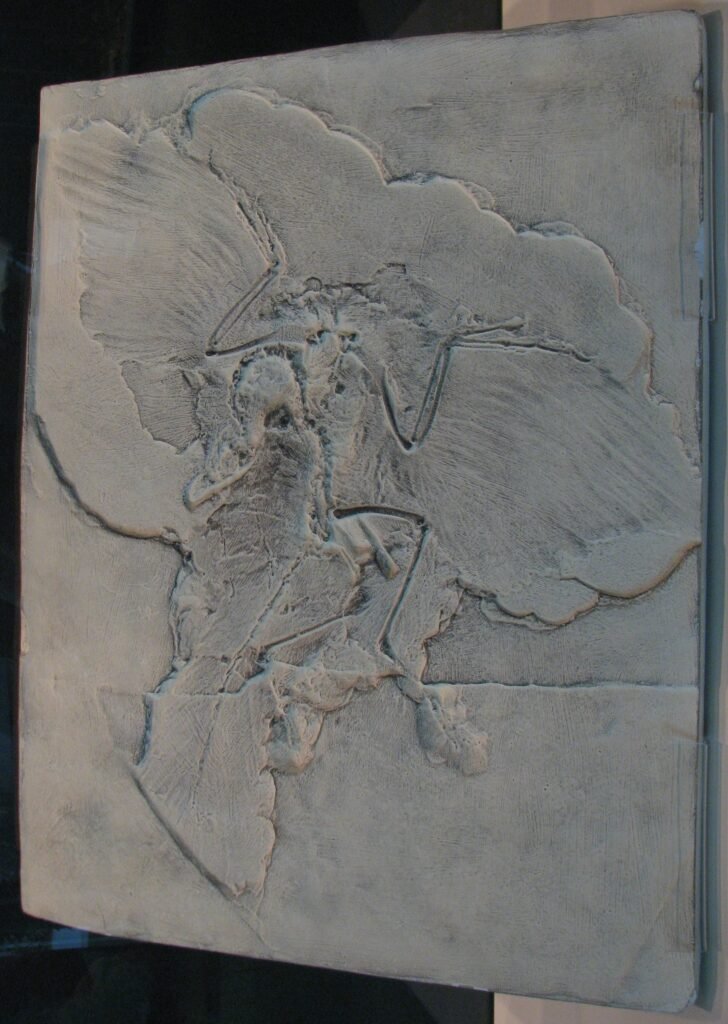
Archaeopteryx is a small feathered dinosaur of the Late Jurassic whose fossils were first found in 1861 in the Solnhofen limestone of Bavaria, Germany. The find combined dinosaur and bird features in one animal and became one of the best-known examples of a transitional fossil.
Background
The Solnhofen Limestone is a fine-grained rock formed about 150 million years ago. It is famous among paleontologists because it preserves rare fossils in exceptional detail, including soft features such as feather impressions.
The discovery came only two years after Charles Darwin published On the Origin of Species, at a time when the origin of birds was an open question. The Natural History Museum in London notes that no birds were known from so far back in time, and that the first fossil caused a lot of confusion. Some people even thought it might be an angel.
The discovery
Archaeopteryx lithographica was unearthed from the Solnhofen deposits in 1861. The first part to be described was an isolated feather. Researchers writing in Nature Communications call it the first described Archaeopteryx fossil, and it is now held in Berlin under the number MB.Av.100. The German paleontologist Hermann von Meyer described the material, and his 1862 publication illustrated the feather.
The first skeleton appeared soon afterward. According to the Natural History Museum, its London specimen came from the latest Jurassic limestone of Bavaria and was among more than 1,900 Solnhofen fossils bought from Dr. Karl Häberlein in 1862 for £700. The name Archaeopteryx means ancient wing. Germans call the animal Urvogel, meaning primeval bird.
How it was confirmed
More skeletons followed. The University of California Museum of Paleontology reported a total of seven specimens known in its account, and the Natural History Museum notes that multiple fossils have been found since 1861, many of them showing clear evidence of long feathers. A famous example is the Berlin specimen, whose original is kept at Humboldt University in Berlin and is catalogued as HMN 1880.
The skeletons show a mosaic of features. Archaeopteryx had a full set of teeth, a rather flat breastbone, a long bony tail, belly ribs and three claws on each wing that could have been used to grasp prey or branches. It also had feathers, wings, a wishbone and reduced fingers, all characteristics of modern birds. One specimen with poorly preserved feathers was first described as a skeleton of the small dinosaur Compsognathus.
Later studies added detail. In 2012 researchers examined the isolated feather using fossilized melanosomes, the structures that carry pigment, and concluded with 95 percent probability that it was originally black. They also found barbule microstructure identical to that of modern bird feathers, which means this fine feather structure had evolved by the Jurassic. The Natural History Museum adds that a comparison of its eye structure with those of living birds and reptiles suggests the animal was active during the day.
What kind of animal was it?
It had broad feathered wings and a small body. Whether it could fly well is not known: the Natural History Museum says it is unclear whether Archaeopteryx could fully fly or could only glide, and Berkeley suggests it may well have run, leaped, glided and flapped all in the same day.
It is long extinct, and the Natural History Museum classes it as a small theropod, the group of two-legged meat-eating dinosaurs that also includes the large predator in the discovery of Tyrannosaurus rex. The museum describes Archaeopteryx as roughly the size of a magpie, about half a meter long. It lived roughly 149 to 145 million years ago. The museum suggests that it may have eaten small reptiles, mammals or insects. Scientists are unsure whether it lived mostly on the ground or in trees, and some think it might have been equally comfortable in both, like a crow.
Disputes and open questions
The biggest question is how to classify Archaeopteryx. For many years it was called the first bird. The Natural History Museum explains that strictly all birds are dinosaurs, though not all dinosaurs are birds, and that these days many people think Archaeopteryx should be called a dinosaur. The categories are invented by humans and the natural world does not always fit them. The museum adds that other dinosaurs such as Anchiornis and Aurornis might sit even further back on the bird branch of the family tree, which would make them earlier relatives of true birds. It says that this is very difficult to establish.
Berkeley’s paleontology museum says Archaeopteryx resembles its ancestors among the maniraptoran dinosaurs even more than it resembles modern birds. It also records that the astronomer Fred Hoyle and colleagues proposed that the fossil was a forgery, a claim reviewed in a separate essay on its site.
The identity of the isolated feather has also been questioned. A 2019 study by Kaye and colleagues argued that its shape differed from that of upper major primary coverts, a kind of wing feather. A 2020 paper in Scientific Reports reported an error in the way that comparison had been drawn and found that the evidence corroborates the feather as a wing covert of Archaeopteryx. The two groups disagree, and the discussion continues.
Impact and legacy
The Natural History Museum describes Archaeopteryx as one of the few fossils that show evolution in action, with the transition between two major groups of animals. Berkeley calls it one of the most important fossils ever discovered, a strong link between dinosaurs and birds. Researchers writing in Nature Communications describe it as an icon of evolution ever since its discovery, and its mixture of reptile-like traits, such as teeth, a long tail and clawed fingers, with bird-like plumage has inspired a large scientific literature. Many experts, in the museum’s words, now think of it as a transitional fossil that sits across two categories rather than neatly inside one.
It has also shaped debate about the origin of flight. In one model, birds evolved from tree-living ancestors that glided down, as flying squirrels do. In another, the ancestors lived on the ground and made long leaps. Berkeley says it is currently thought that Archaeopteryx could sustain powered flight but was probably not a strong flier, and that feathers may first have evolved for insulation before being used for flight.
More in Biology
Key facts
- Archaeopteryx was unearthed from the Solnhofen Limestone of Germany in 1861.1
- The first described specimen was an isolated feather, catalogued as MB.Av.100.1
- The Natural History Museum bought its specimen with more than 1,900 Solnhofen fossils in 1862 for 700 pounds.2
- A 2012 study concluded the isolated feather was black, with 95 percent probability.1
- Archaeopteryx lived about 149 to 145 million years ago.3
- Many experts now class Archaeopteryx as a dinosaur rather than simply a bird.3
Related concepts
Quick checkWhen was Archaeopteryx discovered?Show answer
In 1861, in the Solnhofen Limestone of Bavaria, Germany. An isolated feather was the first part described, and the first skeleton followed soon after.
Sources
- 1. Nature Communications, New evidence on the colour and nature of the isolated Archaeopteryx feather, https://www.nature.com/articles/ncomms1642
- 2. Natural History Museum, London, Fossil bird collection, https://www.nhm.ac.uk/our-science/services/collections/palaeontology/fossil-birds.html
- 3. Natural History Museum, London, Dino Directory: Archaeopteryx, https://www.nhm.ac.uk/discover/dino-directory/archaeopteryx.html
- 4. University of California Museum of Paleontology, Archaeopteryx: An Early Bird, https://ucmp.berkeley.edu/diapsids/birds/archaeopteryx.html
- 5. Scientific Reports, Evidence corroborates identity of isolated fossil feather as a wing covert of Archaeopteryx, https://www.nature.com/articles/s41598-020-65336-y
Editorially reviewed by Specialty Digest Editorial TeamLast reviewed November 5, 2026Researched and drafted with AI assistanceReport an issue