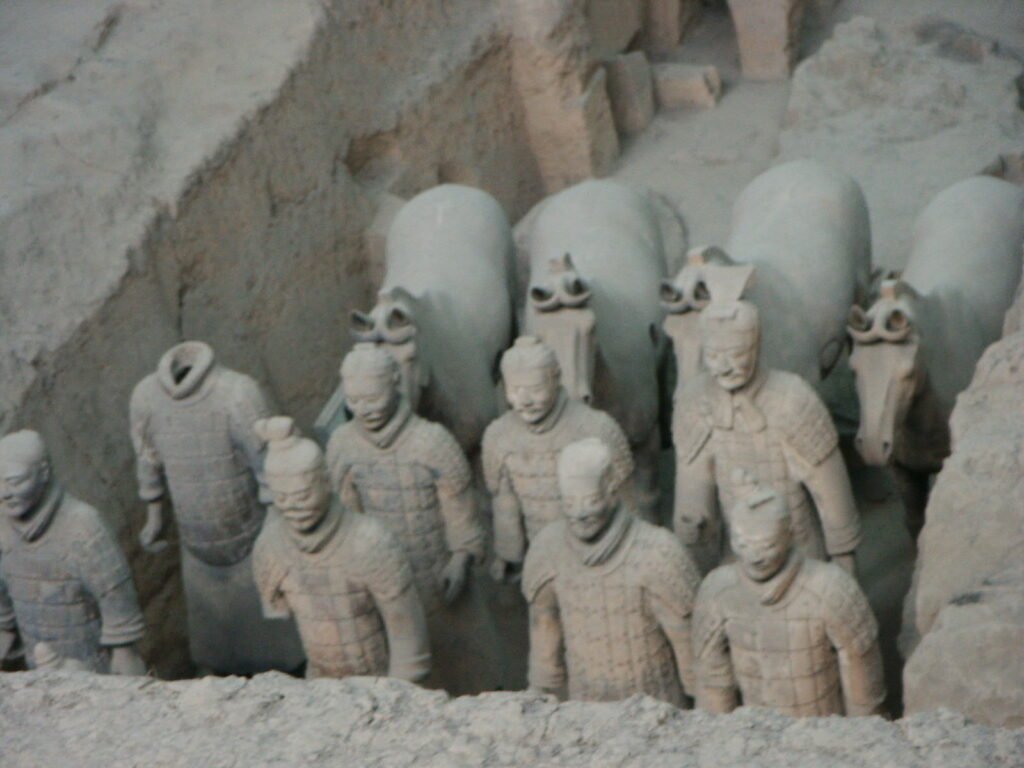
The discovery of the Terracotta Army happened on 29 March 1974, when farmers digging a well near Xi’an in Shaanxi Province, China, struck buried clay figures of soldiers. The figures guarded the tomb of Qin Shi Huang, the first emperor of a unified China, who died in 210 BCE.
Archaeologists have since uncovered thousands of life-size warriors, horses and chariots in pits near the burial mound. The emperor’s own burial chamber has not been opened.
Background to the discovery of the Terracotta Army
Qin Shi Huang ruled the state of Qin and, from 221 BCE, a unified China. He imposed one system of writing, money, weights and measures across the land, and he began building his tomb in 246 BCE.
The historian Sima Qian, who lived from about 145 to 95 BCE, wrote that workers from every province labored on the tomb until the emperor died in 210 BCE. In a passage from his history, translated by the World History Encyclopedia, he gives the number of convict laborers as more than 700,000.
The mausoleum is the largest tomb in Chinese history, according to UNESCO, and its layout is unique. It lies at the northern foot of Lishan Mountain, about 35 kilometers northeast of Xi’an. The grave mound still rises 51.3 meters inside a rectangular enclosure with two walls, and written records alone did not reveal the army buried beside it.
The discovery
On 29 March 1974, farmers digging a well in the Lintong District near Xi’an reached the clay figures. The spot lay east of the burial mound, at the foot of Lishan.
Excavation followed, and according to the New World Encyclopedia the State Council authorized a museum on the site in 1975. The work opened a window onto one of the largest burial complexes ever recorded.
The find spot lies just over a kilometer east of the burial mound.
The main pit, known as Pit 1, measures about 230 by 62 meters and is 4 to 6 meters deep. It contained around 6,000 infantry figures standing about 1.8 to 1.9 meters tall, together with chariots and horses, once covered by a roof supported on wooden columns.
Three of the four pits found so far have been fully explored. The army occupies only one quarter of the tomb area, and even that section has not been fully excavated, while the inner tomb of the emperor remains unopened.
How the discovery was confirmed
Confirmation came from the objects themselves and from the written record. The weapons found in place include lances, swords, axes, halberds, bows and arrows, which match what is known of the armies of the Warring States period (475 to 221 BCE) and the short Qin Empire (221 to 210 BCE).
The figures are modeled in great detail, from uniforms and weapons to the halters on the horses. That precision lets researchers study the craft techniques of potters and bronze workers as well as military organization.
Survey of the wider area then showed that the army was only one part of a much larger complex. UNESCO counts nearly 200 accompanying pits holding thousands of terracotta soldiers and horses and bronze chariots and weapons, along with tombs and architectural remains, across more than 600 sites in a protected area of 56.25 square kilometers.
The army faces outward from the tomb. UNESCO reads that arrangement as a symbolic guard against threats from any direction, and it notes that the layout of the whole mausoleum echoes the plan of the Qin capital, Xianyang.
Impact and legacy of the discovery
The find is regarded as one of the greatest archaeological discoveries of the twentieth century. It gave scholars direct physical evidence for the military organization, weapons and sculpture of the first Chinese empire, which had previously been known mainly from texts.
UNESCO lists the mausoleum as a World Heritage Site and calls the terracotta warriors, horses and bronze chariots major works in the history of Chinese sculpture before the Han dynasty. The Qin mausoleum is also the largest preserved site of its kind in China.
UNESCO rates the site highly for integrity and authenticity. The grave mound, the burial pits, the sites of ritual buildings and the surrounding setting are well preserved, so the complex still reflects the layout and ritual system of the original mausoleum.
The complex also records the power of the dynasty that built it. According to UNESCO, the Qin Empire of the third century BCE held unprecedented political, military and economic power, and it advanced the social, cultural and artistic level of the empire it ruled.
UNESCO ties the mausoleum to an event of universal significance, the first unification of Chinese territory by a centralized state in 221 BCE. The mausoleum is a World Heritage Site, a status administered by UNESCO, and it ranks among the best-known places in China.
The site has also shaped Xi’an. The city, an ancient capital, is discussed in the entry on Xi’an, and visitors from around the world come to see the pits.
Estimates and open questions
The exact number of figures is uncertain. Sources describe the army as more than 7,000 warriors, 600 horses and 100 chariots, while others mention about 8,000 figures, and only part of the complex has been excavated.
Archaeologists have not opened the main burial chamber. Sima Qian wrote that it held a model of the heavens and the land, with traps to deter intruders, but those descriptions have not been checked directly.
Sima Qian also wrote that members of the emperor’s harem and many craftsmen and laborers were entombed with him. That account has not been checked by excavation, so it remains a historical claim rather than an archaeological finding.
Because of such gaps, the discovery is still an active field of research. Surveys, conservation work and careful excavation continue to refine what is known about how the figures were made, who made them and how the complex was organized.
More in Archaeology
Key facts
- Farmers digging a well near Xi'an found the Terracotta Army on 29 March 1974.2
- The tomb of Qin Shi Huang was begun in 246 BCE and lies about 35 kilometers northeast of Xi'an.1
- The mausoleum has nearly 200 accompanying pits and more than 600 sites in a protected area of 56.25 square kilometers.1
- Pit 1 measures about 230 by 62 meters and held around 6,000 infantry figures with chariots and horses.2
- The emperor's inner tomb has not been excavated.2
Related concepts
Quick checkWhen was the Terracotta Army discovered?Show answer
On 29 March 1974, when farmers digging a well in the Lintong District near Xi'an, Shaanxi Province, uncovered clay warriors from the tomb of Qin Shi Huang.
Sources
- UNESCO World Heritage Centre, Mausoleum of the First Qin Emperor, https://whc.unesco.org/en/list/441
- World History Encyclopedia, Terracotta Army, https://www.worldhistory.org/Terracotta_Army/
- New World Encyclopedia, Terracotta Army, https://www.newworldencyclopedia.org/entry/Terracotta_Army
Editorially reviewed by Specialty Digest Editorial TeamLast reviewed November 5, 2026Researched and drafted with AI assistanceReport an issue