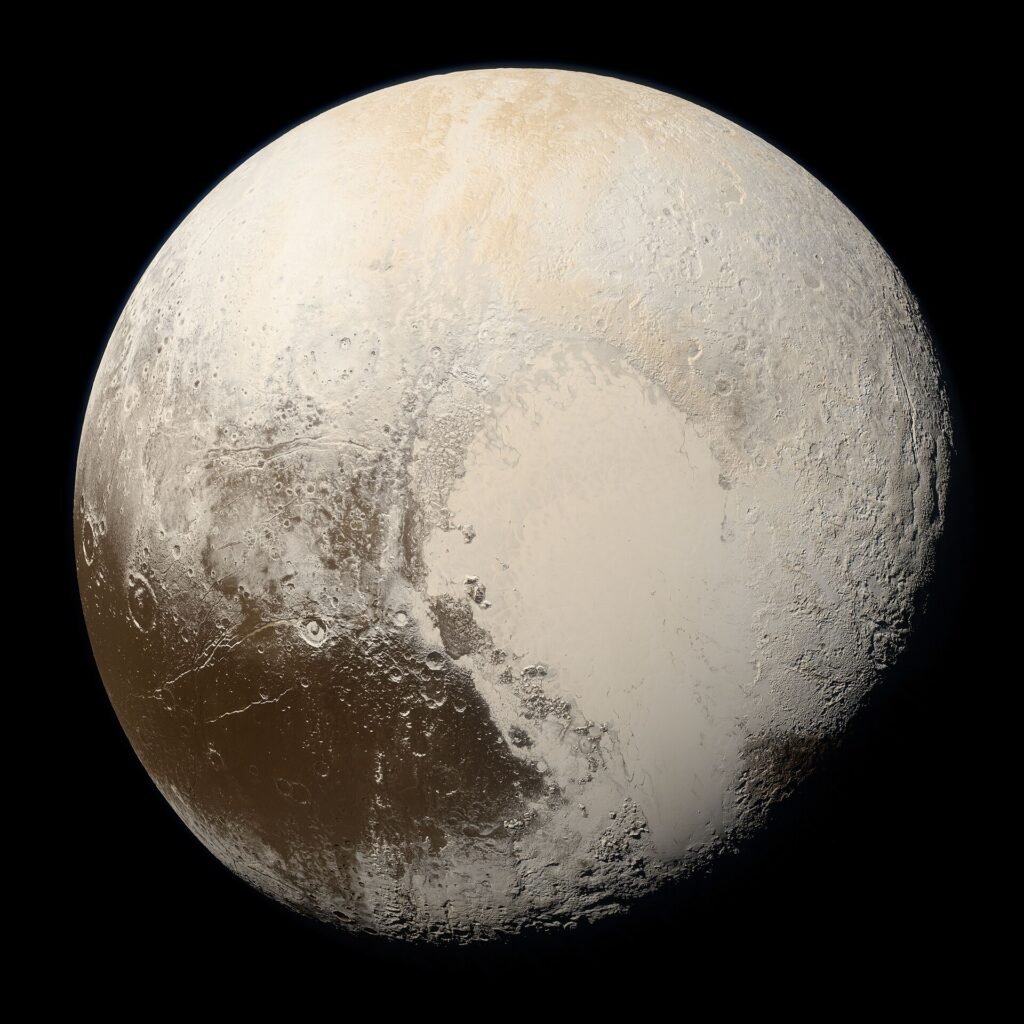
The discovery of Pluto was made by Clyde Tombaugh at Lowell Observatory in Arizona on 18 February 1930, when he spotted a small moving dot on two photographic plates. It was announced on 13 March 1930 as the ninth planet. In 2006 the International Astronomical Union reclassified Pluto as a dwarf planet.
Background to the discovery of Pluto
The search for Pluto began with Percival Lowell, the founder of Lowell Observatory. From 1905 until his death in 1916, he looked for a ninth planet that he called Planet X. Lowell based his prediction on irregularities in the orbit of Uranus, the same type of evidence that led astronomers to Neptune in 1846.
The search stalled after Lowell’s death. In 1929, the observatory’s director, V. M. Slipher, hired Clyde Tombaugh, a self-taught astronomer, to resume it. Tombaugh was given the job of taking and examining photographic plates of the night sky, looking for objects that moved against the background stars.
The discovery of Pluto
Tombaugh photographed the same patch of sky on different nights using long exposures. On 18 February 1930, he compared two plates of one region taken about six days apart in late January, and he noticed a small dot that had changed position. According to the Linda Hall Library, he used an instrument called a blink comparator to do this.
A blink comparator projects two photographs onto one screen and alternates between them quickly. Stars stay in place, while anything that has moved appears to jump back and forth. Tombaugh checked the dot on other plates and then told Slipher that he had found Planet X, according to Astronomy magazine.
How the discovery was confirmed and named
After the observatory confirmed the find, it announced the ninth planet on 13 March 1930, which was Percival Lowell’s birthday. The news traveled quickly. Tombaugh went from an enthusiastic amateur to an international celebrity in a short time.
The name came from an 11-year-old girl in Oxford, England. NASA states that Venetia Burney suggested Pluto over breakfast, and its account places the news reaching her family on 14 March 1930, a day after Lowell Observatory’s announcement. The suggestion reached the observatory and was selected, and the American Astronomical Society officially accepted it later that year.
Scientific significance of Pluto
For 76 years Pluto was counted as the ninth planet. Its orbit is unlike those of the eight larger planets. NASA describes it as both elliptical and tilted, taking about 248 years to circle the Sun and ranging from 30 to 49.3 astronomical units away. Its average distance is about 3.7 billion miles, or 5.9 billion kilometers, roughly 39 times Earth’s distance from the Sun.
Pluto is small. Its equatorial diameter is about 1,477 miles, or 2,377 kilometers, roughly one fifth the width of Earth. It has five known moons: Charon, Nix, Hydra, Kerberos and Styx. Charon is about half the size of Pluto, which NASA says makes it the largest satellite relative to its planet in the solar system, and the pair is often called a double planet.
Reclassification as a dwarf planet
As astronomers found other objects in the region beyond Neptune, called the Kuiper Belt, it became clear that Pluto was one of many. In 2006, the International Astronomical Union reclassified it as a dwarf planet. NASA quotes the resolution: a dwarf planet orbits the Sun, is massive enough to pull itself into a nearly round shape, but has not cleared its orbit of other objects.
NASA explains that Pluto was reclassified because other objects might cross its orbit. It also notes that Pluto is about 14 times more massive than Ceres, the largest object in the asteroid belt, which shows how small these worlds are by planetary standards. The decision was a change of category, not a change in the discovery itself. According to the Linda Hall Library, Tombaugh died in 1997 at the age of 90 and did not live to see the change. His widow said he would have understood it, since the alternative was a list of planets that kept growing.
Later developments and legacy
NASA’s New Horizons spacecraft flew past Pluto on 14 July 2015, giving the first close views of a world once seen only as a dot. It revealed mountains, valleys, plains, craters and glaciers. One widely shared image, taken on 13 July 2015 from 476,000 miles, or 768,000 kilometers, away, showed a large bright region that people called Pluto’s heart. New Horizons also carried a portion of Tombaugh’s ashes, which the Linda Hall Library confirms.
The blink comparator Tombaugh used is preserved at Lowell Observatory. The instrument is a reminder that the discovery depended on patient comparison of photographs rather than on a single dramatic observation. Pluto’s story also shows how a scientific category can change as knowledge grows without erasing the achievement of the person who first found the object.
From the surface of Pluto at noon, NASA says, the Sun would look about 1/900 as bright as it does on Earth, though still around 300 times brighter than a full moon. Sunlight takes about 5.5 hours to reach the dwarf planet. Its rotation axis is tilted 57 degrees to its orbit, and it spins east to west, like Venus and Uranus.
Charon orbits Pluto at a distance of about 12,200 miles, or 19,640 kilometers, once every 153 hours, the same time Pluto takes to rotate once. As a result Charon hovers over one spot on Pluto and keeps the same face turned toward it. Its name comes from the boatman who ferries souls across the river Styx and also honors Charlene, the wife of Charon’s discoverer James Christy, who was nicknamed Char. The other four moons are much smaller, under 100 miles wide, and are named for other figures linked to the underworld.
More in Astronomy & Space
Key facts
- Clyde Tombaugh spotted Pluto on 18 February 1930 by comparing two plates of one sky region taken about six days apart in late January.2
- He used a blink comparator at Lowell Observatory; Percival Lowell had searched for a ninth planet from 1905 until his death in 1916.3
- Lowell Observatory announced the ninth planet on 13 March 1930.3
- Venetia Burney, aged 11, suggested the name Pluto; the American Astronomical Society accepted it later in 1930.13
- The International Astronomical Union reclassified Pluto as a dwarf planet in 2006.1
- Pluto has an equatorial diameter of about 2,377 kilometers and takes about 248 years to orbit the Sun.1
- NASA's New Horizons spacecraft flew past Pluto on 14 July 2015.1
Related concepts
Quick checkWho discovered Pluto, and when?Show answer
Clyde Tombaugh found it on photographic plates at Lowell Observatory on 18 February 1930. The discovery was announced on 13 March 1930.
Sources
- NASA Science, Pluto Facts, https://science.nasa.gov/dwarf-planets/pluto/facts/
- Linda Hall Library, Scientist of the Day: Clyde Tombaugh, https://www.lindahall.org/clyde-tombaugh
- Astronomy magazine, Feb. 18, 1930: Discovery of Pluto, https://www.astronomy.com/today-in-the-history-of-astronomy/feb-18-1930-discovery-of-pluto/
Editorially reviewed by Specialty Digest Editorial TeamLast reviewed November 5, 2026Researched and drafted with AI assistanceReport an issue