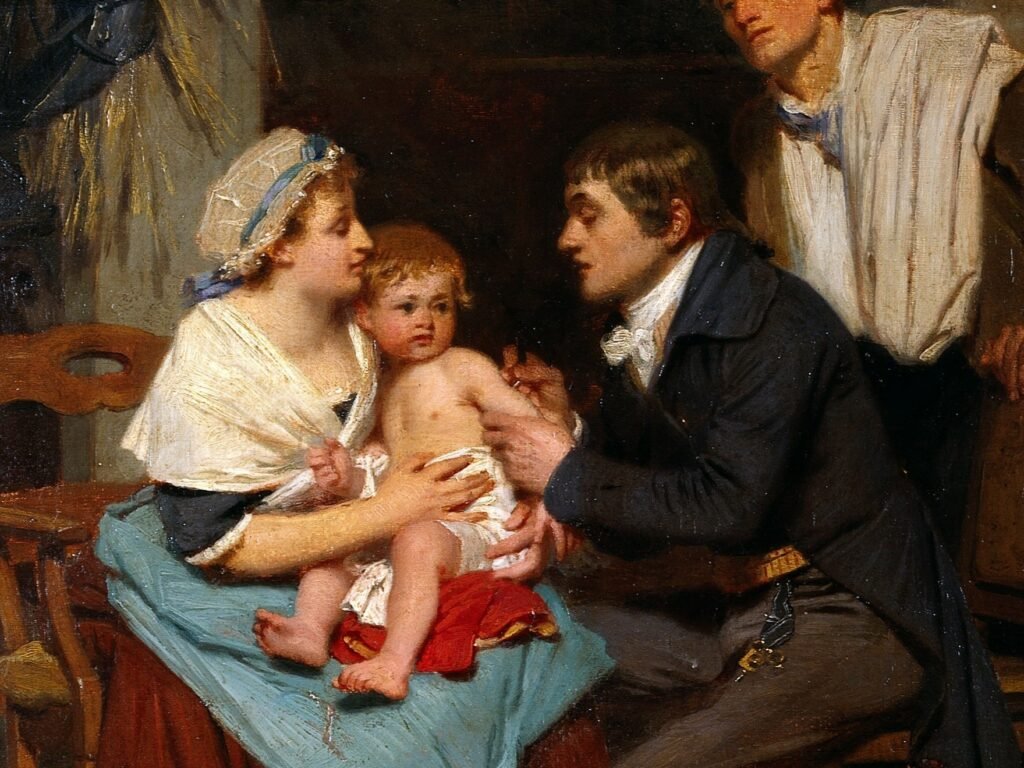
The discovery of vaccination was the finding, made in England between 1774 and 1796, that deliberate exposure to cowpox protects people from smallpox. Benjamin Jesty carried out the first recorded vaccination in 1774, and Edward Jenner tested the idea systematically in 1796 and published it in 1801.
Background
Smallpox is one of the oldest known diseases. The US Centers for Disease Control and Prevention notes that smallpox-like rashes on Egyptian mummies suggest it has existed for at least 3,000 years. The earliest written description of a similar disease appeared in China in the 4th century.
Long before vaccination, people tried to prevent smallpox by variolation, which means inoculating a healthy person with material from a smallpox sore. Methods varied. One tradition took material from people with the milder form of the disease, while in India it was introduced through a scratch in the skin.
Variolation reached Europe in the 18th century largely through Lady Mary Wortley Montagu, wife of the British ambassador to the Ottoman Empire, who learned of it in Constantinople. Fewer people died from variolation than from natural smallpox. The method still carried real risks, including severe smallpox and death.
Rural communities had also noticed a pattern. People who had caught cowpox, a mild disease of cattle, seemed to be protected from smallpox, even when they were closely exposed to it.
The discovery
In 1774, during a smallpox outbreak in England, Benjamin Jesty acted on that observation. He inoculated his wife and two sons with material from a cowpox pustule, using a stocking needle. He did not treat himself, because he had already had cowpox. His family never suffered from smallpox, even when they were later exposed to it. This is considered the first recorded vaccination.
Edward Jenner, an English doctor, noticed the same pattern in 1796, when he saw that milkmaids who had had cowpox seemed protected from smallpox. He also knew about variolation and guessed that cowpox could be used in the same way, with less danger.
To test the idea, Jenner took material from a cowpox sore on the hand of the milkmaid Sarah Nelmes and inoculated it into the arm of James Phipps, the 8-year-old son of his gardener. Months later Jenner exposed the boy several times to variola virus, the cause of smallpox. Phipps never developed the disease.
More experiments followed. In 1801 Jenner published a treatise, “On the Origin of the Vaccine Inoculation,” summarizing his results and expressing the hope that the “annihilation of the smallpox” would be the final result of the practice.
The word vaccine comes from Jenner’s phrase variolae vaccinae, which literally means smallpox of the cow.
How it was confirmed
Jenner’s results could be checked by anyone willing to repeat the procedure and then test for protection. Vaccination became widely accepted and gradually replaced variolation. At some point in the 1800s, the virus used to make the smallpox vaccine changed from cowpox to vaccinia virus.
Modern smallpox vaccines are still made from vaccinia, a poxvirus that is similar to the smallpox virus but less harmful. The CDC states that these vaccines do not contain the smallpox virus and cannot give a person smallpox.
In 1881 the French scientist Louis Pasteur, in recognition of Jenner’s legacy, proposed extending the terms vaccine and vaccination to the new protective immunizations being developed at the time. The words then came to describe any preparation that confers immunity to an infectious disease.
Disputes over credit
Jesty is recognized as the first vaccinator, and he acted twenty-two years before Jenner. Jenner, however, ran systematic experiments, published his results and promoted the method widely. A 2023 review concludes that this work laid the foundations of vaccinology as a scientific discipline.
Variolation also deserves mention. The idea of deliberately inducing mild immunity predates both men by centuries, and Jenner’s contribution was to replace smallpox material with the safer cowpox.
Impact and legacy
A vaccine is a biological product designed to stimulate the immune system to produce immunity to a specific pathogen, which prevents the disease it causes. Vaccines are generally made from weakened or inactivated versions of the pathogen, or from parts of it such as proteins and sugars. Newer designs include the mRNA vaccines introduced in recent years.
Smallpox became the first human disease to be eradicated. The World Health Organization began a global plan in 1959, and an Intensified Eradication Program started in 1967. Smallpox was eliminated from South America by 1971, Asia in 1975 and Africa in 1977. The last known naturally acquired case was reported in 1977, and on 8 May 1980 the 33rd World Health Assembly declared the world free of the disease. The full story is told in Eradication of smallpox.
Because smallpox no longer occurs naturally, the CDC does not recommend smallpox vaccines for the general public. Health officials would use them to control an outbreak if one occurred.
Vaccination did not stop with smallpox. Pasteur went on to develop vaccines for chicken cholera, anthrax and rabies, and the 2023 review traces the development of all later vaccines back to Jenner’s discoveries.
FAQs
Who discovered vaccination? Benjamin Jesty performed the first recorded vaccination in 1774. Edward Jenner tested the method systematically in 1796 and published it in 1801.
Why is it called vaccination? The word comes from variolae vaccinae, Jenner’s term for cowpox, from the Latin word for cow.
Who was James Phipps? He was the 8-year-old son of Jenner’s gardener, and in 1796 he was the first person Jenner inoculated with cowpox and later exposed to smallpox.
Did vaccination end smallpox? Vaccination was the main tool in the global eradication campaign. The World Health Assembly declared smallpox eradicated on 8 May 1980.
Key facts
- In 1774 Benjamin Jesty inoculated his wife and two sons with cowpox material, considered the first recorded vaccination.2
- In 1796 Edward Jenner inoculated James Phipps with cowpox from the hand of Sarah Nelmes; Phipps did not develop smallpox when later exposed.1
- Jenner published "On the Origin of the Vaccine Inoculation" in 1801.1
- The word vaccine derives from Jenner's variolae vaccinae, and Pasteur proposed extending it to other immunizations in 1881.2
- The 33rd World Health Assembly declared smallpox eradicated on 8 May 1980.1
- Modern smallpox vaccines use vaccinia virus and cannot cause smallpox.3
This entry explains a medical term. It is not medical advice. If you are concerned about your health, speak with a qualified health professional.
Related concepts
Quick checkWho discovered vaccination?Show answer
Benjamin Jesty gave the first recorded cowpox vaccination in 1774, and Edward Jenner tested the method systematically in 1796 and published it in 1801.
Sources
- US Centers for Disease Control and Prevention, History of Smallpox, https://www.cdc.gov/smallpox/about/history.html
- Frontiers in Public Health (2023), Two centuries of vaccination: historical and conceptual approach and future perspectives, https://pmc.ncbi.nlm.nih.gov/articles/PMC10803505/
- US Centers for Disease Control and Prevention, Smallpox Vaccine, https://www.cdc.gov/smallpox/vaccines/index.html
- PubMed Central (2024), Louis Pasteur: A Legacy Unmasked, https://pmc.ncbi.nlm.nih.gov/articles/PMC11438523/
Editorially reviewed by Specialty Digest Editorial TeamLast reviewed November 5, 2026Researched and drafted with AI assistanceReport an issue