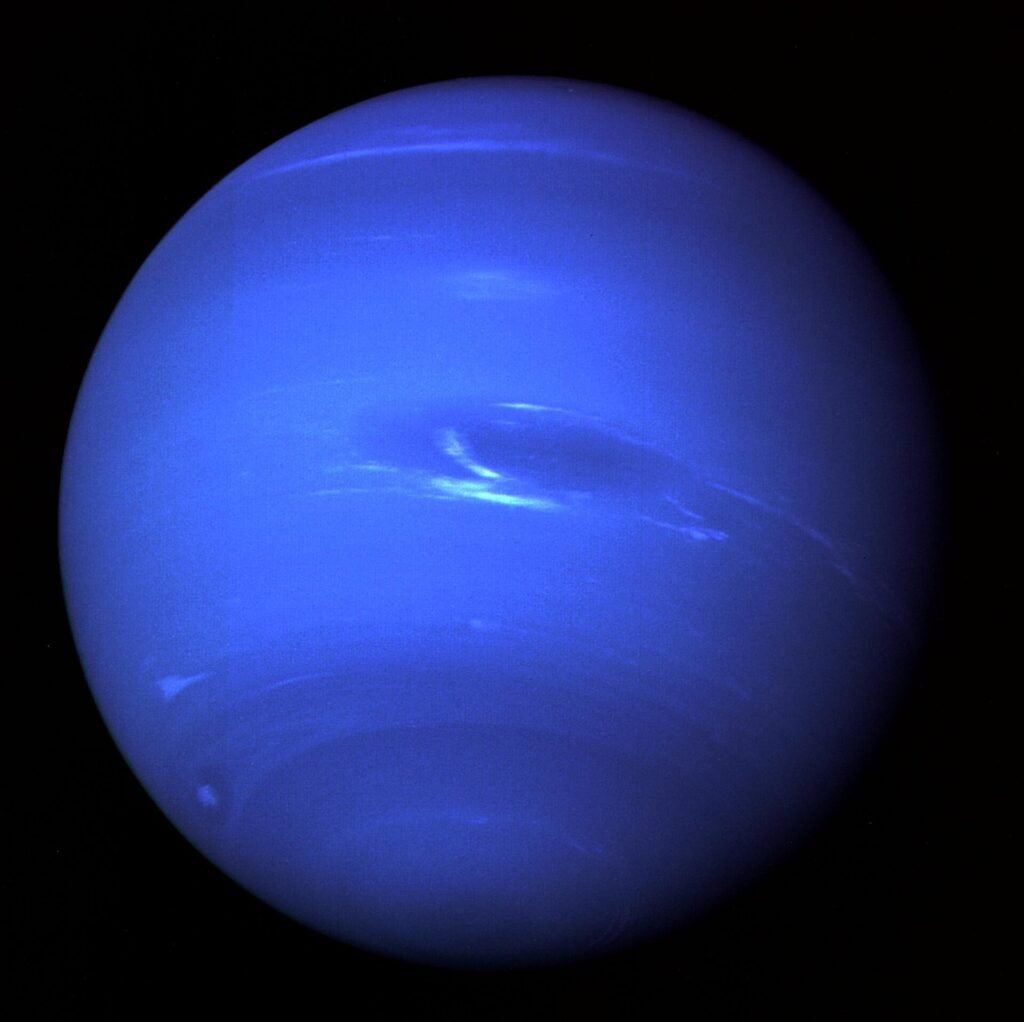
The discovery of Neptune was the identification of the eighth planet on 23 September 1846, found at the Berlin Observatory after mathematicians predicted where it should be. It is the only planet in the solar system located by calculation before anyone saw it. Astronomers still discuss how credit should be shared among the people involved.
Background to the discovery of Neptune
After William Herschel’s discovery of Uranus in 1781, astronomers tracked the new planet for decades. Its observed positions kept drifting away from the path that the known planets’ gravity should produce. Astronomers concluded that an unknown world might be pulling on Uranus and altering its orbit.
Searching for such a body was a problem of mathematics before it was one of astronomy. A calculator had to work backward from small errors in one planet’s motion to the mass and position of something nobody had ever seen. Le Verrier and Adams each took on that task independently, using the recorded motion of Uranus as their only evidence.
The discovery of Neptune
The English mathematician John Couch Adams began work on the problem after more than twenty years of unexplained discrepancies. According to Astronomy magazine, he doubted his early results and kept starting over, and by early 1846 he had computed possible orbits for the unknown planet. He did not publish them until November of that year.
Meanwhile the French mathematician Urbain Le Verrier published his own independent and slightly different calculation. After months of lukewarm responses from astronomers in France, he wrote to Johann Gottfried Galle at the Berlin Observatory and asked him to search with the observatory’s telescope. NASA says Le Verrier proposed both the position and the mass of the unknown planet.
Galle received the letter on 23 September 1846. That same evening he found Neptune, according to Astronomy magazine. It lay about one degree from the position Le Verrier had predicted and about twelve degrees from the one Adams had suggested. NASA adds that Galle found it on his first night of searching.
How the discovery was confirmed
The close match between the predicted and observed positions was itself the strongest confirmation. A faint object had appeared almost exactly where mathematics said a planet should be.
The British effort had not succeeded. After the similarity between the French and English results became clear, the Astronomer Royal, George Airy, urged the astronomer James Challis to search the sky. According to Astronomy magazine, Challis looked over a much wider area than Adams had suggested and did not check whether the objects he logged had moved from night to night. He recorded Neptune twice before Galle did, but he never recognized it. Seventeen days after Galle’s sighting, William Lassell discovered Neptune’s largest moon, Triton, on 10 October 1846, according to NASA.
Disputes over credit for discovering Neptune
An international controversy followed. Adams had finished his calculations first, but Le Verrier published first, and his results proved more accurate. Astronomy magazine reports that international opinion eventually gave Adams and Le Verrier joint credit.
That settlement was later questioned. In 1999, a collection of long-missing British documents came to light and, according to the same article, showed a deliberate bending of the facts that made Adams’s role look stronger than it was. Some sources still credit both men, but the magazine argues that the historical record supports crediting Le Verrier, who predicted the location and persuaded an observer to look.
A separate claim concerns Galileo. In 2009, the physicist David Jamieson argued that notebooks from December 1612 and January 1613 show Galileo saw Neptune and noticed it move. Astronomy magazine points out that a small dot in Galileo’s drawings is unlabeled, so no one can know what he thought it was, and the evidence suggests he did not recognize it as a planet.
Scientific significance of Neptune
The discovery showed that mathematical reasoning about gravity could point to an unseen planet and that observation could then confirm it. It also gave Neptune its place as the eighth planet. NASA notes that the planet was named for the Roman god of the sea, so its moons carry the names of lesser sea gods and nymphs from Greek mythology.
Neptune is an ice giant like Uranus, and NASA says most of its mass, 80 percent or more, is a hot, dense fluid of water, methane and ammonia above a small rocky core. Its equatorial diameter is 30,775 miles, and it makes one orbit of the Sun in about 165 Earth years. Pluto’s elongated orbit brought it inside Neptune’s from 1979 to 1999, but the two never collide because Pluto completes two laps for every three Neptune makes.
Later developments and legacy
NASA’s Voyager 2 spacecraft flew past Neptune in August 1989 and showed the planet’s rings, moons and a large storm. NASA reports that the images were adjusted at the time to bring out clouds and features, which made Neptune look a much deeper blue than Uranus, and researchers reprocessed them in 2024 to show that the two planets look more alike than many people thought.
NASA reports 16 known moons today. Triton circles the planet in the opposite direction from the planet’s rotation, which suggests it may once have been an independent object that Neptune captured. Neptune’s winds exceed 1,200 miles per hour, or 2,000 kilometers per hour, making it the windiest world in the solar system.
NASA says Neptune has at least five main rings, named Galle, Leverrier, Lassell, Arago and Adams. Four of those names belong to astronomers who appear earlier in this account of the discovery. The rings are thought to be relatively young and short-lived, and the outermost ring contains clumps of material called arcs, including four prominent ones named Liberte, Egalite, Fraternite and Courage.
More in Astronomy & Space
Key facts
- Johann Gottfried Galle found Neptune at the Berlin Observatory on 23 September 1846, the evening he received Urbain Le Verrier's letter.2
- The planet lay about one degree from Le Verrier's predicted position and about twelve degrees from John Couch Adams's.2
- Adams finished his calculations first, but Le Verrier published first.2
- James Challis recorded Neptune twice before Galle but did not recognize it as a planet.2
- William Lassell discovered Neptune's largest moon, Triton, on 10 October 1846, 17 days after the planet.1
- Neptune takes about 165 Earth years to orbit the Sun and has 16 known moons.1
- Voyager 2 flew past Neptune in August 1989.1
Related concepts
Quick checkWho discovered Neptune?Show answer
Johann Galle first saw it on 23 September 1846, using the position Urbain Le Verrier calculated. Credit is often shared with John Couch Adams, though some historians favor Le Verrier alone.
Sources
- NASA Science, Neptune Facts, https://science.nasa.gov/neptune/facts/
- Astronomy magazine, Who discovered Neptune?, https://www.astronomy.com/science/who-discovered-neptune
- NASA Science, Uranus Facts, https://science.nasa.gov/uranus/facts/
Editorially reviewed by Specialty Digest Editorial TeamLast reviewed November 5, 2026Researched and drafted with AI assistanceReport an issue