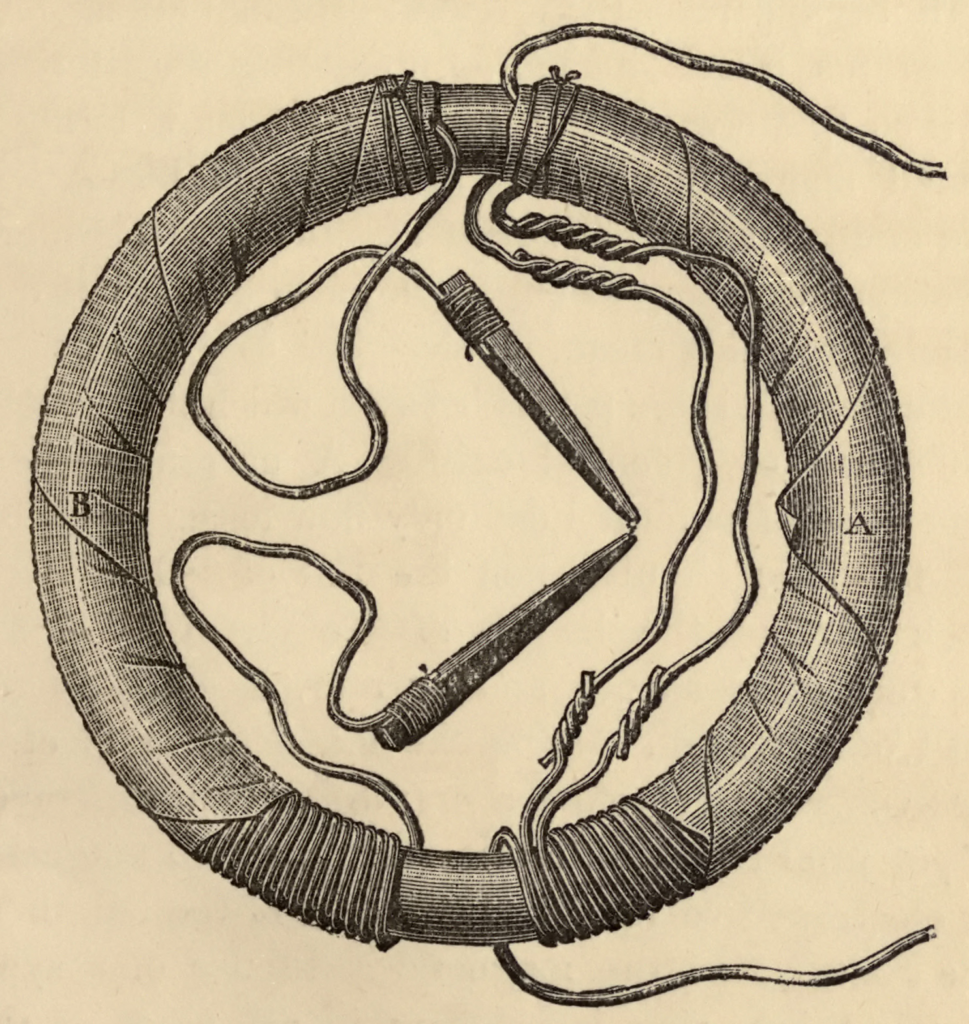
Electromagnetic induction is the production of an electric current by a changing magnetic field, an effect Michael Faraday demonstrated in 1831. It is the principle behind generators and transformers and therefore behind almost all electric power.
Background
During the 1820s Faraday tried to discover how to make electricity from magnetism. Hans Christian Ørsted had shown in 1820 that an electric current affects a compass needle, and Faraday had built devices in the early 1820s that turned that effect into continuous rotation. The first surviving apparatus of this kind dates from 1822. Ten years later he returned to the opposite question: could magnetism produce a current?
The discovery
Faraday succeeded on 29 August 1831 with a device now held by the Royal Institution in London. It consists of an iron ring about 170 millimeters across, with coils of insulated copper wire wound on opposite sides. Winding the coils was tedious, because each wire had to be insulated with cotton, and the Institution estimates the work took about ten working days.
The apparatus was made from everyday materials, including wire made for bonnets, although the iron ring seems to have been specially made. It is now on display in the Faraday Museum at the Royal Institution.
When he passed a current through one coil, a current appeared briefly in the other. The effect lasted only a moment, at the instant the current was switched on or off. The apparatus is regarded as the first electric transformer.
A few months later, in October 1831, Faraday made a second device: a tube wound with an insulated coil of wire and a bar magnet. He connected the coil to a galvanometer, an instrument that detects current. When he moved the magnet back and forth through the stationary coil, the needle jumped. This was the first electric generator.
How electromagnetic induction works
Induction happens whenever the magnetic field passing through a loop of wire changes. The Royal Institution describes it in terms of lines of magnetic force: as a magnet moves, the lines repeatedly cut across the wire and push the electrons in it, producing a current. If a light bulb replaced the galvanometer, it would light.
The National High Magnetic Field Laboratory points out that the mechanical energy of the moving magnet is converted into electricity. No current flows when the magnet is still, and the size of the current depends on how fast the field changes and how many turns of wire the field passes through. These are the same design levers engineers use in a modern generator.
How it was confirmed
The National High Magnetic Field Laboratory describes the same experiment in its simplest form. A magnet moved inside a wire coil produces current only while it is moving. Moving the magnet faster raises the reading, adding more turns to the coil raises it, and flipping the magnet reverses its direction.
Faraday did not stop there. In 1832 he showed that three kinds of electricity once thought different, that induced from a magnet, that from a battery and static electricity, were in fact the same phenomenon. This helped build the case that electricity is a single physical effect with several sources.
Impact and legacy
The Engineering and Technology History Wiki calls electromagnetic induction the most important of Faraday’s discoveries, because power generation and transmission would be impossible without it. The Royal Institution makes the same point: virtually all electric power is produced using his principles, whether the fuel is coal, oil, gas, nuclear, hydro or wind, because each of those drives a turbine that turns a generator.
Induction also works in the other direction. A transformer relies on a changing current in one coil to induce a current in another, which is what Faraday’s iron ring did, and so it can raise or lower voltage for the power grid. The same principle is used in electric motors and in wireless chargers. The capacitor, which stores electric charge, is measured in farads, a unit named in his honor.
James Clerk Maxwell later translated Faraday’s findings into equations, which became the foundation of the study of electromagnetism. Faraday himself also introduced words such as ion, electrode, cathode and anode into the vocabulary of electricity.
Faraday and public science
The Engineering and Technology History Wiki lists induction alongside his other discoveries, which include the laws of electrolysis. Faraday was also an unusually committed teacher. In 1826 he founded the Friday Evening Discourses at the Royal Institution, and in the same year the Christmas Lectures for young people. He gave 123 discourses between 1826 and 1862 and 19 Christmas lectures between 1827 and 1861, and one of them was published as The Chemical History of a Candle, which remains a classic of scientific writing.
Order of Faraday’s inventions
Sources differ on the order of Faraday’s inventions. The Royal Institution dates his first surviving electric motor apparatus to 1822, nearly a decade before induction. The Engineering and Technology History Wiki, by contrast, says that once he had the principle he built the motor, then the generator and transformer. The Royal Institution’s dating of the objects is the more specific.
Disputes over credit
Faraday was not the only person working on the problem. The National High Magnetic Field Laboratory notes that Joseph Henry, in the United States, was not far behind and made an independent discovery of electromagnetic induction in 1832. Faraday’s 1831 apparatus came first, and the records at the Royal Institution date his success to 29 August of that year, so he is generally credited with the discovery. Henry’s independent work is recognized as well.
Later developments
Practical machines followed the experiments within decades, and the same idea now underlies every large power station. It also gave scientists a new way to think about forces acting through space, an idea Maxwell developed mathematically. Faraday was born on 22 September 1791 and died on 25 August 1867.
More in Physics
Key facts
- Faraday succeeded in making a current from magnetism on 29 August 1831.1
- His iron ring with two coils is regarded as the first electric transformer.1
- In October 1831 he built the first electric generator from a coil and a bar magnet.2
- Joseph Henry independently discovered electromagnetic induction in 1832.3
- Virtually all electric power is produced using Faraday’s principles.2
- Faraday was born on 22 September 1791 and died on 25 August 1867.4
Related concepts
Quick checkWho discovered electromagnetic induction?Show answer
Michael Faraday, on 29 August 1831 in London. Joseph Henry independently found the effect in 1832 in the United States.
Sources
- 1. Royal Institution, Michael Faraday’s ring-coil apparatus, https://www.rigb.org/explore-science/explore/collection/michael-faradays-ring-coil-apparatus
- 2. Royal Institution, Michael Faraday’s generator, https://www.rigb.org/explore-science/explore/collection/michael-faradays-generator
- 3. National High Magnetic Field Laboratory, Electromagnetic Induction (Magnet Academy), https://nationalmaglab.org/magnet-academy/watch-play/interactive-tutorials/electromagnetic-induction/
- 4. Engineering and Technology History Wiki (IEEE), Michael Faraday, https://ethw.org/Michael_Faraday
Editorially reviewed by Specialty Digest Editorial TeamLast reviewed November 5, 2026Researched and drafted with AI assistanceReport an issue