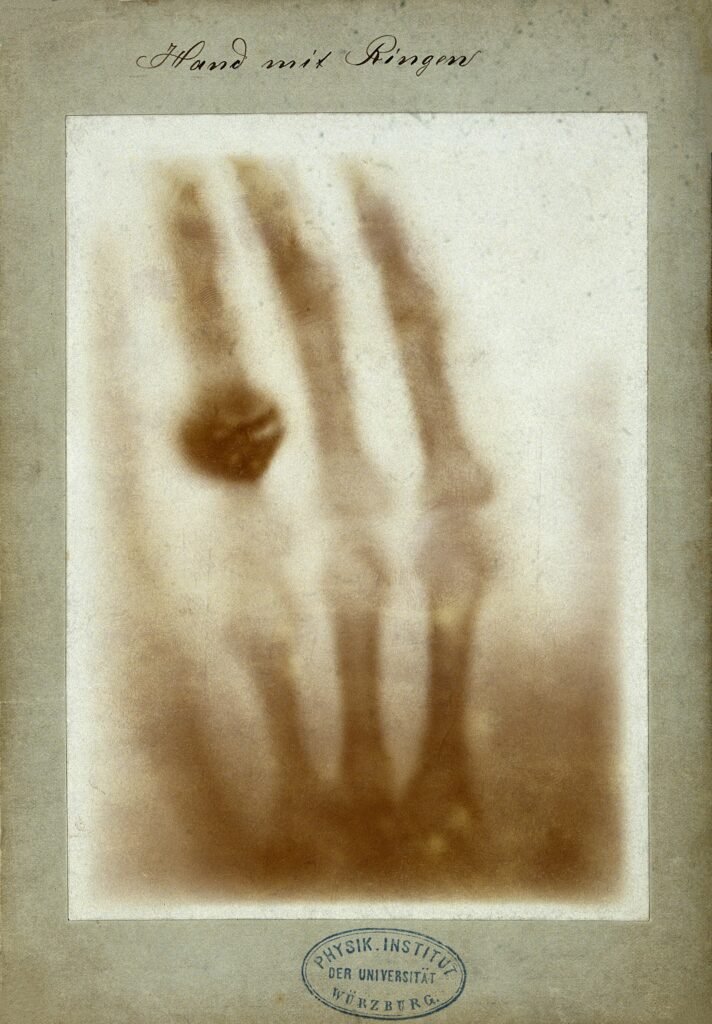
The discovery of X-rays was the identification, by the German physicist Wilhelm Conrad Röntgen at Würzburg in November 1895, of a previously unknown penetrating radiation produced by a vacuum tube. Within a year, doctors were using it to see bones and locate foreign objects inside the body.
Background to the discovery of X-rays
Röntgen was born on 27 March 1845 in Lennep, Prussia, and grew up in Holland. He married Bertha Ludwig in 1872. He earned a doctorate in physics from the University of Zurich and went on to work at universities in Strasbourg, Giessen and Würzburg. His path was not smooth. He was expelled from a technical school in Utrecht over a prank committed by another student, and his lack of a diploma at first prevented him from getting a post at Würzburg.
At Würzburg he studied what happens when a high-voltage current passes through a Crookes tube, a glass bulb with two electrodes from which the air has been removed. These tubes glow with a fluorescent light. Röntgen was particularly interested in cathode rays, later recognized as electrons, as described in the entry on the discovery of the electron, and in how far they travel outside a tube.
The discovery
On 8 November 1895, Röntgen shielded a tube with heavy black cardboard. A screen coated with platinobarium, about nine feet away, still glowed green. That distance was too great for the cathode rays as he understood them, so he concluded that some invisible ray from the tube was passing through the cardboard.
According to the Nobel Foundation, the apparatus was screened off, yet he noticed a faint light on light-sensitive screens that happened to be close by. Asked later what he thought at the moment of discovery, Röntgen is reported to have said, “I didn’t think, I investigated.”
Further tests showed that the new rays passed through most substances, including the soft tissue of the body, but left bones and metals visible. One of his earliest photographic plates showed the hand of his wife, Bertha, with her wedding ring clearly visible.
Röntgen then spent about seven weeks on careful experiments. On 28 December 1895 he submitted a provisional communication, titled “On a New Kind of Rays,” to the Würzburg Physico-Medical Society. In January 1896 he gave his first public lecture and demonstration, making a plate of the hand of an anatomist in the audience. The anatomist suggested that the discovery be named Röntgen’s rays, although Röntgen himself called them X-rays.
How the discovery spread and was confirmed
News of the discovery traveled around the world within weeks. The equipment needed to make X-rays was soon widely available, and other investigators could reproduce the effect. Thomas Edison was among those who tried to improve on it, and he developed a handheld fluoroscope. Studios opened to take “bone portraits,” and the public was fascinated.
The medical community recognized the value of the rays almost at once. By February 1896 an X-ray plate had been used in the United States to show a patient’s fractured wrist. The first angiography, moving-picture X-rays and military radiology followed in early 1896. According to the American Physical Society, within a year of the announcement the use of X-rays for diagnosis and therapy was an established part of the medical profession.
The nature of the rays was less clear. When the prize was awarded in 1901, the Royal Swedish Academy of Sciences stated that the actual constitution of the radiation was still unknown. It noted that the rays travel in straight lines, as light does, and that different materials stop them to very different degrees.
Impact and legacy of the discovery
The Academy pointed out that metals are impenetrable to X-rays, while wood, leather, cardboard and muscle tissue let them pass. A bullet or needle lodged in the body could therefore be located by exposing a photographic plate, and the Academy credited the method with making many surgical operations possible or easier. It also noted that X-rays had been used successfully against some severe skin diseases.
Today the same basic principle underlies X-ray imaging. According to the US Food and Drug Administration, radiography, fluoroscopy and computed tomography all pass a beam of X-rays through the body, where a portion is absorbed or scattered. The FDA classes X-rays as ionizing radiation, which has enough energy to potentially damage DNA, so medical use weighs benefits against risks. The equipment itself is covered in the entry on the X-ray machine.
Treatment came almost as quickly as diagnosis. In January 1896, only days after the announcement, a Chicago electrotherapist named Emil Grubbe irradiated a woman with a recurrent breast cancer, and by the end of the year several researchers had noted palliative effects of the rays on cancers. The same period produced popular excitement and some absurdity, from poems about X-rays to lead underwear sold to defeat the supposed peeking of “X-ray glasses.”
Röntgen received the first Nobel Prize in Physics in 1901, and the prize motivation praised the extraordinary services he had rendered by discovering the remarkable rays later named after him. The award recognized a result that had by then proved its worth in both laboratories and hospitals. He never sought profit from it, declined a title that would have given him entry into the German nobility, and donated his prize money to his university. In 1900 he moved to the University of Munich, where he remained for the rest of his life, and he died there on 10 February 1923.
The discovery also set off a chain of research. Henri Becquerel, searching for a link between X-rays and phosphorescence, found a different kind of radiation, as described in the entry on the discovery of radioactivity.
More in Physics
Key facts
- Wilhelm Röntgen noticed the rays on 8 November 1895 when a screen glowed far from a shielded cathode-ray tube.1
- Röntgen submitted his first communication, On a New Kind of Rays, on 28 December 1895.1
- Röntgen received the first Nobel Prize in Physics, in 1901, for the discovery of the rays later named after him.2
- X-rays are ionizing radiation, which has enough energy to potentially damage DNA, so medical imaging balances benefits and risks.4
This entry explains a medical term. It is not medical advice. If you are concerned about your health, speak with a qualified health professional.
Related concepts
Quick checkWho discovered X-rays and when?Show answer
Wilhelm Conrad Röntgen, a German physicist working at Würzburg, discovered X-rays on 8 November 1895 while studying cathode rays, and he announced the finding at the end of December 1895.
Sources
- American Physical Society, This Month in Physics History: November 8, 1895, Roentgen's Discovery of X-Rays, https://www.aps.org/apsnews/2001/11/1895-roentgens-discovery-xrays
- Nobel Prize Outreach, Wilhelm Conrad Röntgen: Facts (Nobel Prize in Physics 1901), https://www.nobelprize.org/prizes/physics/1901/rontgen/facts/
- Nobel Prize Outreach, The Nobel Prize in Physics 1901: Award ceremony speech, https://www.nobelprize.org/prizes/physics/1901/ceremony-speech/
- US Food and Drug Administration, Medical X-ray Imaging, https://www.fda.gov/radiation-emitting-products/medical-imaging/medical-x-ray-imaging
Editorially reviewed by Specialty Digest Editorial TeamLast reviewed November 5, 2026Researched and drafted with AI assistanceReport an issue