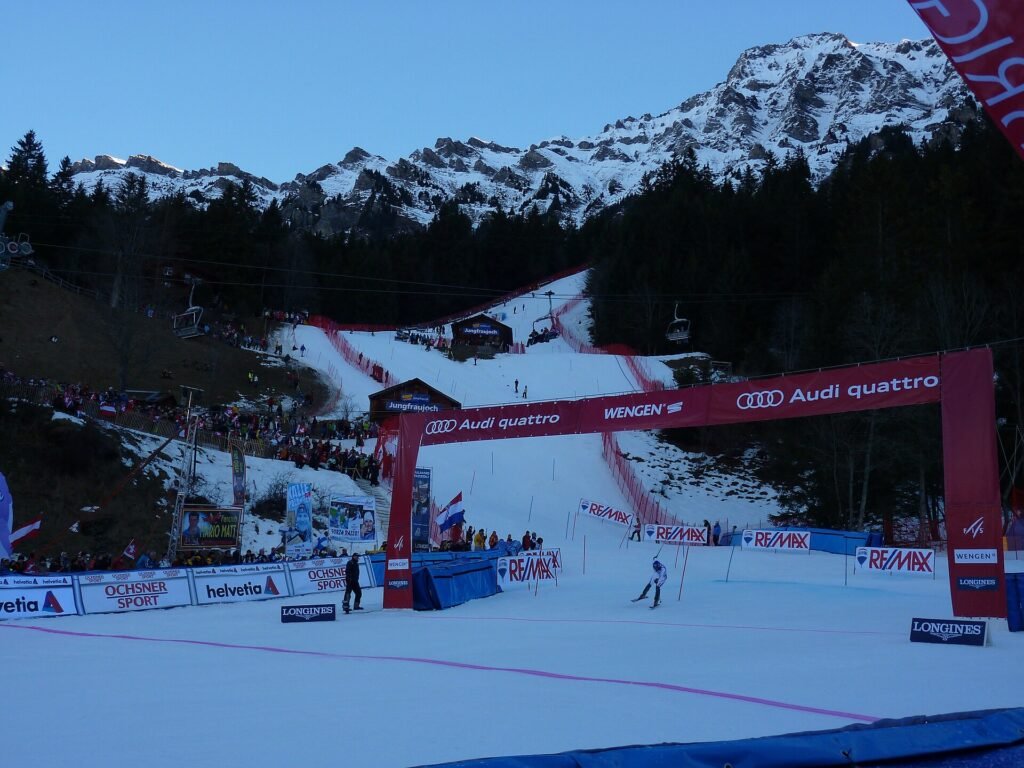
Skiing is the sport of traveling and racing over snow on long, narrow runners attached to the feet. As a competitive sport it covers several disciplines governed by the International Ski and Snowboard Federation, known as FIS: alpine skiing, cross-country skiing, ski jumping, Nordic combined and freestyle skiing. The federation was founded in 1924 at the first Winter Olympic Games in Chamonix.
History of skiing
People have used skis for travel for thousands of years and for recreation for centuries, and races were held for decades before any international body existed. In the late nineteenth century the Norwegian skier Sondre Norheim used skis with curved sides and bindings that held the heel with stiff willow bands.
Competition developed alongside this equipment. Slalom was first organized as a race by Sir Arnold Lunn in 1922 in Mürren, Switzerland. By then European nations had cooperated through an International Ski Commission, which began operating in 1910, and the First World War convinced many delegates that a stronger organization was needed.
On 2 February 1924, delegates from across Europe met at the Hotel Majestic in Chamonix, France, and founded FIS. Henry Cuenot, a driving force behind the effort, called for a complete ski organization that would assure the most rapid expansion of the sport. Because France was the host, the British delegate Sir Harry Brittain proposed a French name, and the body became the Fédération Internationale de Ski. It grew from a handful of races to thousands of events a year and now spans Asia, the Americas, Africa and Australasia as well as Europe.
Rules and how skiing is played
Skiing competitions are grouped by discipline. The IOC recognizes FIS as the governing body for alpine skiing, cross-country skiing, ski jumping, Nordic combined, freestyle skiing and snowboarding, and each has its own rules, courses and scoring.
Alpine skiing has five main events at the Olympics: downhill, slalom, giant slalom, super giant slalom, known as super-G, and combined. Races are decided on time, and the alpine combined event is also decided on time rather than on points, a change made after the event returned to the program in 1988.
In cross-country skiing, racers who start at intervals are ranked by the lowest time, or they start together and the first across the line wins. International races are typically 10, 20 or 50 kilometers, and sprints run about 1 to 1.8 kilometers. The classic style, which uses parallel tracks, was the only style until the 1970s, when the American Bill Koch popularized the faster skating stride.
In ski jumping each athlete makes two jumps, and scores combine distance with style marks from five judges. Normal hills measure 85 to 109 meters and large hills 110 to 149 meters, and jumpers reach about 100 kilometers per hour on the approach before landing in the Telemark position. Nordic combined pairs a jumping contest with a cross-country pursuit, in which the best jumper starts first and the others start after time penalties.
Freestyle skiing was a demonstration sport at Calgary in 1988, and moguls debuted at Albertville in 1992 and aerials at Lillehammer in 1994. FIS recognized freestyle skiing in 1980 and organized a World Cup that year. In aerials, judges give 50 percent of the score for form and technique, 20 percent for takeoff and height, and 30 percent for landing.
Snowboarding joined the same family at the Olympics in 1998, when the IOC made it a discipline of skiing under FIS governance, a compromise that many snowboarders opposed at the time. The federation now covers both sports under a combined name.
Equipment and venues
Norheim’s late nineteenth-century skis had curved sides, and his bindings used stiff willow heel bands. That combination is part of the story of how ski design moved from simple travel gear toward equipment made for turning and racing.
Nordic skiing developed in the hilly terrain of Norway and other Scandinavian countries, and the Holmenkollen Ski Festival near Oslo began holding annual cross-country and ski-jumping events in 1892. Individual Nordic events debuted at the Winter Olympics in Chamonix in 1924, the year FIS was founded. The first Winter Olympic Games were held at Chamonix in 1924. Milano Cortina hosted the Olympic Winter Games in 2026, where alpine skiing included men’s and women’s events and a new team combined event.
Governing bodies and major competitions
FIS is the international federation for skiing and snowboarding. Its headquarters are in Oberhofen, Switzerland, and it reports 133 member national ski associations in its general fact sheet. Its presidents have included Ivar Holmquist of Sweden from 1924 to 1934 and Marc Hodler of Switzerland, who served from 1951 to 1998.
The Winter Olympic Games are the largest stage for the sport. FIS presidents since then include Nicolai Ramm Østgård of Norway from 1934 to 1951, Gian-Franco Kasper of Switzerland from 1998 to 2021, and Johan Eliasch of Great Britain, who has served since 2021.
Records and notable moments
Alpine skiing joined the Olympic program in 1936 at Garmisch-Partenkirchen, with a single combined event of downhill and slalom for men and for women. In 1948 at St. Moritz the combined event was held again, along with separate downhill and slalom races. Giant slalom was added at Oslo in 1952, and super-G became a fourth separate event at Calgary in 1988.
A mixed team event was added in 2018 at PyeongChang. At Milano Cortina in 2026 the mixed team event and the individual combined events were replaced by a men’s and a women’s team combined event.
Kjetil André Aamodt of Norway holds the men’s Olympic alpine record with eight medals, including four golds. Janica Kostelić of Croatia and Anja Pärson of Sweden each have six Olympic medals, a women’s record as of 2026, and Kostelić has four golds. Toni Sailer of Austria and Jean-Claude Killy of France won all three golds available at Cortina d’Ampezzo in 1956 and Grenoble in 1968. Five women have won three golds each: Vreni Schneider, Deborah Compagnoni, Maria Höfl-Riesch, Katja Seizinger and Mikaela Shiffrin.
Global reach
Olympic alpine skiing has been dominated by Alpine nations. Austria leads the all-time medal table with 41 golds and 132 medals, followed by Switzerland with 31 golds and 84 medals and the United States with 19 golds and 52 medals. France has 16 golds, Italy 16, Germany 14 and Norway 11.
Beyond these leading nations, FIS says it now spans Asia, the Americas, Africa and Australasia, and it describes audiences in the tens of millions for its events.
More in Sports Coaching and Performance
Key facts
- FIS was founded on 2 February 1924 at the Hotel Majestic in Chamonix, France, during the first Winter Olympic Games.1
- The IOC recognizes FIS as the governing body for alpine, cross-country, ski jumping, Nordic combined, freestyle skiing and snowboarding.2
- Alpine skiing joined the Olympics in 1936, with giant slalom added in 1952 and super-G in 1988.3
- Austria leads the Olympic alpine medal table with 41 golds and 132 medals.3
- Ski jumpers make two jumps scored on distance and style marks from five judges.5
Related concepts
Quick checkWhen was the International Ski Federation founded?Show answer
FIS was founded on 2 February 1924 at the Hotel Majestic in Chamonix, France, during the first Winter Olympic Games, and it is now based in Oberhofen, Switzerland.
Sources
- International Ski and Snowboard Federation, History, https://www.fis-ski.com/inside-fis/about-fis/history
- International Ski and Snowboard Federation, FIS general factsheet, https://assets.fis-ski.com/f/252177/5a319e1453/fis-factsheet-general.pdf
- Olympedia, Alpine skiing, https://www.olympedia.org/sports/ALP
- Olympics.com, Description of alpine skiing, https://olympics.com/en/news/description-of-alpine-skiing
- Encyclopaedia Britannica, Nordic skiing, https://www.britannica.com/sports/skiing/Nordic-skiing
- Encyclopaedia Britannica, Freestyle skiing, https://www.britannica.com/sports/skiing/Freestyle-skiing
- Olympedia, Snowboarding at the 1998 Winter Olympics, https://www.olympedia.org/editions/46/sports/SBD
Editorially reviewed by Specialty Digest Editorial TeamLast reviewed November 4, 2026Researched and drafted with AI assistanceReport an issue