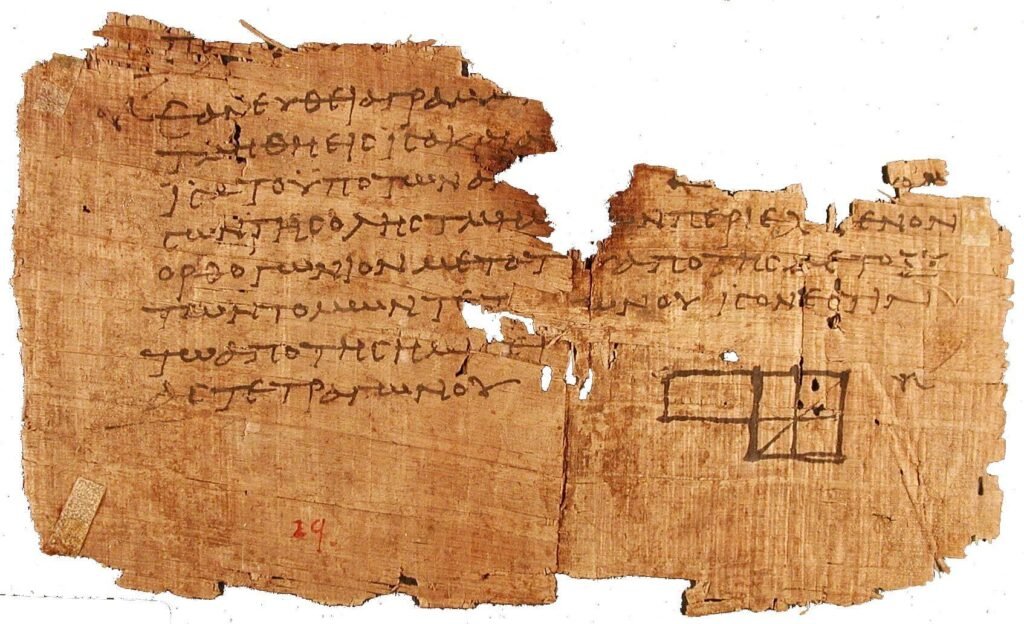
Euclid was a Greek mathematician who taught in Alexandria, Egypt, around 300 BCE and wrote the Elements, often described as one of the most influential textbooks ever written. Almost nothing is known about his life, and scholars give only approximate dates. The Elements presents geometry and number theory as a chain of logical proofs built from a small set of starting assumptions.
Early life of Euclid
Very little is known about Euclid’s life. The MacTutor History of Mathematics archive at the University of St Andrews estimates that he was born around 325 BCE and died around 265 BCE, and treats these dates as probable guesses rather than records. All that can be said with confidence is that he taught in Alexandria.
The main evidence comes from Proclus, a philosopher who wrote around 450 CE, roughly 700 years after Euclid. Proclus says Euclid lived in the time of the first Ptolemy and gathered the work of earlier mathematicians in the Elements. A well-known story has Ptolemy asking whether there was a shorter way to learn geometry and Euclid replying that there was no royal road to geometry. Because the story was recorded long after the event, it is best treated as an anecdote.
Euclid is often confused with Euclid of Megara, a philosopher who lived about a century earlier. Some old biographies, by error, say that the mathematician was born in Megara. The name was common in this period, which adds to the difficulty of tracing the right man in ancient records.
Career and major work of Euclid
Euclid’s best-known work is the Elements, which is divided into 13 books. Books 1 to 6 cover plane geometry. Books 7 to 9 deal with number theory, including the Euclidean algorithm for finding the greatest common divisor of two numbers and a proof that there are infinitely many prime numbers. Book 10 treats irrational magnitudes, and books 11 to 13 cover solid geometry, ending with a proof that there are exactly five regular polyhedra.
Book 1 alone contains 23 definitions, five postulates, five common notions and 48 propositions, according to the edition by David Joyce at Clark University. It opens with the construction of an equilateral triangle on a given line and closes with the theorem now called the Pythagorean theorem, in proposition 47, and its converse in proposition 48.
Several other works survive. Data, with 94 propositions, studies which properties of a figure follow when others are given. On Divisions covers constructions that divide a figure in a given ratio. Optics is the first Greek work on perspective, and Phaenomena is an elementary introduction to mathematical astronomy. Other books, including Surface Loci, Porisms, Conics and the Book of Fallacies, are lost.
Ideas and contributions of Euclid
Euclid’s central contribution is method. He begins with definitions, five postulates and five common notions, then proves each proposition from these and from earlier propositions. This set a new standard of clarity, and MacTutor notes that its rigor became a goal for the inventors of the calculus centuries later. Book 5 sets out a theory of proportion, credited to Eudoxus, that put the geometry of ratios on a sound footing, and book 6 applies it to plane figures. MacTutor also praises the clarity with which the theorems are stated and proved.
Much of the material was not his own. MacTutor explains that Euclid reorganized and improved earlier results, such as the theory of proportion and the method of exhaustion from Eudoxus, and work on irrational numbers and regular polyhedra associated with Theaetetus. His achievement was to order this material into a single logical structure, so it is wrong to credit every theorem in the Elements to him alone.
The parallel postulate is the best-known feature of his system. In a modern equivalent, it says that exactly one line can be drawn through a point parallel to a given line. MacTutor says Euclid’s decision to make this a postulate led to Euclidean geometry, and that mathematicians in the 19th century developed non-Euclidean geometries that do without it. The same source notes that Euclid sometimes relies on subtle assumptions that he never states.
Legacy of Euclid
The Elements has been studied for about 24 centuries, according to David Joyce, first in Greek and later in Arabic, Latin and many modern languages. In late antiquity, writers such as Heron, Pappus, Proclus and Simplicius wrote commentaries on it, and Theon of Alexandria re-edited the text.
More than a thousand editions have appeared since the Elements was first printed in 1482. MacTutor says that, next to the Bible, it may be the most translated, published and studied book in the Western world. It was the primary source of geometric reasoning at least until non-Euclidean geometry arrived in the 19th century, and Euclid’s name remains attached to Euclidean geometry and the Euclidean algorithm. Archimedes, who lived shortly after him, refers to Euclid once in surviving works, in On the Sphere and Cylinder, and that reference helps date him.
Questions about Euclid’s identity
Because so little is known, some historians have asked whether Euclid was one man. MacTutor summarizes three hypotheses: that he was a single person who wrote the works attributed to him, that he led a team at Alexandria whose members wrote under his name, or that he was not a real person at all. Most ancient accounts, including those of Proclus and Pappus, treat him as an individual.
Pappus describes him as fair and kind to anyone who could advance mathematics, and MacTutor says this picture matches the evidence of the surviving texts. The questions about his life remain open, but the influence of the Elements is not in doubt.
More in Mathematics
Key facts
- Euclid taught in Alexandria, Egypt, around the time of the first Ptolemy, and his dates are uncertain.1
- The Elements has 13 books covering plane geometry, number theory and solid geometry.1
- Book 1 of the Elements has 23 definitions, five postulates, five common notions and 48 propositions.2
- The Elements was first printed in 1482 and has appeared in more than 1,000 editions.1
- Euclid of Alexandria should not be confused with the philosopher Euclid of Megara.1
Related concepts
In the news
Quick checkWhat is Euclid best known for?Show answer
He wrote the Elements, a 13-book treatise that built geometry and number theory from definitions, postulates and proofs, and that shaped mathematics for over two thousand years.
Sources
- MacTutor History of Mathematics, University of St Andrews, Euclid of Alexandria, https://mathshistory.st-andrews.ac.uk/Biographies/Euclid/
- David E. Joyce, Clark University, Euclid Elements, Book I, http://aleph0.clarku.edu/~djoyce/elements/bookI/bookI.html
- David E. Joyce, Clark University, Euclid Elements, Introduction, https://mathcs.clarku.edu/~djoyce/java/elements/elements.html
Editorially reviewed by Specialty Digest Editorial TeamLast reviewed November 4, 2026Researched and drafted with AI assistanceReport an issue