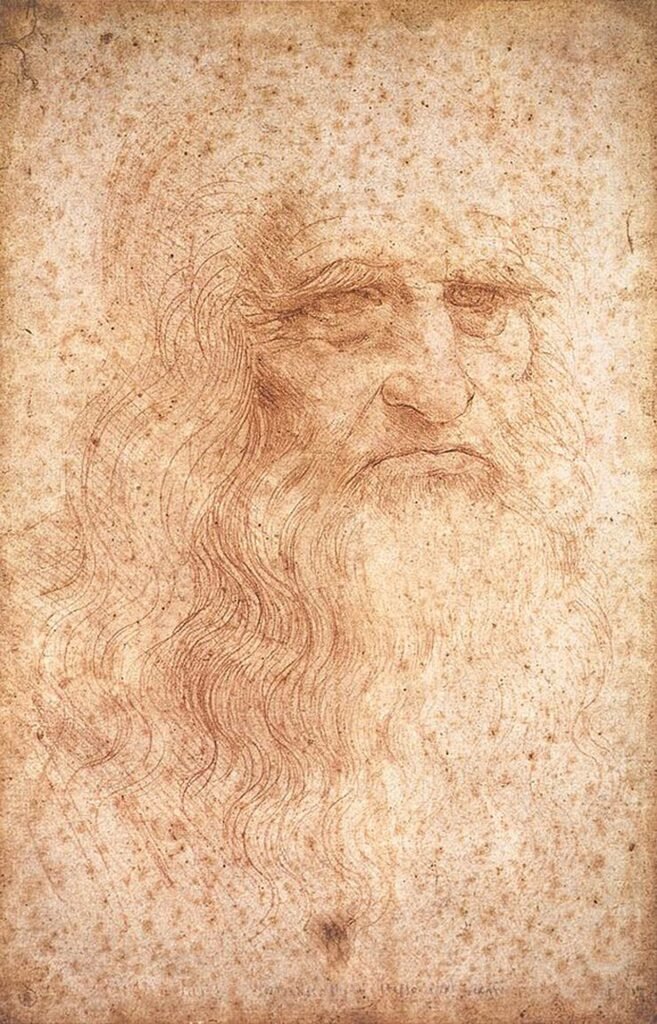
Leonardo da Vinci (1452 to 1519) was an Italian painter, draftsman, engineer and scientific observer of the Renaissance, best known for the Mona Lisa and The Last Supper. He worked in Florence, Milan, Rome and France, and his notebooks record studies of anatomy, geometry, engineering and flight. Few of his paintings survive, and fewer still were finished, which is one reason each of them is so closely studied.
Early life and training of Leonardo da Vinci
Leonardo was born near the Tuscan hill town of Vinci in 1452. The National Gallery in London describes him as an illegitimate child who was raised by his paternal grandfather, while his father kept a flourishing legal practice in Florence. Florence was the city where Leonardo received his early artistic training.
He trained in the workshop of the sculptor Andrea del Verrocchio. The workshop took on a wide range of commissions, including sculpture, decorative metalwork and paintings, so an apprentice learned to move between crafts and materials. By 1472 Leonardo had joined the Compagnia di San Luca, a brotherhood of Florentine artists.
He worked in Florence for roughly the next ten years, although few paintings from that decade have survived. He made many drawings, however, and these show his curiosity spreading into geometry, anatomy and engineering. By 1483 he felt stifled in Florence and decided that Milan offered better prospects.
Career and major works of Leonardo da Vinci
In Milan, Leonardo wrote to the ruling Sforza family to ask for employment. According to the National Gallery, he presented himself first as an expert in military engineering and mentioned painting and sculpture as an added bonus. Soon after he arrived, a confraternity commissioned an altarpiece from him, which became The Virgin of the Rocks.
The painting shows the Virgin Mary, the infant Saint John the Baptist, an angel and the infant Christ in a rocky grotto. The commission was linked to the feast of the Immaculate Conception, a subject so new that no standard way of picturing it existed. A disagreement over the price led Leonardo to sell the first version to another buyer, and that version is now in the Louvre in Paris. It was some years before the confraternity persuaded him to paint a second version, which hangs in the National Gallery in London.
His major painting from this Milan period is The Last Supper, made for a wall of the refectory, or dining hall, of the church of Santa Maria delle Grazie. The National Gallery notes that it illustrates his belief that poses, gestures and facial expressions should reflect the motions of the mind.
After the French army invaded Milan in 1499, Leonardo returned to Florence. There he painted the portrait now known as the Mona Lisa. The Louvre catalogs it as the portrait of Lisa Gherardini, wife of Francesco del Giocondo, and gives a date range of about 1503 to 1519. The museum holds it in its Department of Paintings.
By the summer of 1508 he was back in Milan, working for the city’s French rulers, and he stayed there until 1513. He then spent three years in Rome. At some point the French king offered him a post as first painter and engineer, and in 1517 Leonardo moved to the Chateau of Cloux, near Amboise, where he spent the rest of his life.
Ideas and contributions
Leonardo kept notebooks for the whole of his working life. They are filled with drawings and diagrams, and the notes are written in mirror handwriting. They cover science, biology, anatomy, engineering and art, and they include a design for a flying machine resembling a helicopter, which was never built.
In painting, he treated the face and body as a way of showing thought and feeling. The National Gallery points out that he was fascinated by the possibility of reading the motions of the soul through facial expression and gesture, and the Mona Lisa is famous for the enigmatic expression of its sitter. He planned his compositions in drawings before painting, and the Burlington House Cartoon, now in the National Gallery, is a large preparatory drawing of the Virgin and Child with Saint Anne and Saint John the Baptist.
His technique also changed how painters handled light. In The Virgin of the Rocks he blurred the edges of the figures so that they seem to emerge from the shadows of the grotto. This soft modeling of light and shade is often linked to sfumato, an Italian term for a smoky, gradual blending of tones without hard outlines. Leonardo also studied the human body directly, and his anatomical research is generally understood to have included the dissection of corpses.
Death of Leonardo da Vinci
Late in life Leonardo suffered from ill health, and a stroke left him paralyzed down the right side of his body. His notebooks show that he stayed active, although his assistants probably did most of the physical work. In April 1519, aged 67, he drew up his will and left most of his works to his pupil and companion Francesco Melzi.
He died later that year and was buried at Amboise. Biographical references give the date of his death as 2 May 1519.
Legacy of Leonardo da Vinci
The National Gallery describes Leonardo as a painter, sculptor, architect, designer, theorist, engineer and scientist who influenced generations of artists and is still revered as a universal genius. His reputation rests on a small body of work, since he completed few paintings and fewer still have survived. The Mona Lisa is today one of the most famous paintings in the world and remains on display at the Louvre.
His notebooks preserved observations in anatomy, engineering and the natural world, which is why he is often described as a polymath as well as a painter.
Controversies and criticism
Leonardo was notorious for leaving commissions unfinished. The National Gallery explains that his growing absorption in experiments and scientific projects interfered with his artistic work, and that his reputation for not finishing things grew with time. Because he completed so few works, an entire industry arose around the search for genuine Leonardos, with many copies and pastiches presented as originals.
Questions of attribution continue today. In 2017 a painting called Salvator Mundi, attributed in whole or in part to Leonardo, sold at auction for 450.3 million US dollars, a record for any painting sold at public auction. Scholars still debate how much of that work, and of some other pictures, came from his own hand rather than from his workshop.
More in Visual Arts
Key facts
- Leonardo da Vinci was born near the Tuscan town of Vinci in 1452 and trained in the Florentine workshop of Andrea del Verrocchio.1
- He moved to Milan in 1483 and later worked in Florence, Rome and France, settling at the Chateau of Cloux near Amboise in 1517.1
- His notebooks cover anatomy, engineering, biology and art, and are written in mirror handwriting.1
- The Louvre catalogs the Mona Lisa as the portrait of Lisa Gherardini, wife of Francesco del Giocondo, dated about 1503 to 1519.3
- Two versions of The Virgin of the Rocks exist, one in the Louvre and one in the National Gallery in London.2
Related concepts
Quick checkWhere did Leonardo da Vinci spend the last years of his life?Show answer
In 1517 he moved to the Chateau of Cloux, near Amboise in France, after the French king offered him a post as first painter and engineer. He died there in 1519 and was buried at Amboise.
Sources
- National Gallery, London, Leonardo da Vinci (1452 - 1519), artist biography, https://www.nationalgallery.org.uk/artists/leonardo-da-vinci
- National Gallery, London, The Virgin of the Rocks (NG1093), https://www.nationalgallery.org.uk/paintings/leonardo-da-vinci-the-virgin-of-the-rocks
- Louvre Museum, collections database, record for the portrait of Lisa Gherardini, known as the Mona Lisa (inventory 779), https://collections.louvre.fr/en/ark:/53355/cl010062370
Editorially reviewed by Specialty Digest Editorial TeamLast reviewed November 4, 2026Researched and drafted with AI assistanceReport an issue