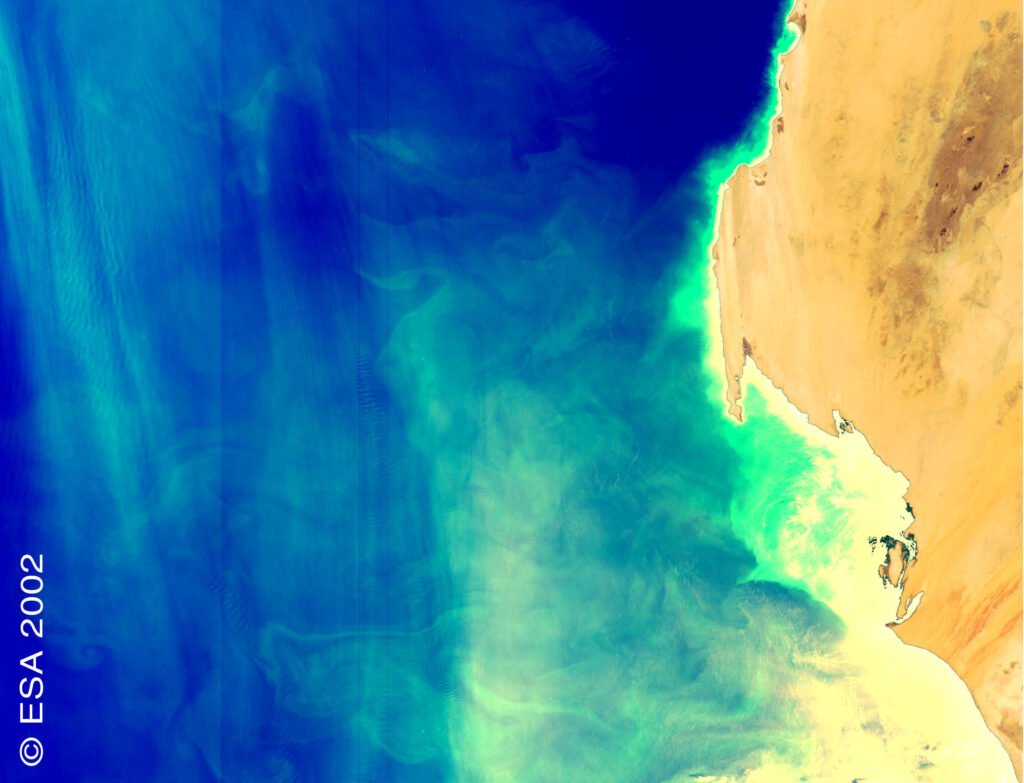
Upwelling is an oceanographic process in which wind patterns and the earth’s rotation cause surface water to move away from a coastline or diverge at the open ocean, drawing colder, denser, nutrient-rich water up from deeper layers to replace it. This upward movement brings nutrients such as nitrate and phosphate from the deep ocean into the sunlit surface zone, where they fuel intense phytoplankton growth.
Because phytoplankton form the base of the marine food web, upwelling regions rank among the most biologically productive areas of the global ocean, supporting fisheries that supply a disproportionate share of the world’s wild-caught seafood despite covering only a small fraction of total ocean area.
Physical Mechanisms Driving Upwelling
Coastal upwelling typically occurs when winds blow parallel to a coastline in a direction that, combined with the Coriolis effect caused by the earth’s rotation, pushes surface water offshore. As this surface water moves away, it must be replaced, and deeper water rises to fill the resulting gap, a process known as Ekman transport.
Equatorial upwelling operates on a different mechanism, where trade winds blowing westward along the equator cause surface currents to diverge away from the equatorial line itself, again drawing deeper water upward to replace the diverging surface flow across a broad equatorial band.
Major Upwelling Regions of the World
Some of the most productive upwelling systems occur along the eastern boundaries of ocean basins, including the Peru-Chile system off South America, the California Current system off western North America, the Canary Current off northwest Africa, and the Benguela system off southwestern Africa. These four major systems are collectively responsible for a remarkably large share of global fish catch relative to their modest combined area.
The Peru-Chile upwelling system in particular supports one of the largest single-species fisheries in the world, centered on anchoveta, a small forage fish whose population and catch levels fluctuate dramatically with the strength of upwelling in any given year.
Connection to El Nino and Climate Variability
Upwelling strength is closely tied to large-scale climate patterns, particularly the El Nino-Southern Oscillation, which periodically weakens trade winds across the tropical Pacific and suppresses upwelling along the South American coast. During strong El Nino events, reduced upwelling starves surface waters of nutrients, triggering sharp declines in phytoplankton, fish populations, and the seabirds and marine mammals that depend on them.
Conversely, La Nina conditions tend to strengthen trade winds and enhance upwelling in these same regions, illustrating how a single climate oscillation can drive dramatic swings in marine productivity across an entire ocean basin from one year to the next.
Biological Productivity and Food Web Effects
The nutrient influx from upwelling triggers rapid phytoplankton blooms that support zooplankton grazers, which in turn feed small forage fish such as anchovies and sardines, which then support larger predatory fish, seabirds, and marine mammals in a tightly linked food web. Disruptions anywhere in this chain, whether from reduced upwelling or overfishing of forage species, can cascade through the entire system.
Because upwelling systems concentrate biological activity into relatively narrow coastal bands, they also attract some of the densest seabird colonies and marine mammal populations found anywhere in the ocean, making them focal points for both commercial fishing and marine conservation.
Economic Importance for Global Fisheries
The disproportionate productivity of upwelling regions makes them economically vital far beyond their geographic footprint, supplying a substantial share of global wild fish catch and supporting the livelihoods of millions of people engaged in fishing, processing, and related industries along affected coastlines.
This economic concentration also creates vulnerability, since fishing communities and national economies dependent on a single upwelling-driven fishery can face severe hardship during years when upwelling weakens and fish populations decline, as has occurred repeatedly during major El Nino events.
Oxygen Depletion and Dead Zones
While upwelling delivers valuable nutrients, the deep water it brings to the surface is often low in dissolved oxygen, and the resulting intense biological productivity can further deplete oxygen as blooming phytoplankton eventually die and decompose. In some upwelling regions, this combination produces seasonal low-oxygen or hypoxic zones that stress or exclude many marine organisms.
Climate change and ocean warming are expected to intensify oxygen depletion in several major upwelling systems, since warmer water holds less dissolved oxygen and can alter wind patterns that drive the upwelling process itself, adding further uncertainty to already variable fisheries.
Monitoring and Forecasting Upwelling Events
Oceanographers track upwelling using satellite measurements of sea surface temperature, since newly upwelled water is characteristically colder than surrounding surface water, along with chlorophyll measurements that indicate resulting phytoplankton blooms and direct wind and current observations from moored buoys and research vessels.
Improved forecasting of upwelling strength and timing has become increasingly valuable for fisheries management, allowing agencies to anticipate productive fishing seasons or warn of potential declines well before they are reflected in actual catch data.
FAQ
What causes upwelling in the ocean?
Upwelling is caused by wind patterns that push surface water away from a coastline or diverge it at the equator, combined with the earth’s rotation, drawing colder, nutrient-rich water up from deeper layers to replace it.
Why are upwelling regions so important for fisheries?
The nutrients delivered by upwelling fuel intense phytoplankton growth that supports an entire marine food web, making these relatively small coastal regions responsible for a large share of global wild fish catch.
How does El Nino affect upwelling?
El Nino weakens the trade winds that drive upwelling along the eastern Pacific, suppressing nutrient delivery and causing sharp declines in phytoplankton and fish populations in affected regions.
Editorially reviewed by Specialty Digest Editorial TeamLast reviewed November 4, 2026Researched and drafted with AI assistanceReport an issue