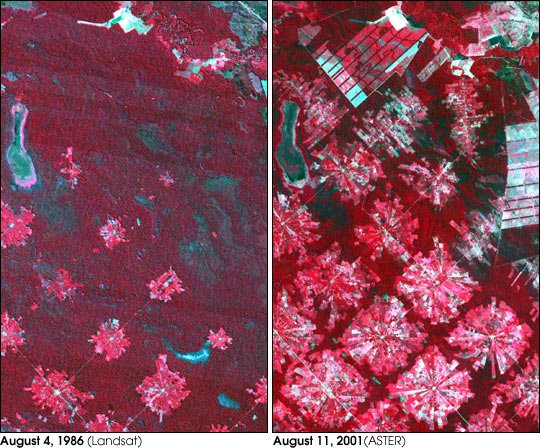
Habitat fragmentation is the process by which a large, continuous area of natural habitat is broken into smaller, more isolated patches, typically as a result of human activities such as road building, agricultural expansion, logging, and urban development. The resulting patches are often too small or too disconnected to support the same populations and ecological processes that existed when the habitat was intact, making fragmentation one of the most significant drivers of biodiversity loss worldwide.
Fragmentation differs from outright habitat loss in an important way: even when the total remaining area of habitat is held constant, breaking it into many small, scattered pieces rather than one large block tends to reduce the number of species that can survive there and increases the vulnerability of the populations that remain. This distinction has made fragmentation a central focus of conservation biology since the field’s early development in the 1960s and 1970s.
Edge Effects and Isolation
Smaller habitat patches have a proportionally larger amount of edge relative to their interior area, and this edge habitat differs ecologically from the interior in ways that can favor some species while disadvantaging others. Edge zones typically experience more light, wind, temperature fluctuation, and exposure to invasive species and predators, conditions that many interior-adapted species, particularly old-growth forest specialists, struggle to tolerate.
Isolation compounds these edge effects, since populations confined to small, disconnected patches cannot easily exchange individuals with other populations, reducing genetic diversity and making local extinction more likely following a disease outbreak, severe weather event, or other disturbance. Species with limited mobility or specialized habitat needs are especially vulnerable to this isolation effect.
Causes of Fragmentation
Road construction is among the most significant and underappreciated drivers of habitat fragmentation, since roads not only remove habitat directly but also create long, linear barriers that many species avoid crossing, effectively dividing a single large population into multiple smaller, disconnected ones even when the habitat on either side remains otherwise intact. Agricultural expansion and urban sprawl produce similar fragmenting effects at a larger scale.
Logging practices that leave scattered, isolated patches of forest rather than large contiguous reserves can fragment habitat even when overall forest cover losses appear modest on a map, which is why conservation scientists increasingly emphasize the spatial pattern of remaining habitat, not just its total area, when assessing ecosystem health.
Mitigation Strategies
Wildlife corridors, which are strips of habitat connecting otherwise isolated patches, have become one of the most widely used tools for countering fragmentation, allowing animals to move between patches for feeding, breeding, and seasonal migration while also facilitating genetic exchange between separated populations. Underpasses and overpasses built specifically to let wildlife cross busy highways safely are a now-common corridor design used in many countries.
Land-use planning that prioritizes large, consolidated conservation areas over scattered small reserves, along with policies that limit new road construction through sensitive habitat, are generally considered more effective long-term strategies than attempting to reconnect habitat after fragmentation has already occurred, since restoring lost ecological connections is typically far more difficult and costly than preventing the original fragmentation.
Measuring Fragmentation
Landscape ecologists use several standardized metrics to quantify fragmentation, including patch size, the total amount of edge relative to interior area, and connectivity indices that estimate how easily organisms can move between patches given the intervening terrain. Satellite imagery and geographic information systems have made it possible to track fragmentation trends across entire countries or continents over time, revealing that fragmentation often accelerates well before total habitat loss becomes severe, giving conservationists an early warning signal if they monitor the right indicators.
Researchers have also found that the effects of fragmentation vary considerably by species: wide-ranging predators and species with specific microhabitat requirements tend to suffer the most from fragmentation, while some generalist species can actually thrive in fragmented, edge-rich landscapes, meaning that fragmentation does not uniformly reduce biodiversity but instead reshapes which species persist and which decline.
Fragmentation in Marine and Freshwater Systems
While most research historically focused on terrestrial fragmentation, scientists increasingly recognize that rivers, lakes, and even ocean habitats can be fragmented as well, often by dams, water diversions, and seafloor disturbance from dredging or trawling that breaks up continuous habitat in ways directly analogous to roads and farmland on land. Dams in particular have fragmented river systems worldwide, blocking the migration routes of fish species that depend on moving freely between upstream and downstream habitats to complete their life cycles.
Addressing aquatic fragmentation has led to a growing movement toward dam removal in some regions, along with the construction of fish passages designed to let migratory species bypass remaining barriers, mirroring the logic of terrestrial wildlife corridors applied to rivers and streams.
Researchers continue refining these connectivity models as new tracking data becomes available each year.
FAQ
How is habitat fragmentation different from habitat loss?
Habitat loss refers to the total reduction in available habitat, while fragmentation refers to how that remaining habitat is broken into smaller, disconnected patches, which can reduce biodiversity even when the total remaining area stays the same.
Why are roads a major cause of habitat fragmentation?
Roads remove habitat directly and also create long barriers that many species avoid crossing, effectively splitting one large population into smaller, isolated groups even when habitat remains on both sides.
What is a wildlife corridor and how does it help?
A wildlife corridor is a strip of habitat connecting isolated patches, allowing animals to move between them for feeding, breeding, and migration, which helps maintain genetic diversity and reduces local extinction risk.
More in Conservation
Editorially reviewed by Specialty Digest Editorial TeamLast reviewed November 4, 2026Researched and drafted with AI assistanceReport an issue