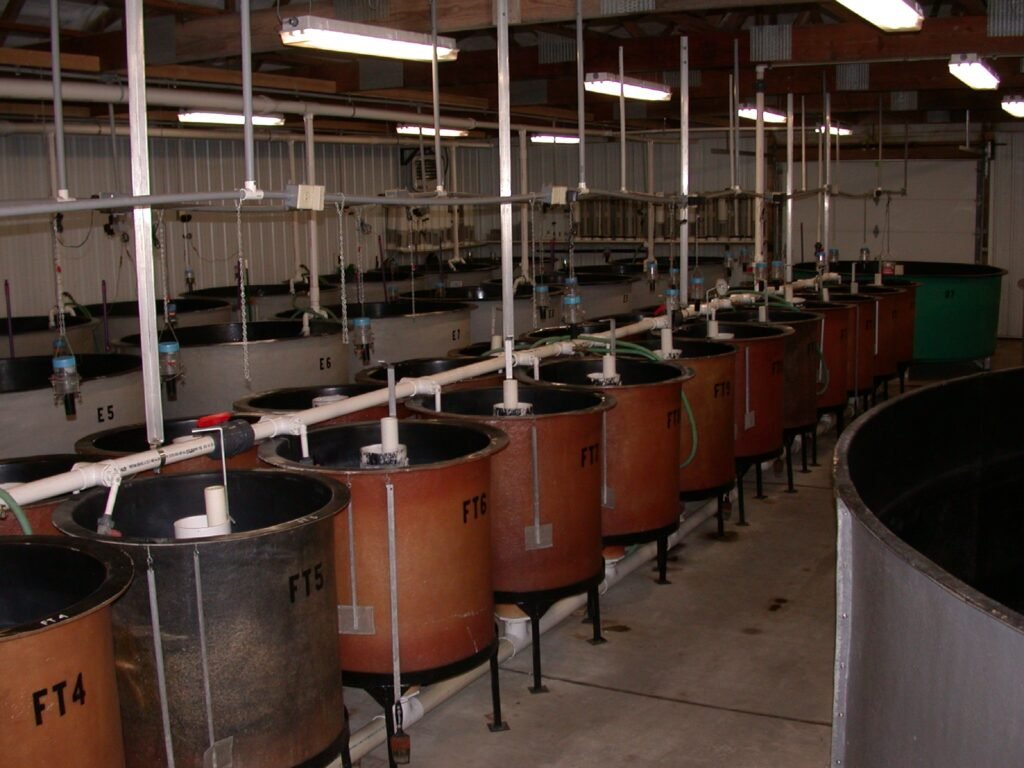
A hatchery is a facility designed to breed fish, shellfish, or other aquatic organisms through their earliest life stages, from fertilized eggs through larvae or juveniles, before they are either released into the wild or transferred to grow-out farms. Hatcheries play a central role in both aquaculture production and conservation programs aimed at supplementing wild fish populations.
Core Functions
A hatchery typically manages broodstock, the adult fish or shellfish kept specifically for reproduction, controlling conditions such as temperature and light to induce spawning at a desired time rather than waiting for natural seasonal cues. After fertilization, hatchery staff carefully manage water quality, feeding, and disease prevention through the especially vulnerable early larval stages, when mortality rates in the wild would normally be very high.
Aquaculture Hatcheries
Commercial aquaculture hatcheries supply juvenile fish, known as fry or fingerlings, to grow-out farms that lack the specialized equipment and expertise needed for successful early-stage rearing, allowing the broader aquaculture industry to specialize across different production stages. Shrimp and shellfish hatcheries operate similarly, producing larvae in carefully controlled tanks before they are large enough to be stocked in ponds or placed in grow-out cages.
Conservation and Stock Enhancement Hatcheries
Many governments operate hatcheries specifically to support wild fish populations, particularly for salmon in rivers where dams, habitat loss, or overfishing have reduced natural spawning success, releasing hatchery-raised juveniles to supplement the wild population. These programs remain scientifically debated, since hatchery-raised fish can sometimes compete with or genetically affect wild populations even as they help maintain fishable numbers in heavily altered rivers.
Technical Challenges
Early life stages of most aquatic species are highly sensitive to water quality, temperature, and disease, making hatchery operation technically demanding and requiring constant monitoring that grow-out farming does not always need to the same degree. Specialized live feeds, such as cultured algae or microscopic crustaceans, are often required to successfully rear larvae of many species through their earliest and most vulnerable feeding stages.
Importance to the Aquaculture Industry
Reliable hatchery supply is often the limiting factor determining how much a given aquaculture sector can grow, since grow-out capacity is frequently larger than the availability of healthy juveniles to stock it. Investment in hatchery research and infrastructure has been a key driver behind the successful large-scale farming of species such as shrimp, salmon, and increasingly difficult-to-breed fish like certain marine finfish species.
Broodstock Management
Selecting and maintaining healthy broodstock with desirable genetic traits, such as fast growth or disease resistance, is a long-term investment central to hatchery success, since the genetic quality of broodstock directly shapes the performance of everything the hatchery subsequently produces. Many hatcheries maintain detailed breeding records and sometimes participate in coordinated regional breeding programs to avoid inbreeding and steadily improve stock quality over successive generations.
Scaling Up Production
Larger commercial hatcheries use automated systems for feeding, water quality monitoring, and even sorting juveniles by size, allowing them to produce millions of juvenile fish or shrimp annually to supply an entire regional aquaculture industry. Smaller hatcheries, by contrast, often serve niche markets or specific conservation programs where production volumes are modest but genetic or regional specificity matters more than scale.
Larval Feeding Innovations
Developing reliable live feed sources, such as cultured rotifers, brine shrimp, and microalgae, suited to the tiny mouths and specific nutritional needs of newly hatched larvae has been one of the most important technical advances enabling hatchery production of many previously difficult-to-breed marine species. Ongoing research into formulated microdiets that could eventually replace some live feeds continues, since live feed culture itself requires significant additional infrastructure and expertise.
Looking Ahead
Continued investment in hatchery technology and genetics is widely viewed as essential to sustaining aquaculture’s growth, since expanding grow-out capacity ultimately depends on a reliable supply of healthy, well-adapted juveniles. Advances in genomics are increasingly being applied to hatchery breeding programs, allowing more precise selection for traits like disease resistance than traditional breeding methods alone could achieve.
Related Specialties
Hatchery operation draws on reproductive biology, water chemistry, and increasingly genetics, making it one of the most scientifically demanding stages of the aquaculture production chain.
Economic Considerations
Hatchery operations occupy a specialized niche within the broader aquaculture supply chain, selling juvenile fish, shrimp, or shellfish to growout farms rather than raising animals to market size themselves. This business model depends heavily on consistent broodstock quality and reliable production volumes, since growout farmers need predictable seed supply timed to their stocking schedules. Capital costs for a hatchery include specialized tanks, water treatment systems, live feed production for larval stages, and environmental controls to manage temperature and water chemistry precisely during the most fragile life stages. Disease prevention carries outsized importance in hatchery economics, since a single contamination event can wipe out an entire production cycle and damage a hatchery reputation with growout customers who depend on healthy, disease-free seed. Many hatcheries diversify across multiple species or customer segments, supplying both commercial farms and, in some cases, government or conservation stocking programs, to reduce their exposure to downturns in any single market.
Workforce and Training
Hatchery work demands close attention to delicate larval and juvenile life stages, and staff often need specialized training in live feed culture, water quality management, and disease recognition that goes beyond general aquaculture husbandry. Many hatchery managers build their expertise through years of hands-on experience, supplemented increasingly by university aquaculture programs and extension courses focused specifically on hatchery biology and techniques.
Hatchery success rates also depend on the quality and health of broodstock, which is why many operations invest in careful broodstock selection and genetic management programs to improve larval survival and growth performance over successive generations.
More in Aquaculture
Key facts
- Manages broodstock and controls spawning conditions.|Supplies juvenile fish to aquaculture grow-out farms.|Also used in conservation to supplement wild populations.|Hatchery supply often limits how much an aquaculture sector can grow.
Related concepts
Quick checkWhat is the main purpose of a fish hatchery?Show answer
A hatchery breeds fish or shellfish through their earliest, most vulnerable life stages before they are released into the wild or transferred to grow-out farms.
Sources
- NOAA Fisheries; FAO Fisheries and Aquaculture Department
Editorially reviewed by Specialty Digest Editorial TeamLast reviewed November 3, 2026Researched and drafted with AI assistanceReport an issue