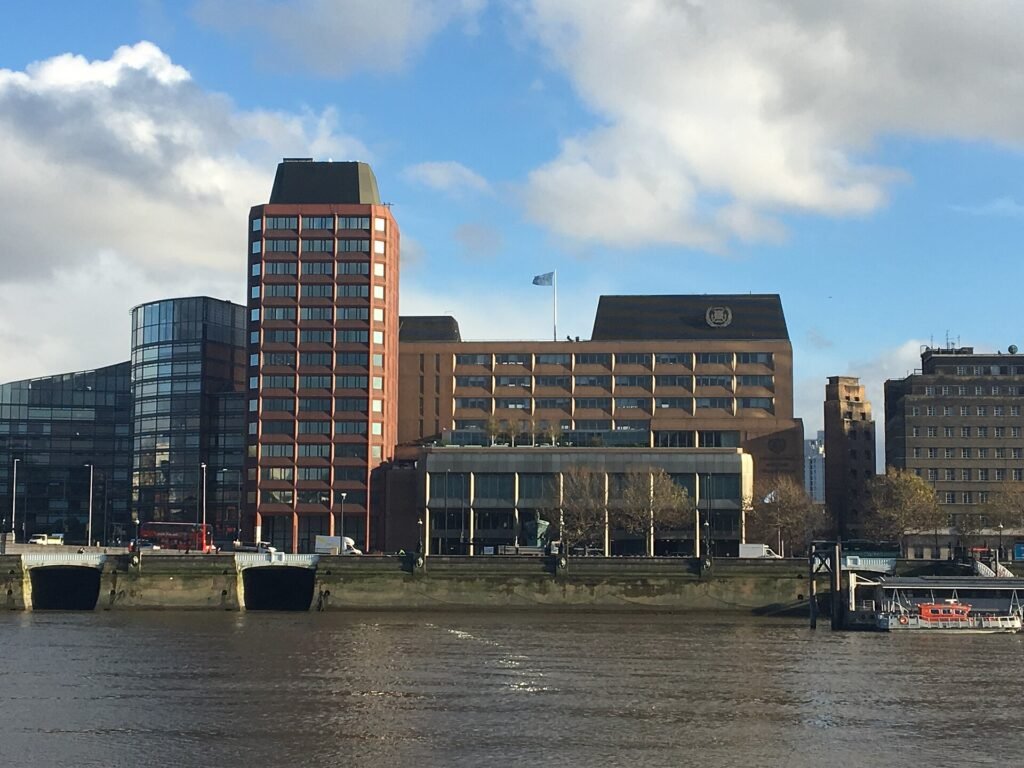
The International Maritime Organization (IMO) is the United Nations specialized agency responsible for the safety and security of shipping and for preventing marine and atmospheric pollution by ships. Headquartered in London, it has 176 Member States and three Associate Members.
History and founding of the IMO
The best way to improve safety at sea, the IMO says, has always been international regulations that all shipping nations follow. From the middle of the nineteenth century a number of such treaties were adopted, and several countries proposed a permanent international body, but that hope was realized only after the United Nations was created. In 1948 an international conference in Geneva adopted a convention establishing the organization, originally called the Inter-Governmental Maritime Consultative Organization (IMCO). The convention was adopted on 6 March 1948, entered into force in 1958 and the new body met for the first time in January 1959. The name changed to IMO in 1982.
Britannica adds that the convention took effect on 17 March 1958 after ratification by 21 countries, seven of which had to have at least a million gross tons of shipping.
The IMO’s first task was to adopt a new version of the International Convention for the Safety of Life at Sea (SOLAS), the most important treaty on maritime safety, which it completed in 1960. Pollution then became a growing concern. The Torrey Canyon disaster of 1967 spilled 120,000 tonnes of oil and showed the scale of the problem. The most important response was the International Convention for the Prevention of Pollution from Ships (MARPOL), adopted in 1973 and modified by a 1978 protocol, which covers oil, chemicals, packaged goods, sewage, garbage and air pollution. Two treaties in 1969 and 1971 created a compensation system for victims of oil pollution.
Later milestones include the Global Maritime Distress and Safety System, adopted in 1988 and fully operational in February 1999, and the International Safety Management Code, which took effect on 1 July 1998. The 2000s brought conventions on antifouling systems, ballast water and ship recycling, and a security regime that began in July 2004 with the International Ship and Port Facility Security Code.
Structure and membership
The IMO has 176 Member States and three Associate Members. Sixty-eight intergovernmental organizations have observer status, and 98 international non-governmental organizations have consultative status. A Secretary-General leads the organization, supported by a Secretariat of about 300 international staff in London. Secretaries-General serve at most two four-year terms, and the current holder, Arsenio Dominguez of Panama, began on 1 January 2024.
The Assembly, which includes all Member States, is the highest governing body. It meets once every two years, approves the work program, votes the budget, sets the organization’s financial arrangements and elects the Council. The Council is the executive organ, supervises the work between Assembly sessions and appoints the Secretary-General, subject to the Assembly’s approval.
Council seats are allocated by category. For 2026 to 2027 the Assembly elected 10 states with the largest interest in providing shipping services, 10 with the largest interest in seaborne trade, and 20 chosen for geographic balance and special interest in maritime transport, a total of 40. The IMO has adopted amendments to expand the Council to 52.
Five main committees do the detailed work, supported by sub-committees: the Maritime Safety Committee, the Marine Environment Protection Committee, the Legal Committee, the Technical Cooperation Committee and the Facilitation Committee.
What the IMO does
The IMO calls itself the global standard-setting authority for the safety, security and environmental performance of international shipping. Its main role is to create a regulatory framework that is fair and effective, universally adopted and universally implemented, so that operators cannot gain an advantage by cutting corners. Its measures cover ship design, construction, equipment, manning, operation and disposal.
The stakes are large because, as the IMO notes, international shipping carries more than 80 percent of global trade. The same account links the organization’s work to the United Nations Sustainable Development Goals, with the oceans goal central. For background on the industry itself, see the entries on maritime shipping and the container ship.
The IMO also issues guidance on newer risks. It has published guidelines on maritime cyber risk management, and during the COVID-19 pandemic it worked with United Nations and industry partners to help seafarers who were stranded on ships or unable to join them. It called on governments to treat seafarers as key workers.
Funding and governance
The IMO’s Assembly votes its budget and determines its financial arrangements, and the Council reviews the draft work program and budget estimates before they reach the Assembly. The IMO publishes a summary of its financial statements. The sources reviewed for this entry do not give a current budget figure.
The Assembly includes every Member State, while Council seats are reserved by category for states with the largest interests in shipping services and in seaborne trade, with the remaining seats chosen to represent all major geographic areas.
Criticism and challenges
The most visible recent debate concerns greenhouse gas emissions from ships. In April 2025 the Marine Environment Protection Committee approved the IMO Net-Zero Framework as a proposed new chapter of MARPOL Annex VI. It has two main elements: a global fuel standard and a global pricing mechanism for ship emissions, in line with the IMO’s 2023 strategy.
At an extraordinary session on 14 to 17 October 2025 the IMO adjourned instead of adopting the amendments, and agreed to reconvene in 12 months. UN News reported that several major economies, including the United States, opposed the pricing mechanism, arguing that it could work like a carbon tax and raise shipping costs. It said shipping accounts for nearly 3 percent of global emissions. The outcome of the reconvened talks was not available from the sources reviewed.
Legacy and impact
SOLAS, MARPOL and the other conventions form the core of the regulatory framework that the IMO maintains. The organization describes its aim as a level playing field in which ship operators cannot solve financial problems by compromising safety, security or environmental performance.
Its history also shows how the agenda has shifted over time, from the safety rules of the first SOLAS revision in 1960, to pollution after the Torrey Canyon spill, to security after 2001 and now to greenhouse gas emissions.
More in Maritime and Rail Transport
Key facts
- The IMO Convention was adopted in Geneva on 6 March 1948, and the organization first met in January 1959.3
- The IMO was called the Inter-Governmental Maritime Consultative Organization until its name changed in 1982.2
- The IMO has 176 Member States and three Associate Members, with its headquarters in London.5
- The IMO says international shipping carries more than 80 percent of global trade.1
- The IMO has five main committees, including the Maritime Safety Committee and the Marine Environment Protection Committee.4
- The Global Maritime Distress and Safety System became fully operational in February 1999.2
- In October 2025 the IMO adjourned an extraordinary session without adopting its Net-Zero Framework and agreed to reconvene in 12 months.7
Quick checkWhat is the International Maritime Organization responsible for?Show answer
The IMO is the United Nations specialized agency responsible for the safety and security of shipping and the prevention of marine and atmospheric pollution by ships. It is the global standard-setting authority for international shipping.
Sources
- International Maritime Organization, Introduction to IMO, https://www.imo.org/en/About/Pages/Default.aspx
- International Maritime Organization, Brief History of IMO, https://www.imo.org/en/About/HistoryOfIMO/Pages/Default.aspx
- International Maritime Organization, Frequently asked questions, https://www.imo.org/en/About/Pages/FAQs.aspx
- International Maritime Organization, Structure of IMO, https://www.imo.org/en/About/Pages/Structure.aspx
- International Maritime Organization, Member States, IGOs and NGOs, https://www.imo.org/en/About/Membership/Pages/Default.aspx
- Encyclopaedia Britannica, International Maritime Organization (IMO), https://www.britannica.com/topic/International-Maritime-Organization
- International Maritime Organization, IMO net-zero shipping talks to resume in 2026, https://www.imo.org/en/mediacentre/pressbriefings/pages/imo-net-zero-shipping-talks-to-resume-in-2026.aspx
- UN News, Talks on net zero shipping framework shelved as nations fail to reach consensus (October 2025), https://news.un.org/en/story/2025/10/1166131
Editorially reviewed by Specialty Digest Editorial TeamLast reviewed November 4, 2026Researched and drafted with AI assistanceReport an issue