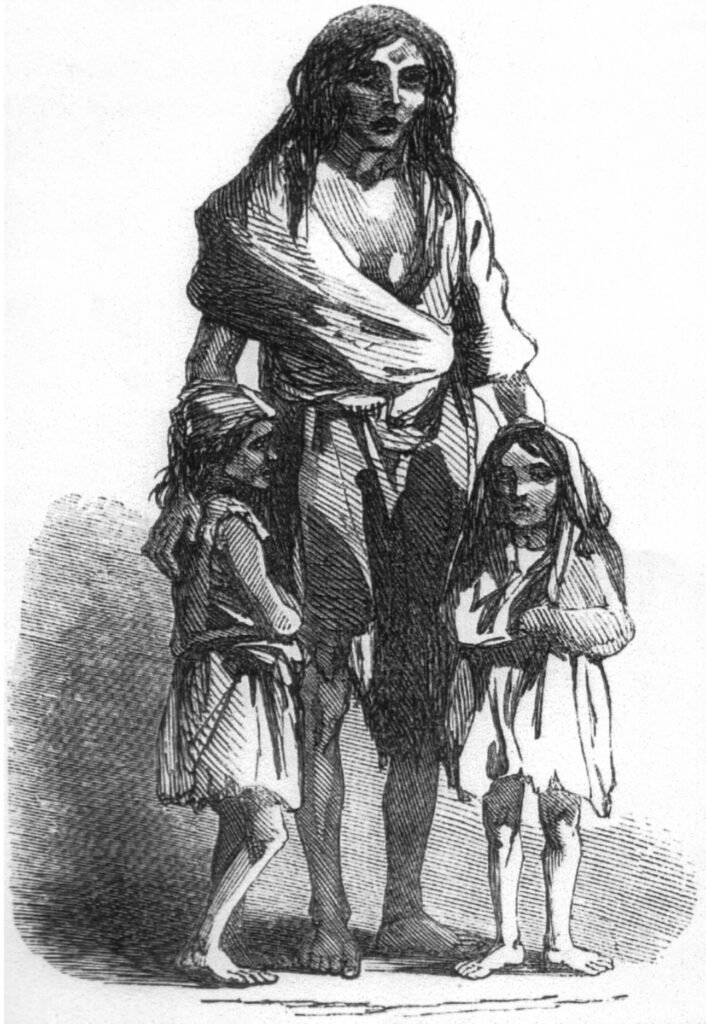
The Great Famine of Ireland, also called the Great Hunger or An Gorta Mór, was a famine caused by repeated failures of the potato crop between 1845 and about 1850. Historians estimate that around one million people died of starvation and disease, and a million or more emigrated, so that the population of Ireland fell sharply and has never fully recovered.
Background to the Great Famine
By the 1840s Ireland was part of the United Kingdom and was among the most densely populated parts of Europe. The Encyclopedia of Irish History and Culture notes that the population on cultivated land reached around 700 people per square mile. After about 1815 an earlier boom in Irish farming collapsed, evictions increased and the cottage linen industry shrank, leaving many families poorer and more dependent on one crop.
That crop was the potato. The same reference says that over 1.5 million landless laborers had no other significant source of food, and about three million more small tenants relied on it very heavily. This heavy reliance on a single crop grown on small plots is a clear example of the risks of monoculture, because one plant disease could destroy the main food supply of millions of people.
Course of the famine
The disease was potato blight, caused by the organism Phytophthora infestans. It reached Ireland from North America by way of the Low Countries and Britain in the fall of 1845. No effective remedy was known. Up to a third of the potato crop was lost in 1845, and in 1846 more than three-quarters was ruined, which left millions without food or seed potatoes for the following year.
The blight faded briefly and then returned in 1848 and 1849, which prolonged the crisis in many areas. It had mostly ended by the early 1850s, although the potato never again reached its earlier levels of productivity. Deaths were highest in the southern and western counties. Starvation was not the only killer. Typhus and relapsing fever spread among weakened people in cabins, on public works and later in crowded workhouses.
Food continued to be exported from Ireland during the famine, which has long been a source of anger and debate. The Encyclopedia of Irish History and Culture notes that the food value of grain exported in 1846 and 1847 was only about a tenth of what was lost to the blight, and that imports of cheaper grains such as maize were twice as large as exports. It also points out that imports arrived in bulk only in spring 1847, after a winter “starvation gap” in which keeping Irish grain at home might have saved many lives.
Relief efforts and the British response
The government of Prime Minister Sir Robert Peel set up public works and a central Relief Commission in early 1846. Peel also secretly bought about 100,000 pounds worth of American maize to steady prices. Peel’s government was replaced in June 1846 by the Whig administration of Lord John Russell, in which the Treasury official Charles Trevelyan had great influence over policy. The new government withdrew from the food trade and reorganized the public works, and the result in the winter of 1846 to 1847 was rising food prices and works that did not pay enough to feed workers.
In spring 1847 the government changed course and set up soup kitchens. At their peak they issued more than three million rations a day and undoubtedly saved many lives. By late summer 1847 the government considered the emergency over and moved relief to the Irish Poor Law, which depended on local taxes. This proved disastrous in the south and west, where heavily burdened landowners evicted tenants in large numbers and crowded workhouses spread disease. Very little state aid was given in the later years, and the historian Peter Gray attributes this to a strong belief that relief was the duty of landowners, not to a deliberate plan of extermination, which some nationalist writers later alleged.
Aftermath: deaths and emigration
The census of 1851 recorded a population of 6.6 million, down from 8.2 million in 1841. Allowing for the growth that would normally have occurred, about 2.4 million people were missing, more than a quarter of the island’s people. Separating deaths from emigration is difficult, but research from the 1980s put the number of deaths from famine and related diseases at around 1.1 million. Irish government speeches today commonly refer to one million dead.
More than a million people left Ireland during the famine years. Most first went to Britain, and many carried typhus into crowded port cities. In 1847 thousands crossed to Canada in converted cargo ships, and the encyclopedia says that up to one in five emigrants on this route died on board or soon after arrival. From 1848 more people traveled directly to the United States, in somewhat better conditions, though deaths were still high. Irish Catholic newcomers often faced hostility and exploitation where they settled.
Significance and legacy of the Great Famine
The famine was the most serious peacetime catastrophe in nineteenth-century Europe, according to the Encyclopedia of Irish History and Culture. It permanently altered Irish society. Emigration became a regular feature of Irish life, and a large Irish diaspora grew up in Britain, Canada and the United States.
Memory of the famine remains strong. In a speech at the National Famine Commemoration in May 2026, the Irish government described it as the most traumatic event in the island’s recorded history and said that after it Ireland became a nation where emigration touched every family. The National Famine Commemoration is a state event, and the 2026 ceremony took place at the Irish Workhouse Centre in Portumna, County Galway.
Historians still debate how far the disaster was caused by the blight and how far by economic structures and government policy. Most agree that the potato failure was the trigger, but that landlord behavior and the limited, delayed relief greatly increased the number of deaths. The Encyclopedia of Irish History and Culture concludes that the indifference of much of the landlord class and of the government made the suffering worse, which is why the famine is still debated and remembered.
More in History
Key facts
- Potato blight reached Ireland from North America via the Low Countries and Britain in the fall of 1845.1
- Up to a third of the potato crop was lost in 1845 and more than three-quarters in 1846.1
- The census population fell from 8.2 million in 1841 to 6.6 million in 1851, and research from the 1980s put deaths at around 1.1 million.1
- More than one million people emigrated during the famine years, and the soup kitchens of 1847 issued more than three million rations a day at their peak.1
- Irish government speeches describe the event as one million dead and as the most traumatic event in the island's recorded history.2
Related concepts
Quick checkWhat caused the Great Famine of Ireland?Show answer
Potato blight destroyed much of the potato crop from 1845, on which millions of people depended for food. Poverty, heavy reliance on one crop and limited, delayed relief then turned the crop failure into a famine.
Sources
- Peter Gray, Great Famine, in Encyclopedia of Irish History and Culture (via Encyclopedia.com), https://www.encyclopedia.com/international/encyclopedias-almanacs-transcripts-and-maps/great-famine
- Government of Ireland, Department of the Taoiseach, speech at the National Famine Commemoration, Irish Workhouse Centre, Portumna, 17 May 2026, https://www.gov.ie/en/department-of-the-taoiseach/speeches/national-famine-commemoration-irish-workhouse-centre-portumna-co-galway-sunday-17-may-2026/
Editorially reviewed by Specialty Digest Editorial TeamLast reviewed November 4, 2026Researched and drafted with AI assistanceReport an issue