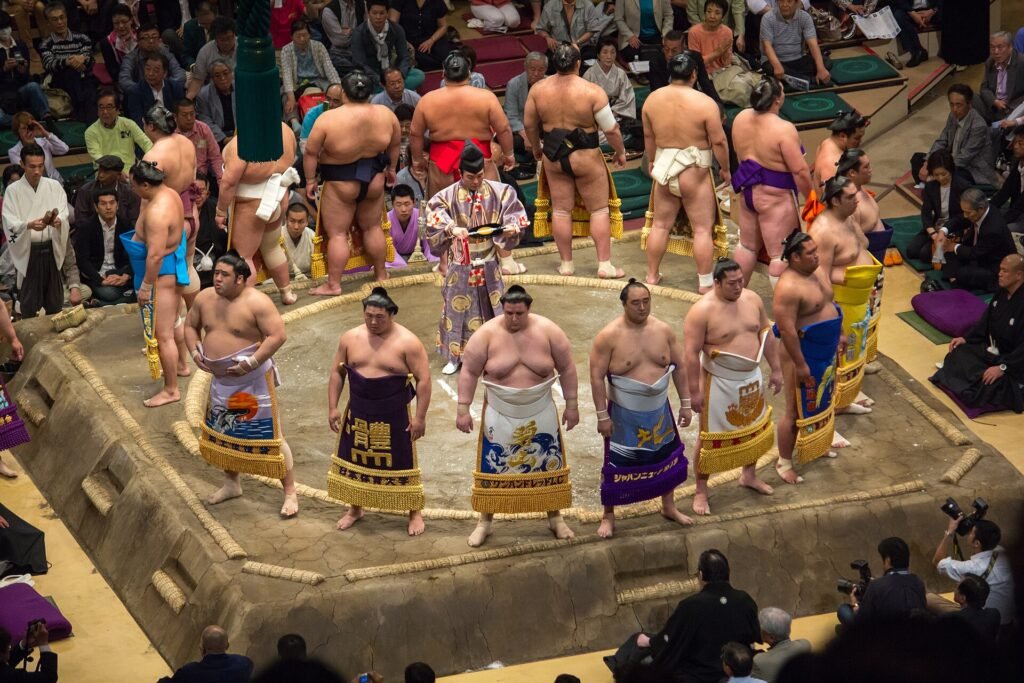
Sumo is a Japanese form of wrestling in which two wrestlers, called rikishi, try to force each other out of a clay ring or make the other touch the ground with anything but the soles of the feet. It is about 1,500 years old by the Japan Sumo Association’s account, and it keeps close ties to Shinto ritual. Professional sumo is organized into six 15-day tournaments each year.
History of sumo
The Japan Sumo Association traces sumo to ritual contests at shrines that were held to pray for a good harvest. By the Nara period in the eighth century, sumo had entered ceremonies at the Imperial Court, and the Heian court held harvest-linked matches for roughly 300 years. An account in the Nihon Shoki, completed in 720, describes an early contest between Sukune and Kehaya.
Under the Kamakura military government, which began in 1192, sumo was valued as warrior training, and the martial art of jujitsu grew out of it. After the Tokugawa shogunate unified Japan in 1603, professional groups formed in the city of Edo, and the Japan Sumo Association traces its origins to them. Professional sumo is generally dated from the revival of public matches after 1600, and the list of yokozuna, or grand champions, begins with Akashi Shiganosuke in 1632.
Time limits were added later. A 10-minute limit was introduced in 1928, then cut to seven minutes, then five, and it now stands at four minutes.
Rules and how sumo is played
A bout is usually over in seconds. A rikishi wins by forcing the opponent out of the circle or by throwing him to the ground. A rikishi loses if any part of his body other than the soles of the feet touches the ground, or if he steps on or over the straw bales that mark the circle.
There are no weight classes. Punching, hair pulling, eye gouging, choking and kicking the stomach or chest are forbidden, as is grabbing the cloth that covers the vital organs. The Association recognizes 82 winning techniques, called kimarite, and many of them depend on grips on the belt. Open-handed slaps to the upper body are allowed. In the top division a bout is limited to four minutes, with water breaks and restarts before a draw is declared. Five judges, called shimpan, who are former wrestlers, sit around the ring and can overrule the referee when a close call is disputed.
Before each bout the wrestlers perform a routine of stamping, crouching and glaring, and they toss salt into the ring to purify it. These rituals link the sport to Shinto, and yokozuna enter the ring in a separate ceremony with attendants.
Equipment and venues
The ring, or dohyo, is a square platform about 6.7 meters on each side and 60 centimeters high, built from clay with a thin layer of sand. Bouts take place inside a circle just over 4.55 meters across, marked by straw bales. Before each tournament, about 20 centimeters of soil is replaced and the surface is leveled, and a Shinto-style roof with tassels hangs above.
Each rikishi wears a silk belt called a mawashi, about nine meters long and 80 centimeters wide. Makuuchi wrestlers also wear ornamental silk aprons in ceremonies. Hairstyle reflects rank, with the more elaborate oichomage reserved for the top two divisions.
Wrestlers compete under ring names called shikona, which often end in -yama, -kawa or -umi. Ceremonies such as the ring-entering ritual, the pre-bout crouching and salt throwing, and a bow-twirling ceremony belong to the tournament routine.
Governing bodies and major competitions
The Japan Sumo Association governs professional sumo. It publishes the banzuke, the ranking list issued after each tournament that sets promotions and demotions. Six grand tournaments, called honbasho, take place each year, each lasting 15 days: January, May and September in Tokyo, March in Osaka, July in Nagoya and November in Fukuoka.
Wrestlers in the top two divisions fight once a day, and lower divisions fight on seven of the 15 days. A winning record decides rank: eight wins from 15 bouts in the top two divisions, or four from seven in the lower divisions, keeps or improves a wrestler’s rank. The top division holds at most 42 wrestlers. The wrestler with the best record in the top division wins the Emperor’s Cup. Special prizes for fighting spirit, technique and upsetting a top-ranked wrestler are also awarded, but only to those with at least eight wins.
The ranks, in descending order within the top division, are yokozuna, ozeki, sekiwake, komusubi and maegashira. Below it are juryo, makushita, sandanme, jonidan and jonokuchi, for six divisions in all. About 700 wrestlers compete professionally, and roughly 70 of them hold salaried status in the top two divisions.
Records and notable moments
Yokozuna is the only permanent rank, and a yokozuna who cannot meet its standards is expected to retire instead of being demoted. About 70 men have held it. Candidates normally need two consecutive tournament titles or equivalent results, plus approval from the Association based on character.
Several historical points are recorded in reference works. A tournament in 1884 organized for Emperor Meiji revived interest after a decline following the Meiji Restoration of 1868. The last drawn bout in the top division was in September 1974, and since then a bout that is not decided is restarted.
Global reach of sumo
Sumo is rooted in Japan, but its top ranks now draw wrestlers from other countries. No Japanese-born wrestler was promoted to yokozuna between 1998 and 2017, and the Association now limits each stable to one foreign wrestler. Women are not allowed to compete in professional sumo or to enter the dohyo.
More in Sports Coaching and Performance
Key facts
- Sumo is about 1,500 years old by the Japan Sumo Association account, with roots in Shinto harvest rituals.1
- The ring is about 6.7 meters square and 60 centimeters high, with a 4.55 meter circle marking the bout area.1
- There are six 15-day grand tournaments a year: Tokyo in January, May and September, Osaka in March, Nagoya in July and Fukuoka in November.1
- Wrestlers are ranked in six divisions, and the Association recognizes 82 winning techniques.1
- Yokozuna is the only permanent rank, and about 70 men have held it.2
Related concepts
Quick checkHow is a sumo bout won?Show answer
A rikishi wins by forcing the opponent out of the circle or by making any part of the opponent's body other than the soles of the feet touch the ground.
Sources
- Japan Sumo Association, Sumo Introduction (history, dohyo, rules, ranks and tournaments), https://www.sumo.or.jp/pdf/en/sumo_introduction.pdf
- Embassy of Japan in Azerbaijan, introduction to sumo (ritual, ranks and tournaments), https://www.az.emb-japan.go.jp/files/000180863.pdf
- Encyclopaedia Britannica, Sumo (history under imperial patronage and after 1600), https://www.britannica.com/sports/sumo-sport
- Wikipedia, Sumo (used for orientation: 1884 tournament, foreign-born wrestlers, last drawn bout), https://en.wikipedia.org/wiki/Sumo
Editorially reviewed by Specialty Digest Editorial TeamLast reviewed November 4, 2026Researched and drafted with AI assistanceReport an issue