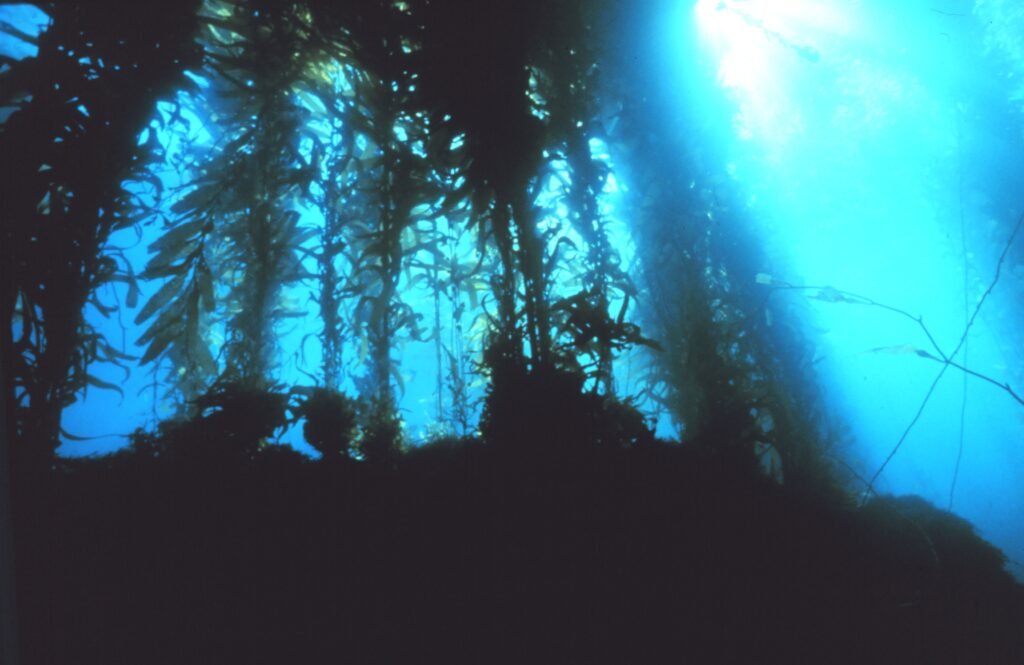
A kelp forest is a dense underwater stand of large brown algae called kelp, which can grow rapidly into towering structures that create a three-dimensional habitat resembling a terrestrial forest canopy, though entirely composed of algae rather than vascular plants. Kelp forests thrive in cold, nutrient-rich coastal waters along temperate coastlines worldwide, from California and Alaska to Chile, South Africa, Australia, and Japan.
Among the fastest-growing organisms on earth, some kelp species can add over thirty centimeters in length per day under favorable conditions, allowing kelp forests to form quickly and support an extraordinarily productive and biodiverse ecosystem that rivals coral reefs and tropical rainforests in ecological importance despite existing in distinctly different, often chilly, environments.
Kelp Biology and Rapid Growth
Kelp are not plants but large brown algae, lacking true roots, stems, or flowers, though they possess analogous structures including a holdfast that anchors them to rocky substrate, a stipe that functions like a stem, and blades that serve the role of leaves in capturing sunlight for photosynthesis. Gas-filled floats called pneumatocysts keep the blades buoyant near the sunlit surface.
This structural simplicity, combined with efficient nutrient uptake directly through the blade surface, allows many kelp species to grow remarkably fast, particularly when cold water delivers abundant dissolved nutrients, enabling entire forests to regenerate within a single growing season following disturbance.
Structure and Three-Dimensional Habitat
Kelp forests create distinct vertical zones analogous to a terrestrial forest, with a canopy layer near the surface, a understory of smaller algae species closer to the seafloor, and the rocky substrate itself where the holdfasts anchor and numerous invertebrates find shelter. This layered structure supports far greater species diversity than a comparable area of bare rock or sand.
The physical complexity created by kelp blades swaying in currents also buffers wave energy, providing calmer water that benefits both the kelp forest residents and adjacent shoreline habitats by reducing the erosive force of incoming waves before they reach the coast.
Keystone Predators and Sea Otters
Sea otters serve as a classic example of a keystone predator within kelp forest ecosystems, controlling populations of sea urchins that would otherwise graze kelp holdfasts and stipes to the point of destroying entire forests. Where otter populations have been depleted by hunting or disease, urchin populations have repeatedly exploded, converting lush kelp forests into barren rock covered in urchins, a state known as an urchin barren.
The recovery of sea otter populations in parts of the Pacific coast has, in several documented cases, allowed kelp forests to rebound dramatically, illustrating how the loss or return of a single predator species can cascade through an entire ecosystem.
Biodiversity Supported by Kelp Forests
Kelp forests provide food, shelter, and nursery habitat for an enormous range of species, including numerous fish, invertebrates such as abalone and various crustaceans, and marine mammals including seals and sea lions that hunt among the kelp fronds. Many commercially important fish species depend on kelp forests during at least part of their life cycle.
The sheer productivity of kelp forests also supports complex food webs extending well beyond the kelp habitat itself, since drifting kelp fragments and detritus provide a significant energy source for organisms living on adjacent sandy seafloors and even distant beaches where kelp washes ashore.
Threats From Warming and Overgrazing
Marine heatwaves pose a severe threat to kelp forests, since many kelp species are adapted to cold water and suffer physiological stress or outright die-off when water temperatures rise beyond their tolerance range for extended periods. Combined with unchecked urchin grazing following predator loss, warming has driven dramatic kelp forest declines in several regions over the past decade.
Northern California experienced one of the most severe documented kelp forest collapses in recent history, following a marine heatwave combined with a disease outbreak that decimated the local sea star population, removing another key urchin predator and accelerating the shift toward urchin-dominated barrens.
Restoration and Urchin Removal Programs
Kelp forest restoration efforts increasingly focus on actively removing or culling sea urchins from degraded sites to allow kelp to recolonize, sometimes paired with transplanting kelp or deploying floating spore collectors to seed new growth once urchin pressure has been reduced.
Some restoration programs have also explored commercial urchin harvesting as a dual-purpose strategy, reducing grazing pressure on kelp while creating an economic incentive tied to urchin removal, though scaling these efforts to match the extent of recent kelp losses remains an ongoing challenge.
Economic and Carbon Storage Value
Kelp forests support valuable commercial and recreational fisheries, along with growing interest in kelp farming for food, animal feed, and biofuel production, adding direct economic value beyond their ecological role. Coastal tourism and recreational diving centered on kelp forests also generate substantial economic activity in many regions.
Researchers have additionally begun investigating the carbon sequestration potential of kelp forests, since some kelp biomass eventually sinks to deeper, carbon-storing environments, though estimates of this contribution remain less certain than those established for seagrass and other coastal blue carbon habitats.
FAQ
Is kelp a plant?
No, kelp is a type of large brown algae, not a true plant, though it has analogous structures such as a holdfast, stipe, and blades that serve similar functions to roots, stems, and leaves.
Why are sea otters important to kelp forests?
Sea otters control sea urchin populations that would otherwise overgraze and destroy kelp forests, making otters a keystone predator whose presence or absence can determine whether a kelp forest thrives or collapses.
What is causing kelp forests to decline in some regions?
Marine heatwaves that exceed kelp’s temperature tolerance, combined with unchecked sea urchin grazing following the loss of key predators, have driven significant kelp forest declines in several coastal regions.
Editorially reviewed by Specialty Digest Editorial TeamLast reviewed November 4, 2026Researched and drafted with AI assistanceReport an issue