The midnight sun is the summer phenomenon in which the Sun remains visible at local midnight, and polar night is its winter opposite, when the Sun stays below the horizon all day. In Alaska both occur north of the Arctic Circle, and Utqiagvik has a polar day of 84 days and a polar night of 68 days. Fairbanks, south of the circle, still gets about 21 hours of daylight from May 10 to August 2 [1][2].
| Midnight sun latitude | About 65°44′ N to the pole |
|---|---|
| Utqiagvik polar day | 84 days |
| Utqiagvik polar night | 68 days |
| Fairbanks solstice sunset | 12:47 a.m. |
| Fairbanks long days | About 21 hours of daylight, May 10–Aug 2 |
| Fairbanks short days | Under 4 hours, Nov 18–Jan 24 |
What Causes It
The midnight sun, or polar day, occurs north of the Arctic Circle and south of the Antarctic Circle at latitudes from about 65°44′ to the poles. Refraction and the size of the Sun’s disc let it reach up to about one degree south of the Arctic Circle. Polar night is the winter opposite [1].
Utqiagvik
Utqiagvik, Alaska, the northernmost city in the United States, has a polar day of 84 days and a polar night of 68 days [1].
Fairbanks
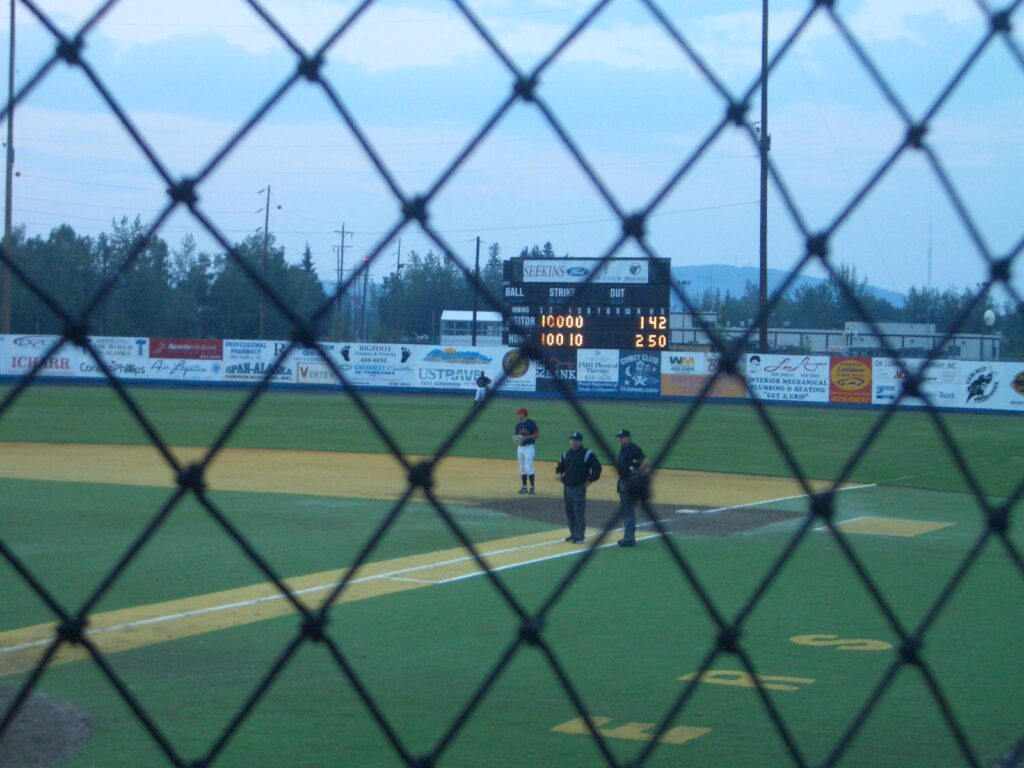
At the summer solstice in Fairbanks the Sun sets at 12:47 a.m. Fairbanks is about 51 minutes ahead of its idealized time zone, or 1 hour 51 minutes under daylight saving time, so solar culmination is at about 12:51 p.m. and solar midnight at about 1:51 a.m. The Midnight Sun Game baseball contest has been played since 1906 in the twilight around June 21 [1]. The Interior gets about 21 hours of daylight from May 10 to August 2 and less than four hours from November 18 to January 24 [2].
Midnight Twilight
Between about 59°34′ or 60°34′ and the polar circle, the Sun stays less than 6 or 7 degrees below the horizon, producing midnight twilight rather than midnight sun [1]. Southcentral Alaska has about 20 hours of daylight in June and July and about 6 hours in December and January [3].
Effects on Daily Life
The long dark of winter is also the season when the aurora is easiest to see; see the entry on the Aurora Borealis in Alaska.
Related Entries
See the entries on Interior Alaska, the North Slope and the Climate of Alaska.
FAQs
What is the midnight sun? The Sun remains visible at local midnight in summer north of the Arctic Circle.
How long is polar night in Utqiagvik? 68 days.
Does Fairbanks have a midnight sun? Not exactly. The Sun sets at about 12:47 a.m. at the solstice, and twilight remains.
How much daylight does Fairbanks get in winter? Under four hours from November 18 to January 24.
What is the Midnight Sun Game? A baseball game played in Fairbanks in the twilight around June 21 since 1906.
Sources
More in Climate & Weather
Key facts
Quick checkHow many days of polar day does Utqiagvik have?Show answer
84
Sources
- Wikipedia. Midnight sun. 2026 (accessed 2026-11-12)
- Wikipedia. Interior Alaska. 2026 (accessed 2026-11-12)
- Wikipedia. Southcentral Alaska. 2026 (accessed 2026-11-12)
Editorially reviewed by Specialty Digest Editorial TeamLast reviewed November 12, 2026Researched and drafted with AI assistanceReport an issue