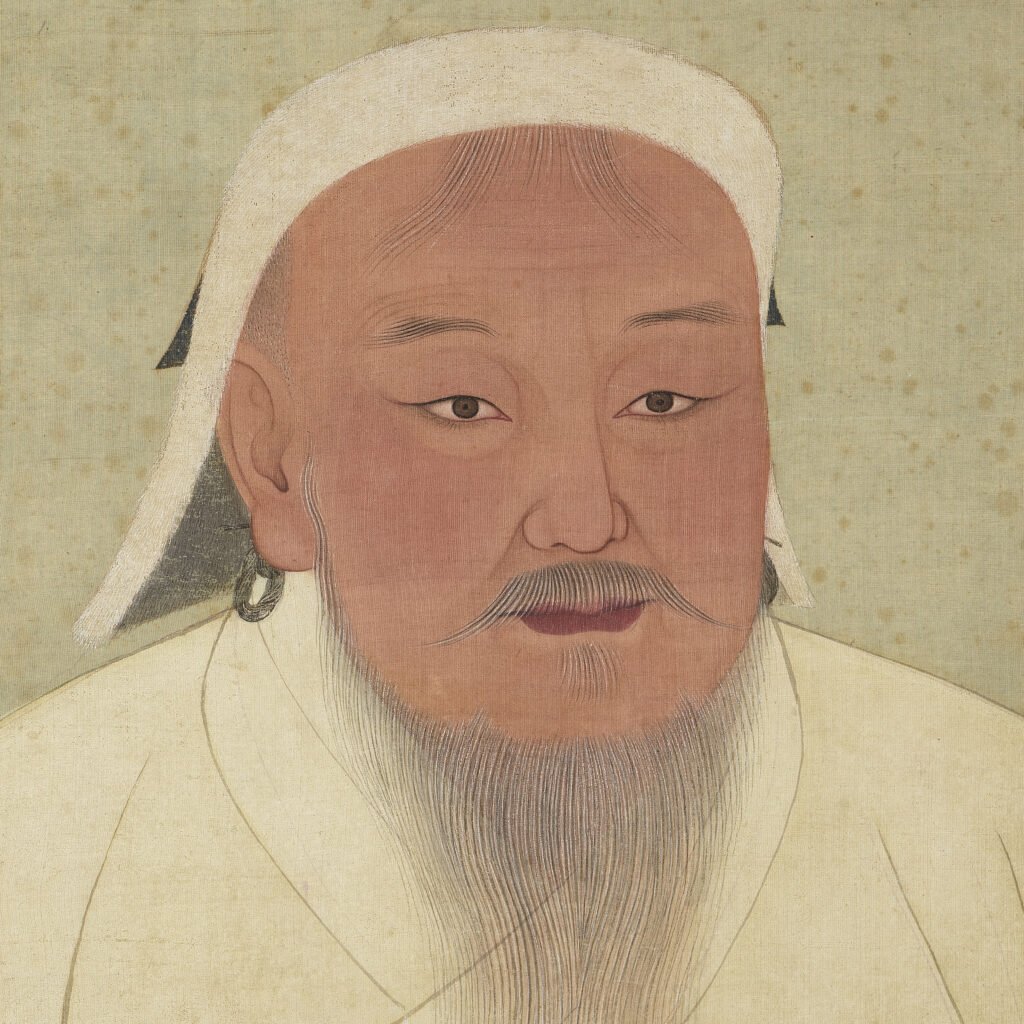
Genghis Khan (also spelled Chinggis Khan) was the founder of the Mongol Empire and ruled it as its first Great Khan from 1206 until his death in 1227. He was born Temujin, and he took the title Genghis Khan, probably meaning universal ruler, after uniting the Mongol tribes. His armies conquered large parts of northern China, Central Asia and Persia.
Early life of Genghis Khan
Much of what is known about his early years comes from the Secret History of the Mongols, a text that is partly legendary, and from later Chinese and Persian sources. His birth date is uncertain, and scholars choose 1162 or 1167. His father, Yisugei, was a tribal leader, and his mother was Hoelun.
When Temujin was nine or twelve years old, his father was poisoned by a rival. Because the boy was too young to command the loyalty of his father’s followers, the family was abandoned on the steppe and lived by foraging. Temujin later married Borte, whom his father had chosen for him, and he allied himself with Toghril, chief of the Kerait people. Over roughly ten years he defeated rival groups, including the Tartars, Kereyids, Naimans and Merkids.
UNESCO notes that the Great Burkhan Khaldun mountain in northeastern Mongolia is believed to be the place of his birth and burial. The site, which UNESCO lists as a sacred landscape, reflects his effort to make mountain worship part of the unification of the Mongol people.
Career and major work of Genghis Khan
In 1206 a great assembly, or kurultai, on the Kerulen river formally declared Temujin the leader of the Mongol confederation, and he took the title Genghis Khan. He then turned the confederation into a military and administrative state. He reorganized the army so that units were no longer built on tribal lines, which reduced the risk that old rivalries would split it, and he expanded his bodyguard from 800 to 10,000 men.
Mongol forces attacked the Jin state of northern China in 1205, 1209 and 1211. In 1214 the Jin agreed to peace and tribute, but fighting resumed in 1215 after the Jin moved their capital south, and the Mongols captured Beijing that year. Genghis also attacked the Tangut state of Xi Xia and later returned to besiege its capital.
Between 1218 and 1220 the Mongols invaded the Khwarazm Empire in what is now Uzbekistan and Iran. Genghis had sent a diplomatic mission asking the Shah to accept his overlordship, but the Shah had the ambassadors executed. The Mongol army, which reached about 100,000 men, captured Bukhara and Samarkand and drove the Shah to flee. Raids into northern Afghanistan followed in 1221, and in 1222 a combined force of Rus principalities and Kipchaks was defeated at Kalka.
Ideas and contributions of Genghis Khan
Genghis Khan combined conquest with administration. He had the previously spoken Mongol language written down using the script of the Uighur Turks, which allowed his government to draw up the Yasa, the first Mongol law code, with set punishments for specific crimes. He also set up a postal system in which riders could carry messages quickly across long distances and change horses and rest at regular stations.
Mongol armies relied on archers with powerful composite bows and on light and heavy cavalry, and each rider might have as many as sixteen spare horses. The Mongols readily borrowed the siege methods and weapons of the peoples they fought, and commanders and ministers came from some twenty nations. Spies and merchants gave Genghis information that he used to exploit divisions among his enemies.
To hold what he had won, rulers were often allowed to keep power as vassals, all religions were permitted, international trade was encouraged and travelling merchants received protection.
Legacy of Genghis Khan
Genghis Khan died on 18 August 1227 of an unknown illness, possibly linked to a fall from his horse some months earlier, while his army was besieging the Xi Xia capital of Zhongxing. The news of his death was kept from the army until the city surrendered. His body was taken back to Mongolia for burial, and the location of his tomb was kept secret. Medieval sources place it near the sacred mountain Burkan Kuldun, but it has never been confirmed.
He had already arranged for the empire to be divided among his sons Jochi, Chagatai, Tolui and Ogedei. Jochi died in 1227, and Ogedei became Great Khan in 1229 and ruled until 1241. Genghis’s grandson Kublai Khan later conquered most of the remaining parts of China and founded the Yuan dynasty, and the Song dynasty collapsed in 1279.
In Mongolia he is regarded as the father of the nation, and special ceremonies honor him in the capital, Ulaanbaatar.
Controversies and criticism
The Mongol conquests brought heavy loss of life. Medieval chroniclers claimed that his campaigns killed millions of people, though such figures are hard to verify and should be treated with caution. A Jin official, Yuan Haowen, wrote a poem describing the devastation of the north as a land without life. Some Mongol campaigns repeated a pattern of capturing a city, destroying it, killing its people and warning neighboring cities of the same fate if they did not surrender.
In the Khwarazm campaign the Mongols destroyed cities and wrecked the region’s irrigation system, and he came to be known as the Accursed One. A thirteenth-century Persian historian, Minhaj al-Siraj Juzjani, described him as a man of great energy and understanding who was at once just and cruel. The memory of the conquests therefore remains divided, with admiration for the state-builder in Mongolia and condemnation of the destruction elsewhere in Iran and across Eurasia.
More in History
Key facts
- Genghis Khan was born Temujin, with a birth year given as either 1162 or 1167.1
- A kurultai on the Kerulen river proclaimed him Genghis Khan in 1206.1
- He had Mongol written in the Uighur script and set up the Yasa law code and a courier postal system.1
- He died on 18 August 1227 during a siege of the Xi Xia capital.1
- UNESCO says Burkhan Khaldun mountain is believed to be the site of his birth and burial.2
Related concepts
Quick checkWhere is Genghis Khan buried?Show answer
The location of his tomb was kept secret and has never been confirmed. Medieval sources place it near the sacred mountain Burkan Kuldun, and UNESCO says the Burkhan Khaldun landscape is believed to be the place of his birth and burial.
Sources
- World History Encyclopedia, Genghis Khan, https://www.worldhistory.org/Genghis_Khan/
- UNESCO World Heritage Centre, Great Burkhan Khaldun Mountain and its surrounding sacred landscape, https://whc.unesco.org/en/list/1440/
Editorially reviewed by Specialty Digest Editorial TeamLast reviewed November 4, 2026Researched and drafted with AI assistanceReport an issue