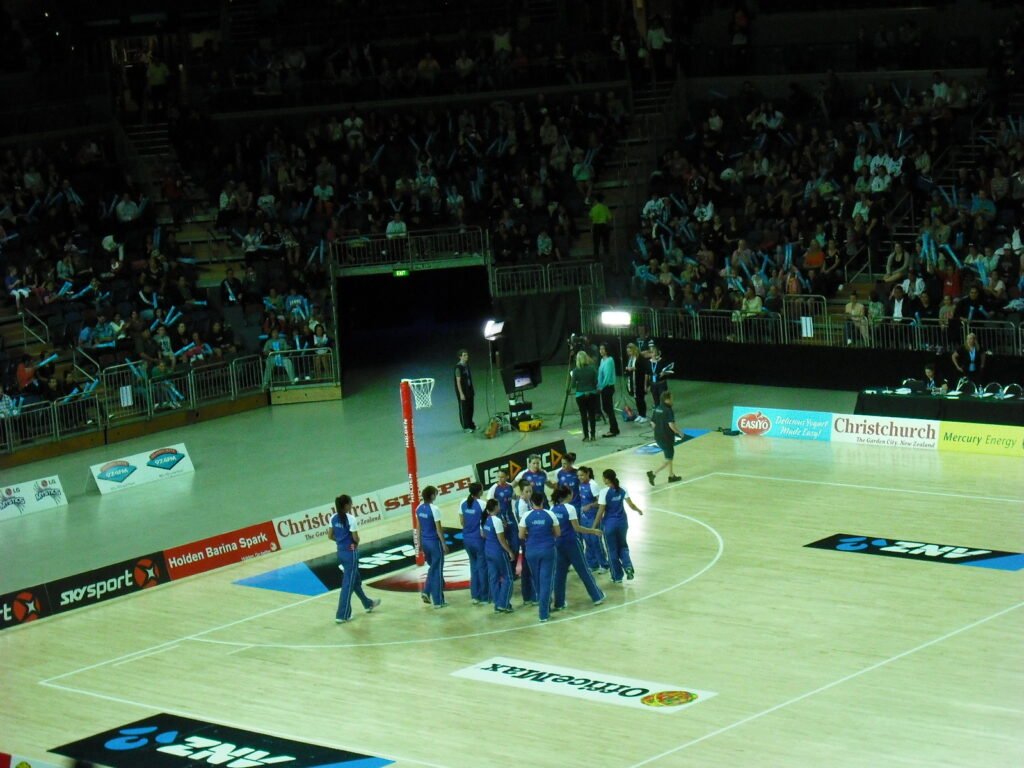
Netball is a seven-a-side ball game in which two teams pass a ball up a court and try to score by shooting it through a ring on a tall post. Players may not run or dribble with the ball, and each position is limited to certain areas of the court. The game was first played in England in 1895 and grew out of early women’s basketball.
History of netball
Netball descends from basketball, which James Naismith devised in 1891. Senda Berenson adapted basketball for women in 1892, and in 1893 Martina Bergman-Osterberg introduced the game to students at her physical training college in Hampstead, London. In the mid-1890s a misreading of the court diagram in a basketball rulebook led to the idea that players should be confined to zones, and that restriction became a defining feature of netball.
By the late 1890s the game was developing into a separate sport, and the first codified rules were published in 1901. The traditional seven-a-side format has been played since 1895, according to World Netball. Rules were standardized at an international meeting in Sri Lanka in 1960, the same year a federation for the sport was founded.
Rules and how netball is played
A match lasts 60 minutes and is divided into four quarters of 15 minutes. Play restarts with a centre pass at the start of each quarter and after every goal, and the pass alternates between teams no matter who scored last. At the restart only the two centre players may be in the centre third of the court.
Each team fields seven players, and each wears a bib with the initials of a position. The positions and the areas they may enter are shown below.
- Goal shooter (GS): the attacking third, including the goal circle.
- Goal attack (GA): the centre third and attacking third, including the goal circle.
- Wing attack (WA): the centre third and attacking third, but not the goal circle.
- Centre (C): anywhere except the two goal circles.
- Wing defence (WD): the centre third and defensive third, but not the goal circle.
- Goal defence (GD): the centre third and defensive third, including the goal circle.
- Goal keeper (GK): the defensive third, including the goal circle.
A player who enters a zone outside the position’s limits is offside, and the other team receives a free pass. Only the goal shooter and goal attack may score, and only from inside the goal circle.
A player holding the ball must pass or shoot within three seconds, and may not dribble or run with it. Once the landing foot has been lifted, it may not touch the ground again while the player holds the ball, although pivoting is allowed. A defender must stay at least 0.9 meters from the player with the ball. Contact is permitted only when it does not impede an opponent or the flow of play, and impeding contact gives the other team a penalty pass.
Defenders have further limits. The goal defence and goal keeper must stay at least 0.9 meters from the shooter’s landing foot, or the play is called as obstruction. Breaks come for three minutes after the first and third quarters and for five minutes at half time. Time lost to injury is capped at two minutes, and elimination games that finish level go to two seven-minute periods of overtime.
Equipment and courts
The court measures 30.5 meters long and 15.25 meters wide and is divided into three equal thirds. At each end a semicircular shooting circle has a radius of 4.9 meters. The goal ring has a diameter of 380 millimeters and is fixed to a post 3.05 meters high, with no backboard behind it.
The ball is about 22 centimeters across and weighs roughly 397 to 454 grams. Players wear bibs showing their positions. World Netball also publishes the rules and standards for facilities, which cover the court, posts, ball and clothing.
Governing bodies and major competitions
The sport’s international federation was founded in 1960 as the International Federation of Netball and Women’s Basketball. It later became the International Netball Federation and is now called World Netball, with offices in Salford, in the United Kingdom. Reference summaries report 63 full members and 12 associate members across five regions. For how bodies like this fit together, see sports governance.
The first international tournament, later called the World Netball Championships and now the Netball World Cup, was held in 1963 in Eastbourne, England, with eleven nations. Australia and New Zealand have dominated the event since. Netball was added to the Commonwealth Games in 1998 in Kuala Lumpur, Malaysia, and has been on the program ever since. World Netball also promotes a shorter format called FAST5.
Records and notable moments
The first recorded international match took place in 1938, when Australia beat New Zealand in Melbourne. The International Olympic Committee recognized the international federation in 1995, after many years of lobbying, but netball has never been played at the Summer Olympics. The game’s history as a sport shaped around women is part of the wider story of gender in sport.
Netball’s place in the Commonwealth Games gives it a global stage every four years. Australia and New Zealand have been the leading medal winners across the Games’ history, with England and Jamaica also reaching podiums.
Global reach of netball
World Netball reports that more than 20 million people play netball in more than 80 countries. Teams from several regions take part in the Netball World Cup, and the 2023 edition included nations such as South Africa and Sri Lanka. Netball’s regular place in the Commonwealth Games keeps it prominent across Commonwealth countries.
Netball and safety
World Netball runs safeguarding work to make sport safer for children, and it offers coaching resources and an officiating program for international events. Its officiating program, called World Class Officiating, aims to develop referees for international events. This entry gives general background and is not medical advice.
More in Sports Coaching and Performance
Key facts
- Netball is played by two teams of seven, and the traditional seven-a-side format has been played since 1895.1
- A match has four 15-minute quarters on a 30.5 meter by 15.25 meter court, with goal rings on posts 3.05 meters high.3
- Only the goal shooter and goal attack may score, and only from inside the goal circle.3
- Netball joined the Commonwealth Games in 1998 in Kuala Lumpur.2
- The IOC recognized the international federation in 1995, but netball has never been an Olympic sport.3
Related concepts
Quick checkWhich two positions can score in netball?Show answer
Only the goal shooter and the goal attack can score, and each must shoot from inside the goal circle at their end of the court.
Sources
- World Netball, The Game (seven-a-side format, rules and equipment pages), https://netball.sport/game/
- World Netball, Commonwealth Games (debut in 1998 and results table), https://netball.sport/?p=27770
- Wikipedia, Netball and Rules of netball (used for orientation, history, court dimensions and position rules), https://en.wikipedia.org/wiki/Netball
Editorially reviewed by Specialty Digest Editorial TeamLast reviewed November 4, 2026Researched and drafted with AI assistanceReport an issue