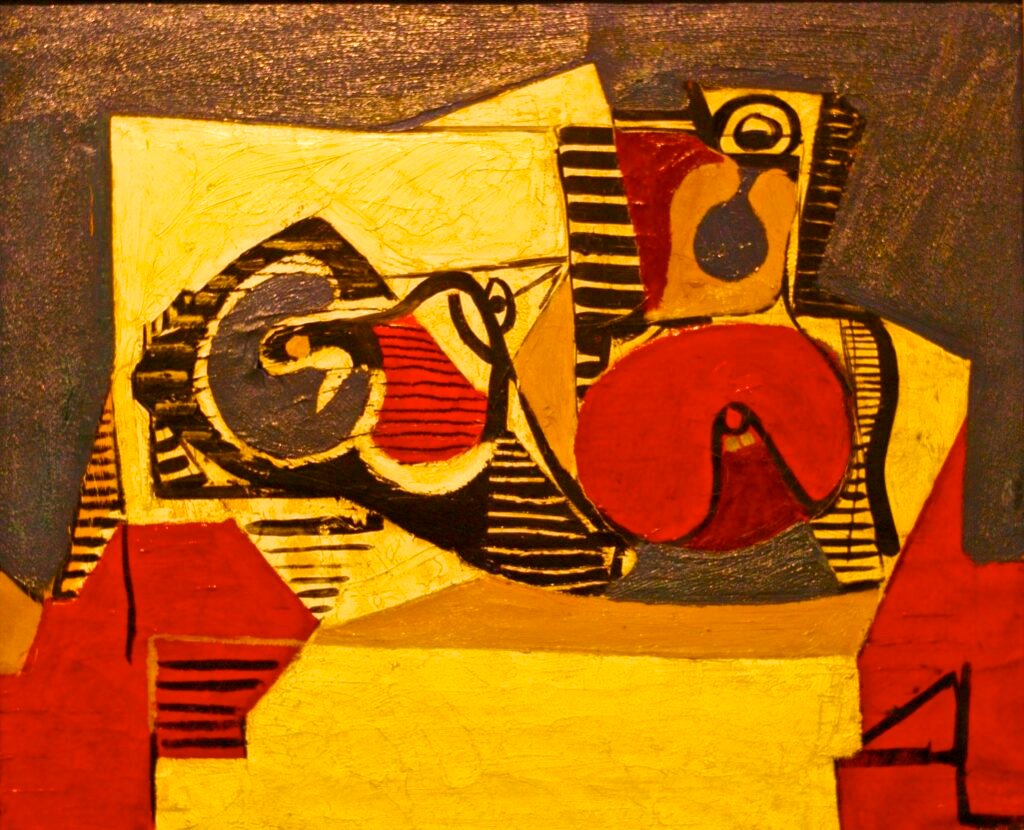
Abstract Expressionism was an American painting movement that emerged in New York in the 1940s and dominated international art through the 1950s, marking the first time an American art movement achieved global artistic influence. It emphasized spontaneous, gestural brushwork, large-scale canvases, and an insistence that painting itself could express profound emotional and spiritual content without depicting recognizable subject matter.
Origins and Historical Context
The movement developed among artists who had lived through the Great Depression and the Second World War, many of whom had been exposed to European Surrealism through emigre artists who fled to New York during the 1930s and early 1940s. Federal arts programs of the Depression era had given many future Abstract Expressionists their first steady income as painters, while wartime anxieties pushed them away from the social realism and regionalist styles that had dominated American art in the 1930s. By the mid-1940s, a loosely connected group of painters working in downtown New York began experimenting with new approaches that rejected both the European reliance on recognizable form and the traditional American emphasis on narrative subject matter.
Core Characteristics and Techniques
Abstract Expressionist painting generally falls into two broad tendencies: gestural abstraction, exemplified by energetic, physical application of paint, and color field painting, which favored large, quiet expanses of color meant to envelop the viewer. Gestural painters often worked on canvases laid flat on the floor, applying paint through dripping, pouring, or sweeping arm motions rather than traditional brushwork at an easel. This physical, full-body approach to painting was sometimes called action painting, a term meant to capture the idea that the finished canvas recorded the actual bodily process of its creation. Color field painters, by contrast, built compositions from soft-edged or hard-edged areas of saturated color intended to produce a contemplative, almost meditative viewing experience.
Major Artists and Works
Jackson Pollock became the most widely recognized figure in the movement through his drip paintings, created by flinging and pouring commercial paint across canvas laid on the ground. Willem de Kooning combined gestural energy with distorted figuration, particularly in his Woman series. Mark Rothko and Barnett Newman developed color field approaches built around large rectangular fields of color and narrow vertical bands known as zips, while Clyfford Still and Franz Kline explored stark contrasts between light and dark forms. Lee Krasner, Helen Frankenthaler, and Joan Mitchell were among the women artists whose substantial contributions were historically under-recognized relative to their male peers.
Critical Reception and Influence
Critics Clement Greenberg and Harold Rosenberg became closely associated with promoting and theorizing the movement, though they emphasized different aspects of it: Greenberg focused on formal qualities like flatness and color, while Rosenberg championed the existential, performative dimension of action painting. The movement benefited from Cold War era institutional support, including international touring exhibitions connected to American cultural diplomacy efforts, which helped establish New York rather than Paris as the center of the contemporary art world for the first time.
Legacy and Contemporary Relevance
Abstract Expressionism opened the door for later movements including a distinct color field tendency, minimalism, and various forms of process based and performance art that treated the act of making art as inseparable from the finished object. Its emphasis on scale, surface, and the physical trace of gesture continues to inform contemporary painting practice, and major retrospectives of its key figures remain among the most heavily attended exhibitions at museums worldwide.
Exhibition and Market Impact
The movement gained critical traction partly through a small number of influential New York galleries willing to show large, unconventional canvases that most dealers considered unmarketable, and through supportive critics who wrote extensively about the work in the years before museums began acquiring it in significant quantities. By the late 1950s, major museums both in the United States and abroad were mounting dedicated exhibitions, and prices for key canvases began climbing steadily as the movement gained institutional legitimacy it had lacked barely a decade earlier.
Second-generation painters who began working in the later 1950s absorbed the lessons of the original group while pushing toward even larger scale and, in some cases, a flatter, more hard-edged treatment of color that anticipated the subsequent minimalist and color field tendencies of the 1960s. This generational handoff illustrates how Abstract Expressionism functioned less as a single fixed style than as a shared set of working assumptions, including scale, physical engagement with the canvas, and resistance to illustrative subject matter, that individual painters interpreted in markedly different ways.
Technical Materials
Many Abstract Expressionist painters used industrial and commercial paints rather than traditional fine art materials, favoring house paint and enamel for their fluid consistency, bold color, and the fast drying times that suited rapid, large-scale working methods. Canvas sizes expanded dramatically compared to earlier painting traditions, with some finished works extending well beyond eight feet in width, a scale intended to physically surround the viewer and create an immersive, environmental experience rather than a framed window onto a separate scene.
FAQ
Was Abstract Expressionism only a painting movement?
While painting was its primary medium, some associated sculptors and printmakers applied similar gestural and improvisational approaches to three dimensional and graphic work.
Why is it sometimes called the New York School?
The term reflects the geographic center of the movement, since nearly all its major figures lived and worked in New York City during the 1940s and 1950s.
Did all Abstract Expressionists paint abstractly?
Most did, though some, like Willem de Kooning, continued to incorporate distorted figurative elements within an otherwise abstract gestural style.
More in Visual Arts
Editorially reviewed by Specialty Digest Editorial TeamLast reviewed November 4, 2026Researched and drafted with AI assistanceReport an issue