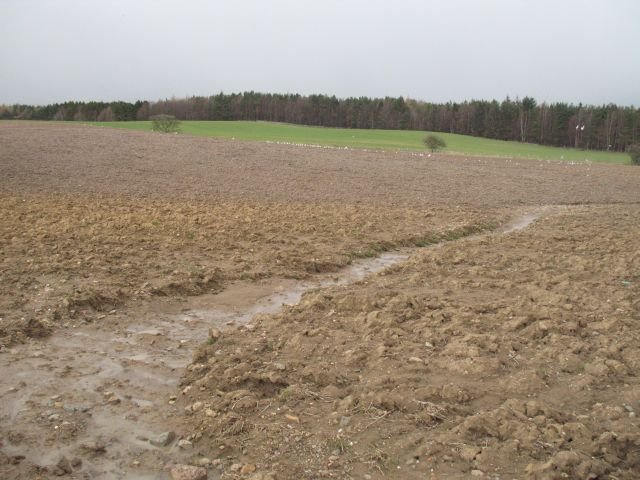
Soil erosion is the process by which topsoil, the nutrient-rich uppermost layer of soil, is worn away and transported by wind, water, or human activity faster than it can naturally reform. Because topsoil formation typically takes centuries, erosion that outpaces this slow rebuilding process represents a largely irreversible loss of agricultural productivity and ecological function on the timescale relevant to human society.
While some erosion occurs naturally as part of landscape evolution, the rate of soil loss has accelerated dramatically wherever vegetation cover has been removed for agriculture, grazing, logging, or construction, exposing bare soil to the direct force of rainfall, runoff, and wind. The resulting loss of fertile land has emerged as one of the most significant long-term threats to global food security.
Types and Mechanisms of Erosion
Water erosion occurs through several distinct mechanisms, including sheet erosion, in which a thin, relatively uniform layer of soil is removed across a slope, and the more visually dramatic rill and gully erosion, in which concentrated runoff carves channels that progressively deepen and widen. Wind erosion, by contrast, lifts and transports fine soil particles across open, unvegetated terrain, a process that became catastrophically visible during events such as the North American Dust Bowl of the 1930s.
Tillage erosion, a less widely recognized mechanism, occurs when repeated plowing gradually moves soil downslope within a field, concentrating it at the base of hills while thinning it near the crest. Each mechanism responds differently to conservation practices, so effective erosion control typically requires diagnosing which processes dominate on a given landscape.
Agricultural Causes and Consequences
Conventional tillage practices that leave soil bare for extended periods between plantings dramatically increase vulnerability to both wind and water erosion, as does the removal of hedgerows, windbreaks, and other vegetation that once buffered fields from the elements. Continuous row-cropping without cover crops or crop rotation further depletes the organic matter that helps bind soil particles together.
The resulting productivity losses compound over time, since eroded soils hold less water and fewer nutrients, requiring ever-greater fertilizer inputs to maintain yields even as the underlying resource base deteriorates. Some studies estimate that historical cropland erosion has already removed a substantial share of naturally occurring topsoil in heavily farmed regions worldwide.
Off-Site and Downstream Impacts
Eroded soil does not simply disappear, it travels downstream, where it can clog waterways, smother aquatic habitat, and carry attached nutrients and pesticides into rivers, lakes, and eventually coastal waters. Sediment-laden runoff is a leading contributor to the nutrient loading that drives algal blooms and oxygen-depleted dead zones in many major river deltas.
Reservoirs and irrigation infrastructure downstream of eroding watersheds must contend with sediment accumulation that reduces water storage capacity and requires costly dredging, making upstream erosion control a practical concern for water managers far from the original farmland or construction site.
Conservation Tillage and Cover Crops
No-till and reduced-tillage farming methods leave crop residue on the soil surface rather than turning it under, protecting the ground from direct rainfall impact and wind while gradually building organic matter and improving soil structure. Cover crops planted between main growing seasons serve a similar protective function, keeping living roots in the ground year-round.
Contour farming, in which rows follow the natural contours of sloped land rather than running straight up and down a hill, and terracing, which physically reshapes steep terrain into a series of level steps, both slow water movement and reduce the erosive energy of runoff on vulnerable slopes.
Measuring and Monitoring Erosion
Soil scientists estimate erosion rates using tools such as the Universal Soil Loss Equation and its revised successors, which combine factors including rainfall intensity, soil type, slope, and land cover to predict expected soil loss under given management practices. Satellite imagery and remote sensing increasingly supplement ground-based measurements, allowing researchers to track vegetation cover and bare soil exposure across large regions over time.
Long-term monitoring plots, some maintained for decades at agricultural research stations, provide crucial calibration data that allows these predictive models to be validated and refined against real-world measured soil loss under varying weather conditions.
Policy and Global Soil Conservation Efforts
Government programs in many countries now provide financial incentives for farmers who adopt conservation tillage, cover cropping, or buffer strips along waterways, recognizing that individual landowners often bear the up-front cost of these practices while downstream communities capture many of the water quality benefits. Such incentive programs aim to correct this mismatch between who pays and who benefits.
International bodies including the Food and Agriculture Organization have designated soil conservation as a priority within broader food security and climate adaptation strategies, since maintaining productive soils is essential both for feeding a growing population and for preserving the carbon stored within healthy soil organic matter.
Soil health advocates increasingly frame erosion prevention as inseparable from broader regenerative agriculture goals, arguing that the same practices protecting topsoil from loss also rebuild the biological activity that makes farmland resilient to drought and extreme weather.
FAQ
How long does it take for topsoil to form naturally?
Natural topsoil formation is extremely slow, often estimated at hundreds of years to form just a few centimeters, which is why erosion that outpaces this rate is considered a largely irreversible loss on human timescales.
What is the most effective way to reduce soil erosion on farmland?
Keeping soil covered year-round through no-till farming, cover crops, and crop residue is generally considered the most broadly effective approach, often combined with contour farming or terracing on sloped land.
Does soil erosion affect water quality?
Yes, eroded soil carries attached nutrients and pesticides into waterways, contributing to sediment buildup, algal blooms, and oxygen-depleted zones in rivers, lakes, and coastal waters downstream.
More in Environmental Science
Editorially reviewed by Specialty Digest Editorial TeamLast reviewed November 4, 2026Researched and drafted with AI assistanceReport an issue