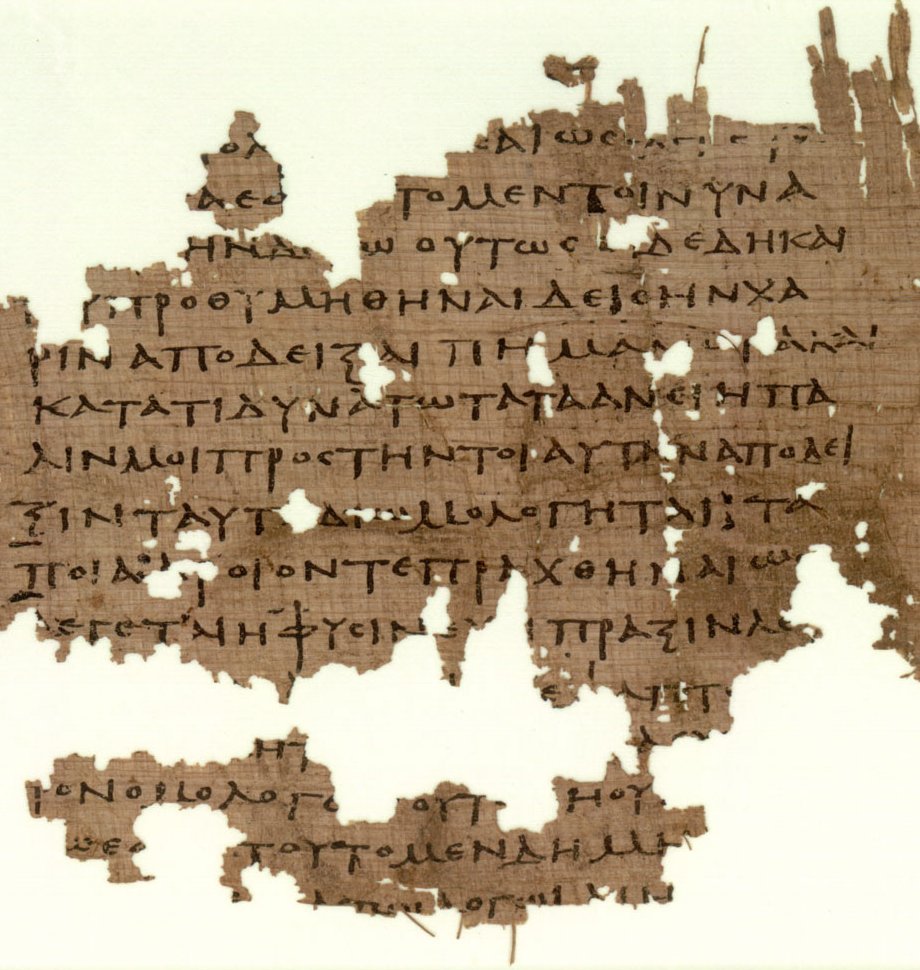
The Republic is a philosophical dialogue by Plato, written in the fourth century BCE, in which Socrates and his companions ask what justice is and whether a just person is happier than an unjust one. Its Greek title is Politeia. To answer, the speakers design an imagined ideal city, called the Kallipolis, and compare its structure with the structure of the human soul. The ten-book work has been Plato’s most famous and widely read dialogue since the middle of the nineteenth century.
Background and composition of the Republic
Plato wrote the Republic in the fourth century BCE, and scholars generally assign it to his middle period, the same stage as the Symposium. In his early dialogues, Socrates refutes the accounts of his companions and the discussion ends without a satisfactory answer. In the Republic, by contrast, Socrates develops a long and unified argument that the just life is necessarily a happy one.
The dialogue begins with Socrates and Glaucon visiting the Piraeus to attend a festival for the Thracian goddess Bendis. They are led to the house of Polemarchus, where Socrates talks with the elderly Cephalus about old age, wealth and justice. From this private conversation the discussion widens to the question of how a whole community should be organized.
Like other Platonic dialogues, the work is dramatic. Arguments belong to characters, and one speaker, here Socrates, usually leads the others to a conclusion. Interpreters note that these dialogues were meant to make readers reflect on and weigh the arguments, so they are cautious about attributing every claim directly to Plato.
Summary of the Republic
In Book I, Cephalus, Polemarchus and then Thrasymachus offer definitions of justice. Polemarchus says justice is helping friends and harming enemies, and Thrasymachus says it is whatever benefits the stronger. Socrates finds problems with each and argues that the just life is better, but he is dissatisfied because no adequate account of justice has yet been given.
In Book II, Glaucon restates Thrasymachus’s challenge. He argues that people value justice only for its consequences and tells of a ring that makes its wearer invisible, the ring of Gyges’ ancestor. Adeimantus adds that the reputation for justice is worth more than justice itself. Socrates proposes to look for justice first in a city and then in an individual, since the city is larger and easier to read.
The first city Socrates describes meets only basic needs, and Glaucon dismisses it as a city of pigs. A more luxurious city needs an army, so Books II and III turn to the education of the guardians, including a strict censorship of poetry. The guardians’ rulers are told a myth of metals, in which gold, silver and bronze in the soul mark the rulers, guardians and producers.
Book IV defines the virtues of the city and the soul. The soul has three parts, and justice in the soul means that each part does its own work. Books V to VII argue that philosophers should rule because they know the truth. Socrates uses the images of the sun, the line and the cave to describe the turn of the soul from shadows toward knowledge of the Forms. The future rulers study arithmetic, plane and solid geometry, astronomy, harmonics and finally dialectic.
Books VIII and IX describe how the ideal city and soul decline into worse regimes, ending with the tyrant, whom Socrates calls the unhappiest of people. Book X returns to poetry and imitation, using the example of a couch, and closes with the Myth of Er, which pictures rewards and punishments after death.
Themes and interpretation of the Republic
The first theme is the nature of justice. Socrates treats it as a condition of order, in which each part of a city or soul does the work it is suited for. The analogy between city and soul lets him argue that a harmonious soul is both just and happy.
The second theme is knowledge and the Forms. Plato’s discussion of the Form of the Good is deliberately elusive, and the account of the cave is read as an allegory of education as a turning of the whole soul.
The third theme is education, which the dialogue treats as the foundation of both character and politics. Poetry, music, physical training and mathematics each have a place in shaping the guardians.
Scholars disagree about the work’s main subject. Some read it as ethics, a defense of the just life, with the city serving as a model for the soul. Others read it as political philosophy, a serious account of how a community should be governed. The dialogue’s range, from rival theories of justice to the family, the role of art and the afterlife, has produced thousands of studies.
Reception and legacy of the Republic
The Republic shaped the later history of Western philosophy. Aristotle, Plato’s pupil, built a different and more systematic approach to ethics. He is credited with writing the first ethical treatises, whereas the Republic does not treat ethics as a separate subject.
Since the nineteenth century the dialogue has been a standard text in courses on philosophy and political theory. Readers have admired its arguments about justice, the cave and education, and they have also criticized its censorship of poetry, its fixed social classes and its rule by a small educated elite. Whether Plato meant the Kallipolis as a practical program or as a device for understanding the soul remains debated.
The work also set questions that later thinkers kept returning to. These include whether morality benefits the person who practices it, whether knowledge of the good is needed for good rule, and how far the state should shape the beliefs of its citizens. The method of cross-examination used by Socrates is described in the entry on the Socratic method.
More in Philosophy
Key facts
- The Republic is a dialogue in ten books in which Socrates is the main speaker.1
- Scholars generally place it in Plato's middle period.12
- Its two central questions are what justice is and whether the just person is happier than the unjust person.1
- The speakers build an imagined just city, the Kallipolis, and compare it with the human soul.1
- The dialogue opens at the Piraeus during a festival of the Thracian goddess Bendis.1
- Book X closes with the Myth of Er, a story of reward and punishment after death.1
Related concepts
In the news
Quick checkWhat two questions drive Plato's Republic?Show answer
What justice is, and whether the just person is happier than the unjust person.
Sources
- 1. Internet Encyclopedia of Philosophy, Plato: The Republic, https://iep.utm.edu/republic/
- 2. Stanford Encyclopedia of Philosophy, Plato, https://plato.stanford.edu/entries/plato/
- 3. Stanford Encyclopedia of Philosophy, Aristotle's Ethics, https://plato.stanford.edu/entries/aristotle-ethics/
Editorially reviewed by Specialty Digest Editorial TeamLast reviewed November 5, 2026Researched and drafted with AI assistanceReport an issue