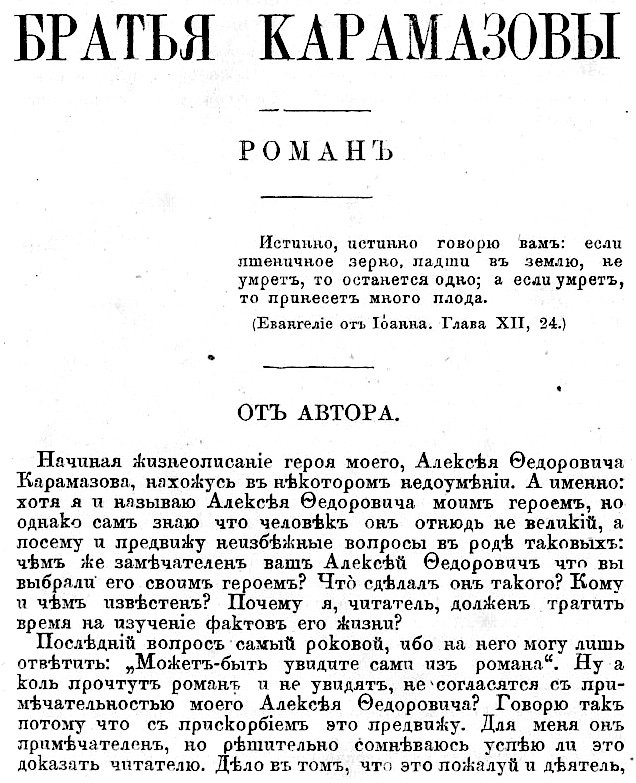
The Brothers Karamazov is a novel by the Russian writer Fyodor Dostoevsky (1821 to 1881), published in 1879 and 1880 and widely seen as his last and greatest work. It tells of the violent Karamazov family in a provincial Russian town, and it uses a murder case to explore questions of God, free will and morality. Dostoevsky died in 1881, the year after the book appeared in full.
Background and publication of The Brothers Karamazov
The novel was first published in installments in the Russian journal The Russian Herald between 1879 and 1880. The Cambridge Companion to Dostoevskii gives 1880 as the year of the book, which is the year before the author died.
Dostoevsky had a long career behind him. He rose to fame with Poor Folk in 1846 and was arrested in 1849 for his part in the Petrashevsky circle. He was sentenced to death, subjected to a mock execution, and sent to hard labor in Siberia, and he did not return to European Russia until the end of 1859. Major novels such as Crime and Punishment followed in the 1860s.
Plot summary of The Brothers Karamazov
The story centers on Fyodor Pavlovich Karamazov, a greedy, lecherous landowner, and his three legitimate sons. Dmitri is passionate and impulsive, Ivan is intellectual and skeptical, and Alyosha is gentle and devout. A fourth man, Smerdyakov, a servant who is rumored to be the old man’s illegitimate son, lives in the house.
Father and eldest son quarrel over money and over a local woman, Grushenka. Dmitri is also tied to Katerina Ivanovna, a proud young woman who is engaged to him. Meanwhile, Alyosha spends time at the monastery with his spiritual guide, the elder Zosima.
When Fyodor Pavlovich is found murdered, suspicion falls heavily on Dmitri, who had threatened him and who was seen near the scene. The book follows the investigation and trial at length.
In the end the real course of events emerges through a series of tense conversations among the brothers and Smerdyakov, and Ivan is overwhelmed by guilt and a breakdown, which the text calls a brain fever. Dmitri is convicted, and the book closes with Alyosha speaking to a group of boys about memory and hope.
Setting and context of The Brothers Karamazov
The story is set in a provincial Russian town and the monastery nearby, a world of landowners, officials, monks and merchants. The events take place in the decades after the reforms of the 1860s, when Russian society was being reshaped.
One of those reforms, the new court system with trials before juries, forms the background of the long courtroom chapters. Dostoevsky used the trial to show how public opinion, rumor and clever speeches can shape the way a crime is understood.
Characters in The Brothers Karamazov
The three brothers can be read as three ways of facing life: the sensual, the rational and the spiritual. Each is also complex, and Dmitri is capable of honor, Ivan of compassion and Alyosha of doubt.
Zosima is a holy elder whose teaching about active love and responsibility for others shapes Alyosha. Smerdyakov is bitter and calculating, and his role shows how an idea can be put to cruel use by a listener.
Themes in The Brothers Karamazov
Faith and doubt are central. The Cambridge Companion sample describes faith in the novel as engaged in pitched battle with atheism, and it notes that the book leaves its religious questions unresolved rather than settling them in favor of one side.
The best-known episode is Ivan’s argument that the suffering of innocent children makes it impossible for him to accept a world ordered by God, followed by his tale of the Grand Inquisitor. These chapters are often discussed as a powerful challenge to theodicy, the attempt to justify the existence of evil, and the book answers not with argument but with the lived example of Zosima and Alyosha.
Moral responsibility and free will also run through the book. If there is no God, Ivan’s followers ask, is everything permitted? The family’s crime shows how ideas, neglect and temptation can lead people to share guilt in unequal ways.
The Cambridge Companion also calls the novel profoundly folklorized, meaning that its religious and philosophical core draws on folk language and references. That quality links its abstract debates to ordinary Russian life.
Style and structure of The Brothers Karamazov
The novel is long and built from many voices. It combines melodrama and detective plot with saints’ lives, courtroom oratory and philosophical debate, and its chapters often alternate between public scandal and private confession.
A narrator who claims to be a local chronicler tells the events. This device gives the book the feel of a documented case and allows Dostoevsky to shift easily between humor, satire and solemn reflection.
Reception and legacy of The Brothers Karamazov
The novel also gained readers well beyond Russia. Translations began to appear in the decades after Dostoevsky’s death, and writers, philosophers and psychologists in many countries have cited it, so that its debates about belief, guilt and responsibility are now part of world literature rather than of Russian culture alone.
The novel has been widely read as the summation of Dostoevsky’s thought. It influenced later thinkers and writers across philosophy, theology and literature, and a Harvard dissertation on Russian realism and early psychiatry discusses Ivan’s brain fever as part of how nineteenth-century fiction portrayed mental illness.
Dostoevsky is thought to have planned a continuation, but he died before writing it. The work is regularly studied in university courses, adapted for stage, film and television, and available in many translations.
More in Literature
Key facts
- The Brothers Karamazov was published between 1879 and 1880, and Dostoevsky died in 1881.12
- It centers on the Karamazov family: the father Fyodor and his sons Dmitri, Ivan and Alyosha.2
- The Cambridge Companion describes its religious questions as left unresolved, with faith engaged in a pitched battle with atheism.1
- Dostoevsky was arrested in April 1849 and returned from Siberian exile to European Russia at the end of 1859.1
- A Harvard dissertation discusses Ivan's brain fever in the context of Russian realism and early psychiatry.3
Related concepts
Quick checkWhen was The Brothers Karamazov published?Show answer
It was published between 1879 and 1880, the year before Dostoevsky died.
Sources
- Cambridge Companion to Dostoevskii, sample chapter (Library of Congress catalog enrichment), https://catdir.loc.gov/catdir/samples/cam033/2002067684.pdf
- Project Gutenberg, The Brothers Karamazov by Fyodor Dostoyevsky (ebook record), https://www.gutenberg.org/ebooks/28054
- Giulia Dossi, Unseemly Selves: Russian Realism and Early Psychiatry, Harvard University dissertation (2022), https://dash.harvard.edu/server/api/core/bitstreams/3ff12d39-f912-4d82-8d87-838b3f87618e/content
Editorially reviewed by Specialty Digest Editorial TeamLast reviewed November 5, 2026Researched and drafted with AI assistanceReport an issue