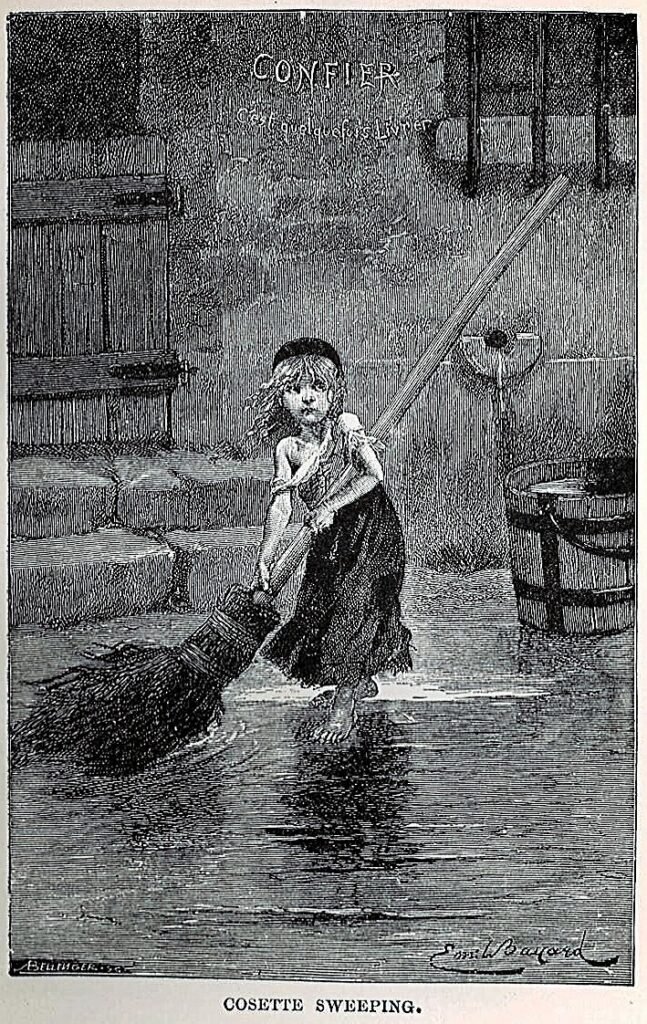
Les Misérables is a French historical novel by Victor Hugo, published in 1862. It runs from 1815 to the June Rebellion of 1832 in Paris and follows the ex-convict Jean Valjean as he tries to build an honest life while the police inspector Javert pursues him. Hugo uses the story to examine law, poverty and mercy in nineteenth-century France.
Background and creation of Les Misérables
Victor Hugo (1802 to 1885) was already famous as a poet, playwright and novelist when he began gathering material for a long book about social misery in the 1840s. In 1851 he was forced into exile after opposing the coup of Louis Napoleon Bonaparte. He eventually settled on the island of Guernsey, where he lived at Hauteville House in Saint Peter Port for about fifteen years. The preface to Les Misérables is signed from that house and dated 1862.
The preface states the book’s purpose plainly. Hugo says that as long as law and custom create a social condemnation that makes hell on earth, and as long as poverty degrades men, hunger ruins women and darkness stunts children, books of this kind cannot be useless. It reads less like a modest introduction than a declaration of intent for a novel built to argue for social reform.
The novel was released in 1862 in successive parts and quickly crossed borders. Its richly documented portrait of Paris, from prisons to convents to barricades, reflects Hugo’s habit of collecting detail from what he saw and from the records he consulted.
Among the sources Hugo drew on were his own visit to the convict prison at Toulon in 1839, where he took notes on life among the prisoners, and the street fighting he had witnessed in Paris. This mix of firsthand observation and documentary research gives the book its realistic texture, even when the plot leans on coincidence.
Plot of Les Misérables
The book is divided into five parts, titled Fantine, Cosette, Marius, The Idyll in the Rue Plumet and the Epic in the Rue Saint-Denis, and Jean Valjean. It opens in 1815 with Bishop Myriel, whose kindness to the freed convict Valjean after nineteen years of imprisonment sets the story in motion. Valjean steals the bishop’s silver, and the bishop’s decision to treat him with mercy rather than turn him in changes the direction of his life.
Valjean takes a new name, becomes a prosperous factory owner and the mayor of a provincial town, and tries to help others. When Fantine, a worker dismissed from his factory, is driven into destitution while paying for her daughter Cosette to live with an innkeeping family, Valjean promises to care for the child. He rescues Cosette and raises her in Paris, always one step ahead of Javert, who is certain that a former convict can never change.
As Cosette grows up, she falls in love with Marius, a young law student who joins the students and workers rising in the barricades of June 1832. Valjean follows Marius into the fighting, spares the life of the captured Javert and carries the wounded Marius through the Paris sewers. Javert, unable to reconcile his rigid sense of the law with the mercy he has received, takes his own life. Valjean lives long enough to see Cosette and Marius married before he dies.
Themes in Les Misérables
The central theme is the tension between law and grace. Javert represents a legal order that treats guilt as permanent, while the bishop and Valjean represent forgiveness as an active moral force. The novel argues that a society that punishes poverty and fails to educate its children creates the criminals it then condemns.
Redemption is the second thread. Valjean is not saved once but repeatedly, through acts of generosity that he must choose to continue even when they cost him safety. Hugo also traces a wider historical theme: the book sees France moving, however painfully, from injustice toward a freer and fairer society.
Fantine’s fall shows the same argument at work. Dismissed from her job, she sells her hair, her teeth and finally herself to pay for her daughter’s care, and Hugo presents her as a victim of social pressure rather than a failure of character.
Love takes several forms, including parental love between Valjean and Cosette and the romantic love of Marius and Cosette. Poor characters such as the street child Gavroche show generosity and courage that wealthier characters often lack.
Structure and style of Les Misérables
The novel is famously long, with short chapters that make its length easier to navigate. Hugo repeatedly steps away from the plot to write essays. The second part begins with a detailed account of the Battle of Waterloo, and later sections discuss convent life, Paris slang and the city’s sewer system. Some readers find these digressions a burden, while others see them as the key to the novel’s ambition to portray an entire society.
In its original French the novel runs to more than 650,000 words, organized into five volumes, 48 books and 365 chapters by one common count. That scale, together with its mix of narrative, history and moral argument, is why it is often described as an epic as much as a novel.
Reception and legacy of Les Misérables
Early critical responses were divided, with some reviewers objecting to the book’s length and sentimentality, but readers embraced it and translations followed quickly. It is now regarded as one of the major novels of the nineteenth century. Isabel Hapgood’s English translation, first published in the 1880s, remains in the public domain and is freely available through Project Gutenberg.
The story has been adapted for film, television, radio and stage many times. The best-known stage version is the musical that opened in Paris in 1980 and in London in 1985, which has played in dozens of countries. Phrases and images from the book, particularly the barricade, are now used worldwide as symbols of resistance to injustice.
More in Literature
Key facts
- Les Misérables was written by Victor Hugo (1802 to 1885) and published in 1862.1
- The story begins in 1815 and ends after the June Rebellion of 1832 in Paris.1
- Hugo was exiled from France in 1851 and spent about fifteen years at Hauteville House on Guernsey.3
- The preface is signed from Hauteville House and dated 1862.2
- The novel is divided into five parts, beginning with Fantine and ending with Jean Valjean.2
- Isabel Hapgood's English translation is available through Project Gutenberg.1
Related concepts
Quick checkWho wrote Les Misérables, and which years does its story cover?Show answer
Victor Hugo wrote it, and it covers the years 1815 to 1832.
Sources
- Project Gutenberg, Les Misérables by Victor Hugo (ebook 135, translated by Isabel F. Hapgood), https://www.gutenberg.org/ebooks/135
- Project Gutenberg, full text of Les Misérables (preface dated Hauteville House 1862, table of contents), https://www.gutenberg.org/cache/epub/135/pg135.txt
- Fine Books and Collections, After Extensive Renovations, Victor Hugo's House Reopens, https://www.finebooksmagazine.com/blog/after-extensive-renovations-victor-hugos-house-reopens
Editorially reviewed by Specialty Digest Editorial TeamLast reviewed November 5, 2026Researched and drafted with AI assistanceReport an issue